Daniil Medvedev Critiques Roland Garros Balls
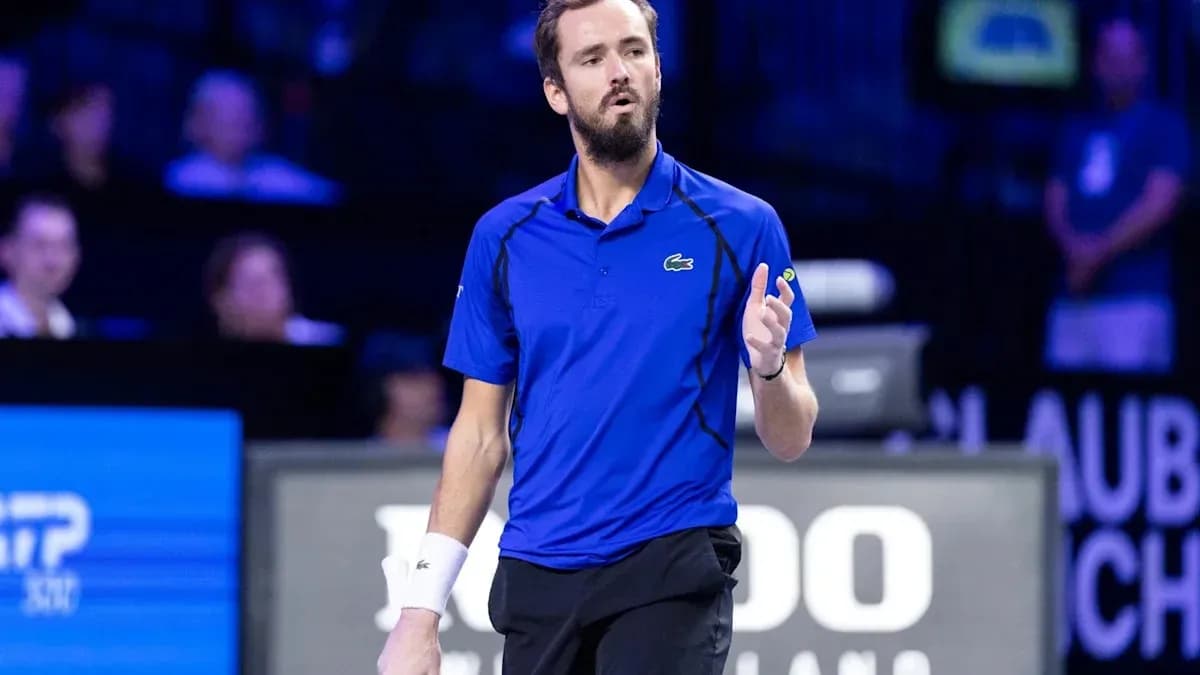
Daniil Medvedev has never been shy about saying what he thinks. Courts, crowds, schedules – nothing is off limits. Now, he’s turned his fire on something far smaller, but increasingly central to the modern game: the tennis ball.
And in his view, Roland Garros is getting it badly wrong.
“Probably the worst ball”
Fresh from winning the Almaty Open, Medvedev sat down with Russian outlet Bolshe and was presented with a curious stat. This season, he has won 81.4% of his service games when using Wilson balls, and 87.1% when playing with other brands.
Numbers in hand, he was asked what that might say about his relationship with Wilson. His answer went straight to one Grand Slam.
“Wilson balls are different,” Medvedev said. “The Wilson US Open ball is completely different from the Wilson Roland Garros ball and I think there aren't any other Wilsons, if I'm not mistaken. Maybe I'm wrong.”
Then came the punch.
“Wilson Roland Garros, in my opinion, is probably the worst ball, worse than the Head ball in Rotterdam. That's just my opinion, of course. I played a quarter-final with them, so it's not like I've never won a single match with them. I reached the Roland Garros quarter-final with them, but for me they're just terrible.”
He didn’t stop there. The Russian even admitted he preferred the previous supplier, Babolat, despite his poor record with them.
“Before that they were Babolat. I always lost with them in the first round, I think I didn't win a match, but in my opinion they were much better balls. You can play better tennis with them.”
It’s a striking contrast: worse results, better feel. Better results, worse ball. For Medvedev, Roland Garros has become the perfect example of how equipment and conditions can warp a player’s comfort zone.
US Open balls get a mixed review
His criticism of Wilson isn’t blanket. The US Open version, he says, sits in a different category.
“Wilson US Open is a different, longer story. In general, I liked them more than not. Whether they've changed over the years, I don't know.”
The uncertainty has even turned into a running debate with fellow Russian Andrey Rublev. The pair practised together in China before Hangzhou and both reached the final there, but the ball sensation stuck in Medvedev’s mind.
“We talked about it this year with Andrey Rublev. We were in China, practicing before Hangzhou, where we both reached the final and it just felt better than how it felt in America for those six weeks. We were just playing well.
“I said to him, 'Listen, we used to play fine, so it's probably something that changed in us, not the balls.' He said, 'Listen, I don't know, it seems to me that the balls have changed.' I was like okay I hope that's the case, because it means it wasn't just me who played badly in America, the balls also contributed to that.”
For a player built on precision and depth, the margin between “fine” and “off” can decide entire tours. In the United States, Medvedev felt that line had been crossed.
“You showed the serving stats, but in America I couldn't hit a backhand in the court, it just flew straight into the net no matter what I did and when I can't hit a backhand, I can't win tournaments. It's not going to happen. When the ball flies into the net on the backhand, I get lost. I start thinking about playing pickleball, curling, and so on.”
The joke lands, but the message is serious: if he doesn’t trust the ball off his strings, his entire game unravels.
The Roland Garros puzzle
Strip away the emotion and the numbers tell their own story. Roland Garros is the only Grand Slam where Medvedev has never gone beyond the quarter-finals. It is also the only major where he failed to win a single match this year.
There are obvious caveats. Clay is his weakest surface. Conditions in Paris – heavy, slow, and often damp – blunt his flat, aggressive baseline game. The ball is just one part of a bigger equation.
Yet in his mind, that part matters. He has made the last eight in Paris with the current Wilson ball, but the frustration hasn’t eased. His comments add another layer to a debate that has been growing louder across the tour, as players link changing balls to a spike in wrist and elbow issues.
The sport has heard this chorus before. Different brands, different tournaments, even different batches within the same event – players regularly complain about inconsistency. Medvedev’s words simply put a Grand Slam badge on the argument.
A change of tune from 2020
What makes his latest outburst more intriguing is how far it sits from his stance when Roland Garros first switched from Babolat to Wilson in 2020.
Back then, the move stirred instant controversy. Rafael Nadal, the tournament’s greatest champion, publicly criticised the change, unhappy with the feel and the way the ball behaved in colder autumn conditions.
Medvedev, though, sounded almost optimistic.
“Maybe it can help me that it's a bit colder, so the balls don't fly as much, don't go as spinny,” he said at the time. “So maybe I can play some flat tennis in practices. I think it can be an opportunity for me actually, an advantage.
“I like the balls because, yeah, tennis is a funny and interesting sport…It's normal that when one player doesn't like something, second one maybe is going to like it. So far I like it. I think it suits me not bad.”
From “I like the balls” to “probably the worst ball” in four seasons. The shift underlines how a player’s relationship with equipment can evolve – shaped by results, confidence, age, even subtle manufacturing tweaks that may or may not exist.
For Medvedev, the clay of Paris remains an unsolved riddle. The question now is whether he can crack it with a ball he openly calls “terrible,” or whether his best chance at Roland Garros glory depends on learning to love – or at least tolerate – the very thing he currently blames.