Israel's Rising Tennis Star: Dan Brand's Journey
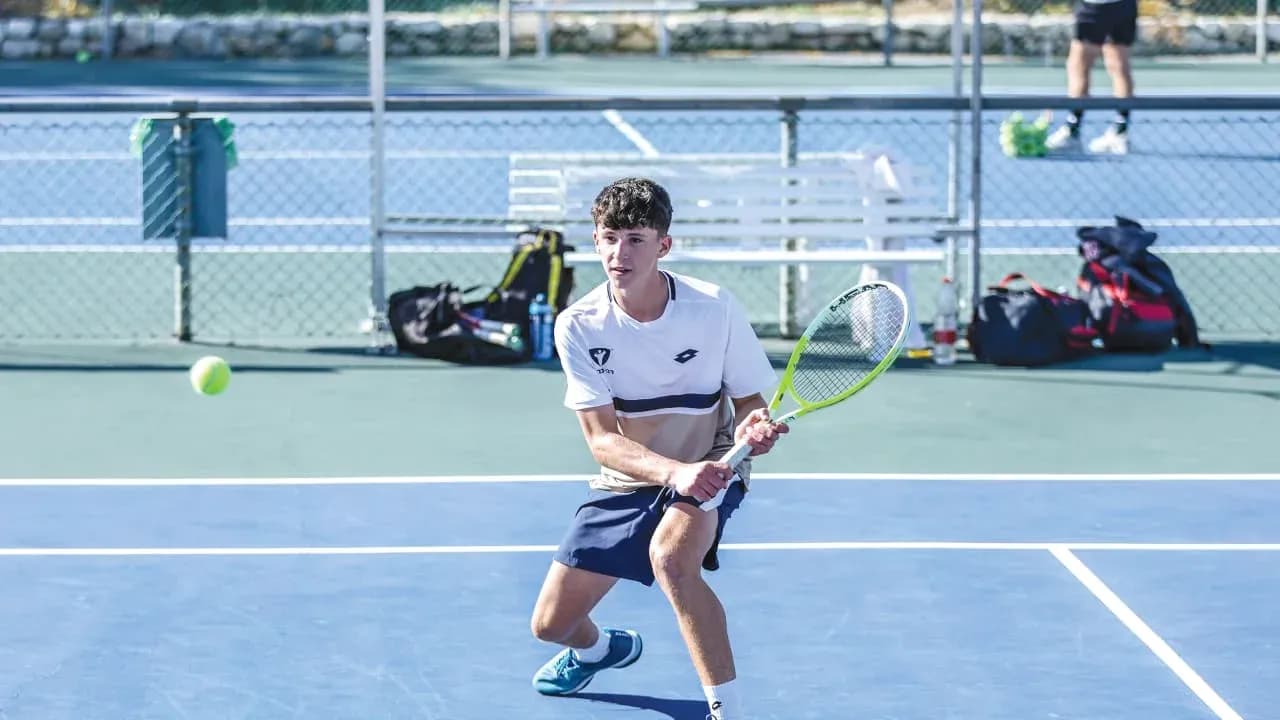
While Israel has been glued to soccer, baseball, and Deni Avdija’s rise in the NBA, one of the country’s most intriguing sporting stories has been unfolding far from the spotlight, on back courts and practice courts around the world.
From Kfar Saba, 17-year-old Dan Brand has quietly climbed to No. 24 in the world junior rankings. He is not done yet. Not even close.
A New Name on the Grand Slam Sheets
Brand’s name already sits on the draw sheets of Roland Garros and Wimbledon. This season he played both singles and doubles at each major, a significant step for a teenager still juggling schoolwork with long-haul flights.
In Paris, he went toe-to-toe with France’s Mathys Domenc in a bruising first-round singles match, bowing out 3-6, 7-5, 6-1. In doubles, alongside American Safir Azam, he reached the quarterfinals.
On the grass of Wimbledon, he went one better in both disciplines, advancing to the second round in singles and doubles. Next up is the US Open juniors in Queens, New York, where he will again compete in both events when the tournament begins on September 8.
Inside Israeli tennis circles, the whispers have already become a clear statement.
“Dan is absolutely our next hope,” says Yoni Erlich, Israel’s Davis Cup captain and tennis director at the Israel Tennis and Education Centers. Erlich talks about Brand as a player on the verge of the junior top 20 and points to a recent men’s Futures event, where the teenager reached the quarterfinals and “had a few very nice wins” against older, stronger opponents. “Hopefully in the next few years, we can see another Grand Slam player. We can only hope and be patient.”
Chasing the Legacy of Israel’s Greats
Patience has been a necessity for Israeli tennis fans. The country has not seen a genuine singles force near the top of the sport for years.
Shahar Peer climbed to No. 11 in the world in 2011, the highest singles ranking ever for an Israeli player. In doubles, Andy Ram and Jonathan Erlich reached No. 5 in 2008, just after winning the Australian Open men’s doubles title. On the men’s singles side, the benchmark remains Amos Mansdorf, who peaked at No. 18 in 1987.
Mansdorf is no longer just a name in the record books. He is Brand’s coach.
He has worked with the Kfar Saba teenager since he was 12. “It is nice to see him coming along and moving in a nice direction. He plays clever tennis and is quite good all around,” Mansdorf says. He describes his pupil as “nice, quiet, low-key, hard-working, and dedicated,” a calm competitor who “doesn’t panic.”
The former world No. 18 has a clear target in mind: the top 50 of the men’s professional tour. To get there, he wants Brand to build the tools required to survive on the ATP circuit: a bigger, more precise serve, more physical strength, and enough firepower to trade blows with established pros. “He likes to compete, and does everything well. We are hoping he will get stronger; he still [is] young. In the future, we want him to have all the weapons for pro play – a big serve with enough power and precision to stay in with good players.”
Given Brand’s rapid rise, Mansdorf expects the teenager will receive a deferment from the IDF and head to “a good US college,” using the American system as a bridge to the pro ranks.
From Bored Soccer Kid to Tennis Prodigy
The story might never have happened if a bored young soccer player had not shrugged off his father’s sport.
Shai Brand, a tort lawyer and Brazilian jiu-jitsu black belt, is a two-time world champion on the mats. He assumed his son would follow him into combat sports. Dan had other ideas.
“Dan was a soccer player. His coach told the kids to try other sports. I tried to get him into jiu-jitsu, but he said it was too boring!” Shai recalls. So Dan picked up a tennis racket at school instead.
Very quickly, his school coach saw something unusual. “I trained hundreds of kids; your son is something special,” he told Shai, urging him to enter Dan into a national competition. Shai hesitated. “It was too early.”
Curiosity eventually won out. Shai approached Mansdorf, who later became head coach at the Ra’anana City Tennis Center, close to the family’s home in Kfar Saba. Brand has trained there ever since.
Shai takes pride in that choice. While many ambitious juniors relocate to elite European academies, Dan still trains at a local club. The father likes that his son has stayed grounded, close to home and to a normal teenage life.
As the results improved and the travel schedule exploded, Shai took on another role: full-time guardian on the road. He often travels with his son to keep an eye on his health and safety. When he cannot, he leans on a network of trusted contacts around the globe to “look out for Dan.”
He is proud that, despite the rankings and the Grand Slam appearances, his son remains “just a kid who is still in a regular school,” studying independently on the road and flying back to Israel to sit exams. “My mother is pretty smart and helps a little with math and other subjects!” Dan admits with a grin.
A Teenager, Not a Starlet
Strip away the rankings and the talk of futures and ATP points, and Brand still sounds like a typical 17-year-old.
He likes playing basketball. He hangs out with friends who, he insists, “treat me the same as before.” His classmates have started seeing him on TV and hearing that he is “famous,” but at home he is just the eldest of three: big brother to 15-year-old Nadav and 10-year-old Shira. His father jokes that “Dan’s got his mother’s calm,” referring to his wife Ruth, a speech therapist.
On tour, he has formed close friendships with peers from around the world. He says he has not faced antisemitic abuse directly, instead encountering curiosity. Some players “ask about the situation in Israel, and listen and try to understand.”
On court, he knows exactly who he is. Brand calls himself a “solid player and a counter-puncher,” a “pretty focused, chill guy” who needs to be more aggressive and add speed to his serve. He loves the feel of grass courts – “It’s not a surface you play on every day” – and models his mentality on Novak Djokovic. “I like his mentality. He is so focused on the match!”
His father sees the same humility. “He’s a good example. He will play with, and talk with, everyone. He is shy,” Shai says. “Everywhere he goes, people fall in love with his son and say, ‘Dan is amazing.’” For Shai, that character is “more important than the tournaments,” even if he beams when he recalls his son’s 6-3, 6-2 win over Jordan Lee in the final of the J300 Charleroi-Marcinelle/Astrid Bowl in Belgium. Lee, ranked No. 8 in the world, went on to win the Wimbledon boys’ title.
Rising Fast, With a Flag on His Back
Brand’s results have not gone unnoticed. US colleges are circling. The IDF may grant him “ilui” status – prodigy status – which sits above the “sportai mitstayen” designation given to elite athletes who usually perform desk jobs while they train.
“Iluim” are exempted from service entirely, their sporting careers deemed a form of national service. Shai, whose own father also served as an IDF combat soldier, still believes Dan will wear the uniform at some point.
He does not dwell on the risks his son faces as a visible Israeli abroad, though he acknowledges that “after Oct. 7, you can feel people turning their backs on you.” Dan has reached out to several European players about potential doubles partnerships and received no replies. Players from the US, South America, and Asia, Shai says, have been far more responsive and warm.
Through it all, Dan has refused to hide his identity. He continues to play under the Israeli flag, fully aware of what that symbolizes. “A kid with a flag [of Israel] is like a target,” Shai says.
The family had another option. Because Dan’s maternal grandfather is German, he holds a German passport and could have switched allegiance. “He would have gotten more money, but Dan said ‘no,’ – he wants to do it the hard way!” Shai says.
The Road to New York
Brand spoke to the Magazine just after a driving lesson, during a brief stopover in Israel. The pause will not last long. He is heading to the ITF Grand Slam Player Development Program at the Junior Tennis Champions Center in College Park, Maryland, one of only a handful of Israelis ever selected.
From there, he will move on to New York for the US Open juniors. Mansdorf will not be courtside this time, but Brand will not be alone. Shai will travel with him, as will Danny Perekalsky, CEO of the Israel Tennis Association.
Perekalsky is effusive. “Dan is a really great kid. He shows a great mentality and behavior on and off the court, and he is a really great example for other kids with his behavior and style.”
He reels off recent highlights: titles in Thailand and Belgium, and a breakthrough in Astana, Kazakhstan, at the ITF M15 event from August 3-9. There, Brand earned his first ATP ranking points by reaching the round of 16 and edging fellow Israeli Oren Shimanov 6-3, 4-6, 7-5. “He has really made a big jump in the last six months!”
The ITA has thrown its weight behind him, alongside sponsors such as Rav Bariach, the Israeli security-door company, and the Wingate Institute, Israel’s National Center for Physical Education and Sport in Netanya. “He is now under their care,” says Shai. “I am just looking out for my son as a father.”
Perekalsky sees something bigger than one promising junior. “We are proud to support Dan and to have such a developing talent! Bravo also to Dan’s family and to coach Mansdorf. Amos is doing a great job with Dan. It is not a coincidence he is achieving the results he has been in the past six months.”
He goes further, predicting Brand will break into the junior top 10 by January as older players age out of the category. That would place the teenager among the very best of his generation.
“Israel is waiting to have something to be proud of in tennis. And we need more than one Dan,” Perekalsky says. “We are proud, but it is only a start!”
For now, the start is a 17-year-old from Kfar Saba, a counter-puncher with a calm head, a stubborn loyalty to his flag, and a ticket to New York. The rest of the story will be written on hard courts, one match at a time.