Carlos Alcaraz Steps Back from Revenue Campaign at US Open
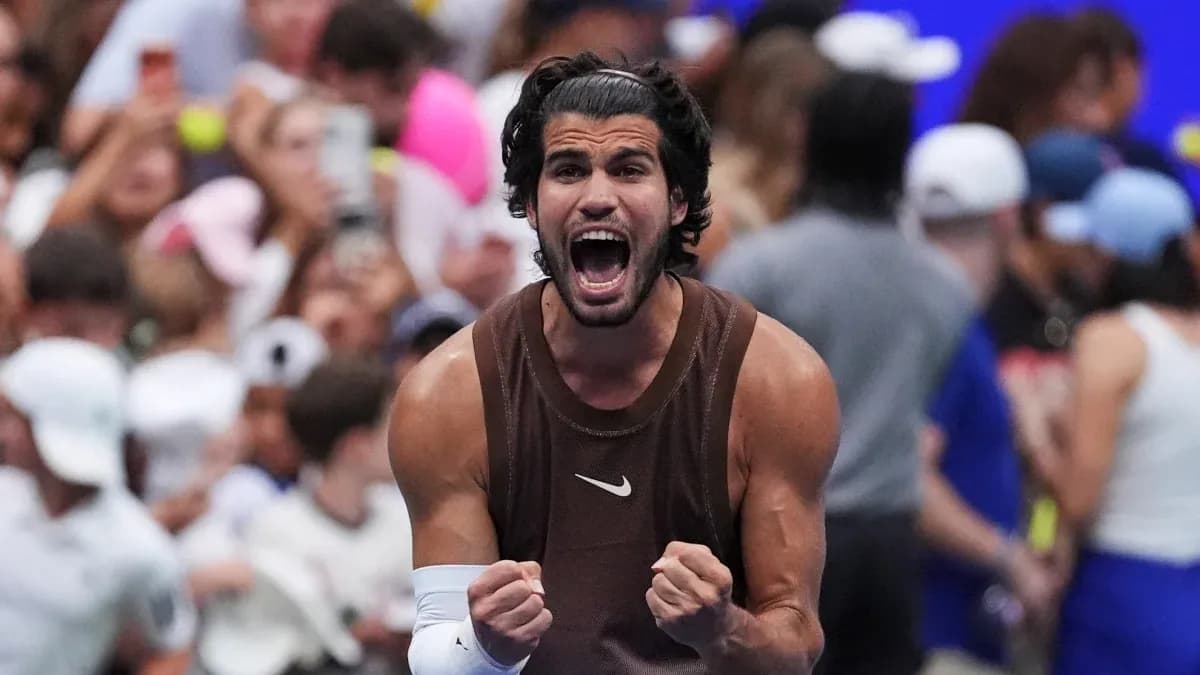
Carlos Alcaraz is back at the US Open looking like a threat again, but the battle he’s choosing to fight has shifted. The forehand is still heavy, the movement still electric, the aura still intact. Off the court, though, one of the most influential young players in the sport has quietly stepped away from a movement that had placed him at the heart of tennis’ political future.
According to The Times, Alcaraz’s long-time agent Albert Molina informed the group behind the Grand Slam revenue campaign shortly before the US Open that the Spaniard would no longer be involved. No public statement, no big explanation. Just a key name gone from a project built on the idea that the game’s biggest stars would stand shoulder to shoulder.
A powerful campaign loses a heavyweight
The campaign, launched in March 2025, pulled together some of the sport’s most prominent figures: Aryna Sabalenka, Jannik Sinner, Coco Gauff and, until recently, Alcaraz. Their target was clear and ambitious: raise the players’ share of Grand Slam revenue to 22% by 2030, while pushing for better welfare measures and a stronger say in how the tour is run.
Tension simmered through 2026 and then boiled over. Sinner made it plain that this was about something deeper than a bigger cheque.
“It’s more about respect, you know?” he said. “Because I think we give much more than what we are getting back.”
That frustration spilled into action. At Roland Garros, players scaled back their pre-tournament media duties in a symbolic protest, linking their reduced availability to what they believed was an unfair slice of the Grand Slam pie.
The majors felt the heat. Wimbledon lifted its prize pot to £64.2 million. The US Open bumped total player compensation by 20% to $108 million and introduced a $2 million Player Support Program. The four Slams also agreed to create a Grand Slam Player Council, a formal platform for player voices that had long been demanded but never fully delivered.
On paper, the movement is still alive. Sabalenka, Sinner, Gauff and others remain in the fight. But losing Alcaraz is not a minor detail. This was a campaign that traded heavily on the optics of unity at the very top. When one of the sport’s defining talents steps away, the picture changes.
His exit doesn’t mean he suddenly disagrees with the goals. It does, however, underline where his priorities lie right now.
A different kind of calculation
Alcaraz’s last year has been shaped not by boardrooms or bargaining tables, but by a wrist that simply refused to cooperate. The injury cost him Roland Garros. It cost him Wimbledon. It cost him four and a half months of competition and momentum in the prime of his early career.
That sort of absence rewires an athlete’s thinking.
“In the future, I’m going to take some breaks, some long breaks,” he said. “Maybe not four months, but one month, two months, missing some tournaments, because it’s impossible to play them all.”
That is not the language of a 21-year-old who believes he’s indestructible. It’s the voice of a player who has already discovered that the modern calendar, with its relentless churn from one continent to another, punishes anyone who tries to say yes to everything.
The debate he is now pushing into the spotlight is not about percentages on a spreadsheet, but about the physical cost of being at the top of the game. How much tennis is too much? How far can the sport stretch its stars before something breaks?
Questions answered in New York
For all the questions surrounding his body and rhythm, Alcaraz has wasted little time reminding everyone what he looks like when he’s healthy. At this US Open, he has powered into the quarterfinals, brushing past Roman Safiullin, Jaime Faria, Wu Yibing and Tommy Paul.
Paul, an established top player in his own right, didn’t sugarcoat the gap he felt on court.
“It felt like he’s playing at a completely different level than me,” Paul admitted.
Alcaraz sounds like a man who believes it too.
“So it probably doesn’t matter that I was out for four months and a half,” he said. “Every time that I come here, I play my best.”
The rust many expected never really showed. The timing returned quickly. The confidence, if anything, seems sharper, as if the months away have clarified what matters most.
Choosing his battles
That clarity may explain his quieter stance in the revenue fight. The campaign rolls on without him, armed with concessions already won and targets still on the horizon. The Grand Slam Player Council is forming. Prize money is climbing. The conversation about fairness and respect is not going away.
But Alcaraz, at least for now, is channelling his energy elsewhere. Into a body that needs managing, not overloading. Into a schedule that will be shaped by longevity, not obligation. Into the trophies that still define legacies more loudly than any off-court movement.
He is still central to tennis’ future. He is still one of the faces broadcasters and tournaments build their posters around. The difference is that he no longer seems interested in pretending he can be everywhere, do everything, and fight every battle at once.
The sport will keep arguing over money, power and structure. Alcaraz, back under the lights in New York and swinging freely again, has made his own calculation: if he wants to be around long enough to shape this era, something has to give.