Carlos Alcaraz Returns with a Statement Win at Grand Slam
Carlos Alcaraz did not ease his way back into grand slam tennis. He walked straight into the fire and started painting.
Serving at 5-4, 30-15 in his first singles set in more than four and a half months, he chased a familiar instinct. Wide serve, follow it in, trust the hands. Roman Safiullin knifed a dipping backhand return at his feet. Alcaraz bent low, cupped the ball on his strings and floated a half‑volley over the net, so soft it almost apologised on landing.
Winner. A gasp, then a roar. And a grin that said more than any scoreboard.
That one touch summed up what the sport has missed during his long layoff: the improvisation, the audacity, the sheer joy. Moments later he closed out the set, and from there he barely loosened his grip, cruising to a 6-4, 6-4, 6-4 win that felt less like a tentative comeback and more like a statement of intent.
Doubts, then demolition
The questions before he stepped on court were real. No warm‑up events. No gentle best‑of‑three easing‑in period. Just a cold plunge back into best‑of‑five against a heavy ball‑striker whose power could expose any weakness in that repaired wrist.
Safiullin can hit through anyone on a fast day. That made this opener awkward, even dangerous. How would Alcaraz’s arm absorb that pace? Would he flinch on the forehand? Would he hold back?
He answered all of it with the shot that has already defined his young career.
From the first games, Alcaraz went after his forehand as if the layoff had never happened. He ripped it cross‑court, flattened it down the line, rolled it high and heavy when he needed time. Twenty forehand winners flew off his racket, against just nine unforced errors on that wing. When he did face pressure on serve, he simply hit his way out of trouble, dictating from the baseline and refusing to retreat.
“It’s pain-free right now,” he said afterwards, speaking about the wrist that has dominated his year. “I felt great. I don’t know how it looked from outside but, from inside, my feeling was that I was hitting normal. I was playing pretty normal, playing my style, and the arm, the wrist, everything felt great. I’m going to still take care of it, obviously, these days and before the matches and everything, but I’m just really happy it’s pain-free finally.”
The numbers and the body language matched. He stepped into returns, chased down drop shots, and never once appeared to baby the forehand. For a first match back on this stage, it was about as emphatic as he could have hoped.
One red flag amid the green lights
There was, though, a clear caveat. His serve.
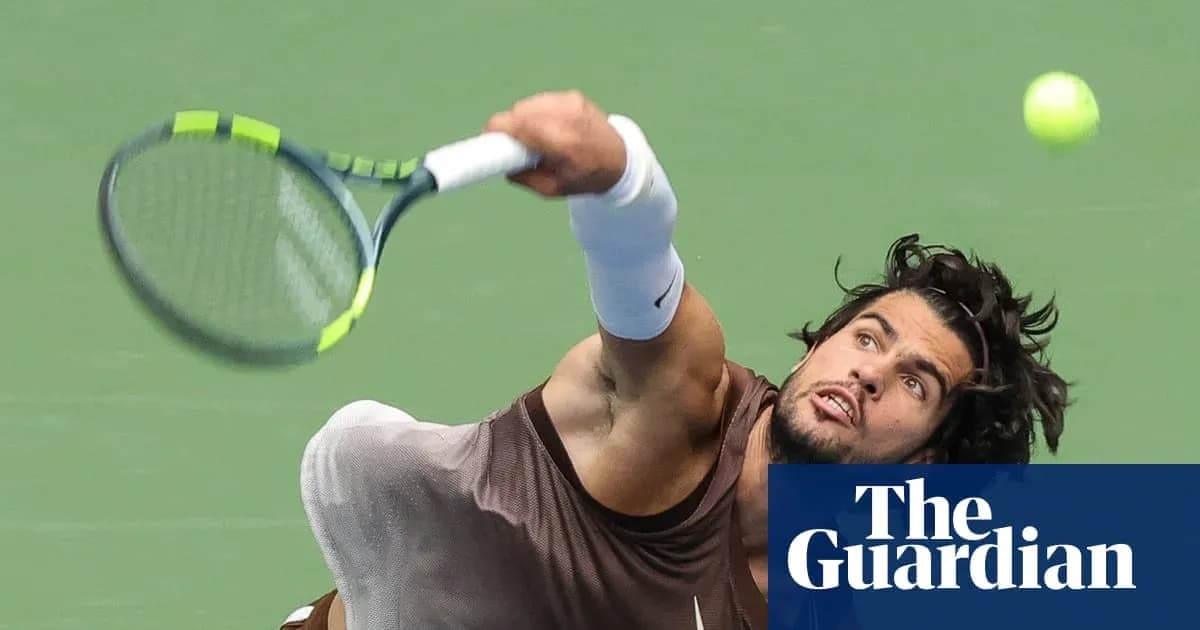
The rest of his game crackled with familiar aggression, but on serve he kept the handbrake on. His first‑serve speed hovered around 113mph, well below his usual peak. The tape under the arm sleeve was visible again, a constant reminder of the months spent managing and protecting the joint.
It makes sense. Firing down full‑throttle serves is the last frontier for any player returning from a wrist issue. The risk‑reward balance is brutal: a few “free” points versus the possibility of a setback. For now, Alcaraz is choosing caution.
That choice will shape his ceiling at this tournament. Without a pile of cheap points on serve, he will have to grind more, sprint more, think more in the longer matches to come. Against Safiullin, his returning and baseline aggression covered that gap. Against the very best over five sets, it becomes a bigger question.
Nerves, family, and a different kind of goal
This was not just another first round. It was a day loaded with emotion, and Alcaraz did not hide from that.
“It was a difficult day for me, to be honest, but at the same time, a really beautiful one,” he said. He woke up jittery, the mind racing. “[I] started the day really nervous. Really, really nervous, thinking: ‘I’m going to make it, I’m going to compete again.’ I had more nerves than usual, but just happy, because for me, my goal here is to compete, to enjoy, and let’s see how my body’s going to react after the matches, after the competition again.”
In his box sat the people who have lived every scan and setback with him: his parents, his brothers, his team. Even rapper Travis Scott watched on, adding a touch of celebrity intrigue to a day that already felt like an event.
This time, though, Alcaraz’s ambitions sound slightly different. Less about trophies, more about the act of playing.
“I don’t know how far I’m going to go in the tournament,” he admitted. “I didn’t know if I was going to lose this one, if I’m going to make the second round, final. I don’t know how far I’m going to go. But what I just really want to do is enjoy every time that I’m going to walk into the court feeling the energy from the people, feel the competition, walking up, I’m thinking, all right, it’s match day. That’s what I’m going to do this tournament.”
For a player already judged by grand slam tallies and generational labels, that sounds almost modest. On court, though, there was nothing modest about the way he swung.
The forehand is back. The smile is back. The serve is still in low gear.
How long that balance holds will decide whether this comeback becomes a deep run or simply a beautifully played first step.