Botic van de Zandschulp Advances to US Open Quarterfinals
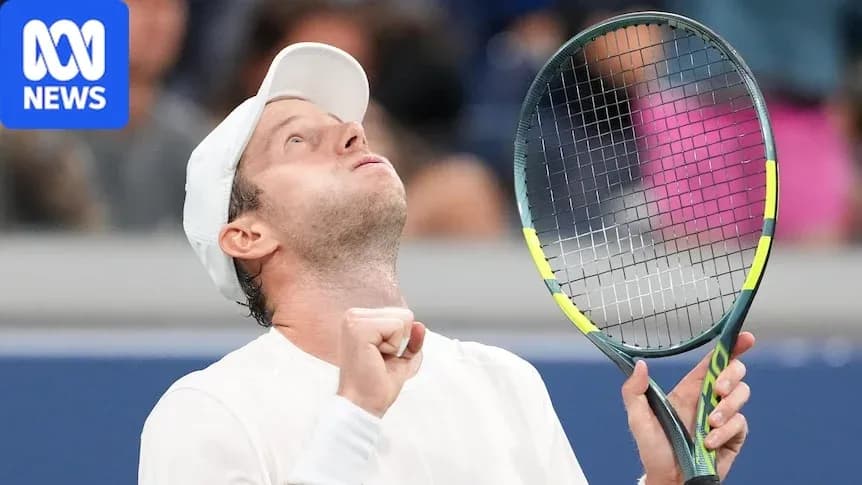
Botic van de Zandschulp walked off Louis Armstrong Stadium looking drained, disbelieving and very much alive in this US Open.
Down two sets. Staring at match point. Five hours and 13 minutes on the clock. Somehow, the Dutchman is the one heading back to a quarterfinal in New York.
He outlasted French lucky loser Arthur Gea 3-6, 6-7(0), 7-6(7), 7-6(3), 6-4 in a marathon that will sit in the record books as the fourth-longest match in US Open history. On a day when the draw threatened to swallow him, van de Zandschulp refused to let go.
From the brink to a second quarterfinal
This is his second US Open quarterfinal, but the manner of it has clearly hit different. Van de Zandschulp, who stunned Australian Alex de Minaur in the second round, looked finished when Gea surged to a two-set lead and then earned match point in the third-set tiebreak.
One point from a straight-sets exit.
He saved it. Just that. No drama from him in the moment, but everything changed. The tiebreak swung, the match tilted, and suddenly it was Gea who had to cope with the weight of history and the creeping fatigue of a five-hour epic.
Van de Zandschulp pinched the third set 9-7 in the breaker, then edged another tiebreak in the fourth. By the time the decider began, the Dutchman had his teeth in the contest and refused to loosen his grip, breaking once and guarding that advantage to the finish line.
“I think this is probably better than the first quarterfinal I made here,” he said afterwards, thinking back to his 2021 run. “It hasn’t sunk in yet, but I think tomorrow it’s going to be a great feeling.”
It already looked like one.
Gea’s near-miss with history
For Gea, this was a night that promised a place in tennis folklore.
The Frenchman only made the main draw when 2022 runner-up Casper Ruud withdrew with a back injury, sneaking in as a lucky loser. No man in that position has ever reached a grand slam singles quarterfinal. Gea stood a point away from changing that, up two sets and holding match point in the third-set tiebreak.
He couldn’t quite land the final punch.
Once van de Zandschulp escaped, Gea’s legs began to heavy, his forehand lost a touch of bite, and the margins he had owned for two sets slipped away. He leaves New York with a breakthrough run, but also with the knowledge that he had history on his racquet and watched it drift by.
Blockx breaks new ground for Belgium
Earlier in the day, Alexander Blockx carved out a slice of history of his own.
The No. 28 seed beat Francisco Cerundolo, seeded 24, 6-3, 4-6, 7-5, 7-5 to become the first Belgian man ever to reach the US Open quarterfinals. It was tight, tense, and decided by the key points at the back end of sets, and Blockx handled those moments with the composure of a player who expects to be here.
Each time Cerundolo threatened to drag the match deeper, Blockx shut the door, twice snatching sets 7-5 to avoid a fifth. It was efficient, ruthless tennis from a man writing a new chapter for his country at Flushing Meadows.
His reward is a quarterfinal against Karen Khachanov.
Khachanov goes the distance
Khachanov had to suffer for his place in the last eight.
The Russian was pushed to five sets by American 14th seed Learner Tien, eventually grinding out a 7-5, 4-6, 6-7(6), 6-1, 6-4 win. The match swung sharply: Tien wrestled control in the third-set tiebreak, only for Khachanov to storm through the fourth set 6-1 and then hold his nerve in a tight fifth.
When the pressure rose, Khachanov’s experience in deep slam runs told. He steadied, found his first serve, and kept Tien at arm’s length just long enough to close.
The No. 1 still to come
One more storyline hovered over the night session: world No. 1 seed Alexander Zverev stepping on court for the final match of the day against Italian 21st seed Luciano Darderi.
By then, the tone of the tournament’s second week had already shifted. Van de Zandschulp’s escape, Blockx’s breakthrough, Khachanov’s endurance — all of it pointed to a men’s draw ready to stretch the favourites to their limits.
The question now is simple: who else is prepared to survive the kind of night that turns a grand slam run into something unforgettable?