Ben Shelton Reaches First Grand Slam Final at US Open
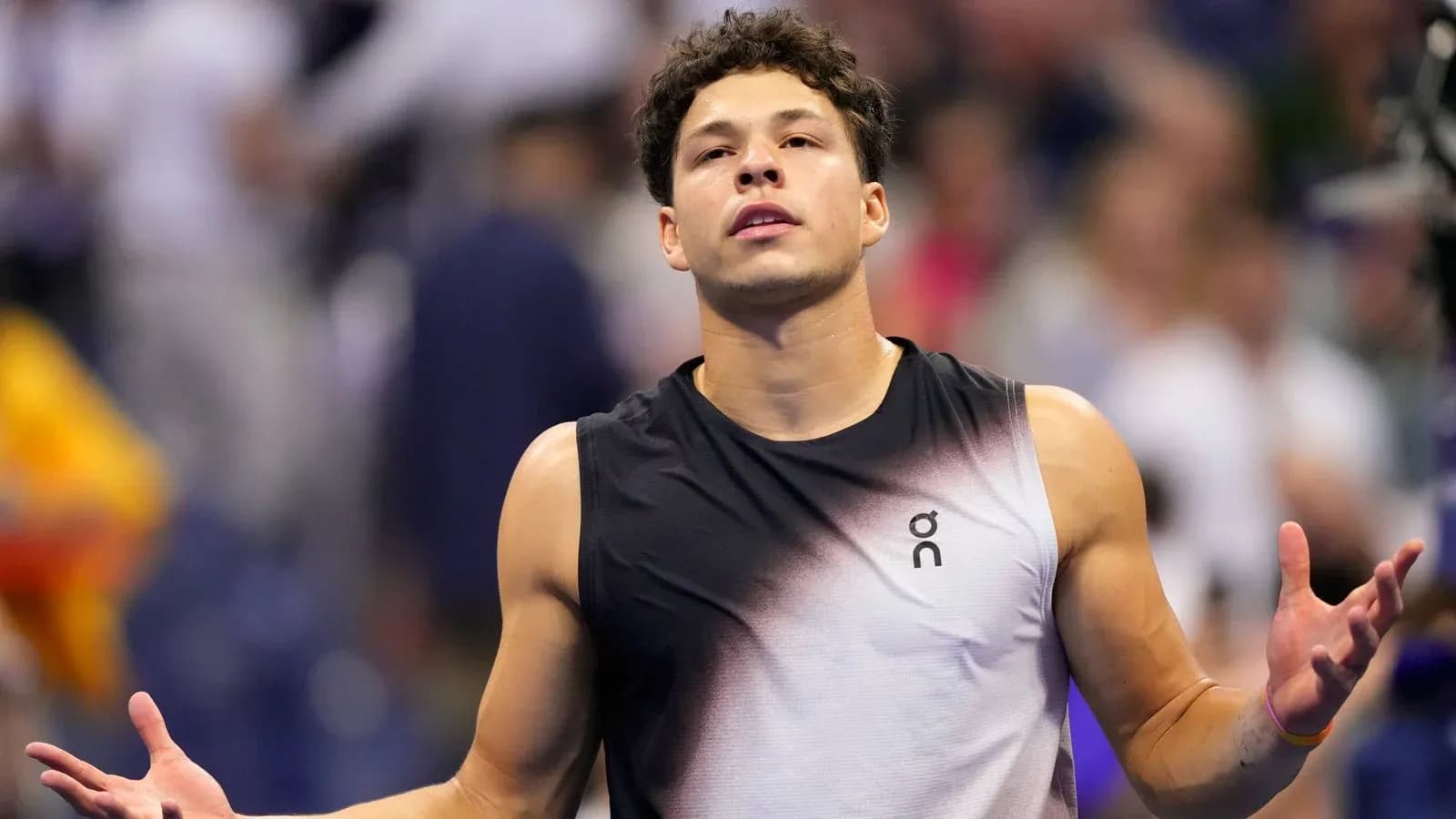
Ben Shelton stormed into his first Grand Slam final on a charged New York night, outlasting close friend and compatriot Frances Tiafoe in a bruising, breathless US Open semi-final that felt bigger than tennis.
On an evening framed by the 25th anniversary commemorations of the September 11 attacks, the 23-year-old American came from a set down to win 4-6 6-3 6-3 7-5 and set up a title showdown with Alexander Zverev. Under the lights of Arthur Ashe, with memory and expectation hanging heavy, Shelton dragged himself and a restless home crowd closer to ending a 23-year wait for a US men’s Grand Slam singles champion.
Not since Andy Roddick in 2003 has an American man lifted a major singles trophy. Shelton now stands one win away from breaking that drought.
“This is where we want to be, at the tail end of this tournament,” he said on court, speaking of Tiafoe as “like a big brother” before turning to the stands and the wider country. “I know what my goal is, what my job is. I’m going for it here. Let’s do this for the USA! One more thing. It’s a difficult day to be out here playing. My thoughts and prayers go to all the families who were impacted by 9/11.”
Those words landed because of what had just unfolded.
Shelton’s serve turns the tide
Tiafoe struck first. The 26-year-old, a showman by instinct and a fighter by habit, leaned into his experience and patterns, dragging Shelton into backhand exchanges and pouncing when the younger man’s level dipped. At 5-4 in the opening set, Shelton tightened, double-faulted, and Tiafoe seized the chance, serving it out and thumping his chest as the crowd roared.
The early signs suggested the veteran of the pair had the measure of the occasion. Tiafoe kept going after Shelton’s backhand in the second set, probing, waiting for cracks. At 3-3, serving with new balls, Shelton ripped up the script.
He opened that game with a 125 mph serve that Tiafoe could barely fend off, his racket coming up almost in self-defence as he was knocked backward to the court. The next deliveries were clocked at 144, 139 and 140 mph. The noise changed. So did the match.
Shelton held with authority, raised his intensity and, suddenly, the rallies tilted in his favour. He broke in the fifth game of the third set, surging ahead and tightening his grip on the semi-final. The left-hander’s booming serve became the anchor of his assault; his legs and lungs did the rest.
The fourth set became a test of nerve as much as shot-making. Tiafoe refused to go quietly, but Shelton’s defence hardened. He chased down balls that had no right to come back, turned defence into attack, and kept asking questions of Tiafoe’s belief. The eighth seed piled on the pressure late, and when the opening appeared, he pounced, closing out a deeply emotional win that felt like a changing of the guard on American hard courts.
Shelton finished with 47 winners, including 20 aces. On this stage, on this night, those numbers told the story of a young player ready for the biggest match of his life.
Zverev’s clean run continues
Waiting for him is a man who has quietly pieced together one of the most ruthless stretches of his career.
Earlier on Friday, French Open champion Alexander Zverev defeated Karen Khachanov 6-3 7-6 (9-7) 7-6 (8-6) to reach his third consecutive Grand Slam final and his second US Open title match. After being dragged to five sets in each of his opening two rounds, the German has now won four straight matches without dropping a set.
The win carried him back into a familiar arena: a Flushing Meadows final, four years after he finished runner-up to Dominic Thiem in a five-set heartbreaker in 2020.
“After the second round at 3am, me and my team were in the dressing room actually laughing at how bad I was playing. That sense of humour helped me,” Zverev said on court. “I have improved a little bit, otherwise I wouldn’t be in the US Open final.”
It has been a curious fortnight for the 29-year-old. Locked into the night sessions, he lived in a loop of late starts and early-morning finishes, his campaign initially feeling flat, almost joyless. He admitted as much.
“I really started off the tournament, and I was like, ‘Well, this is pointless because I’m not going to do anything here,’ and here I am sitting and preparing for a Sunday final,” he told reporters.
The draw opened up. Jannik Sinner never arrived. Carlos Alcaraz and Novak Djokovic fell away. Zverev did what top players must do when opportunity knocks: he walked through the door.
Edging Khachanov in the big moments
Khachanov, powerful and stubborn, made him earn it.
A single break decided the first set, Zverev squeezing it away with the economy of a man who has been here before. When he broke again at the start of the second, it looked like a routine afternoon in the late-summer sun.
Then came the wobble. A double fault handed Khachanov a route back into the set and dragged Zverev into a tie-break. The German trailed 5-3, the match threatening to stretch into something far more complicated. He dug in, and the key point of the match turned into a lung-burning 35-shot rally that he eventually claimed. He took the breaker 9-7 and with it, a stranglehold.
The third set followed a similar path. Khachanov pushed hard, earned set points at 6-4 in the tie-break, and stared at the chance to extend the contest. Two forehands flew long. Zverev landed an ace. Match point. One more big swing, and it was over.
No drama in the scoreline. Plenty in the margins.
“He’s cooking now”
The run caps a remarkable year at the majors for Zverev. He has already lifted the Coupe des Mousquetaires in Paris, and his level has risen as the season has gone on.
Sky Sports Tennis analyst Martina Navratilova was blunt in her assessment.
“What a year Zverev has had at the majors. It’s been outstanding stuff,” she said. “Okay, Sinner lost early at the French Open and Alcaraz didn’t play, but there are no asterisks, he still had to get through even as a favourite.
“And that has given the confidence to play better tennis after that. I think he played better at Wimbledon than he did at Roland Garros, and now he started off badly here by his own admission, but he hasn’t lost a set the last four matches. He’s cooking now.”
A final built for noise
Sunday will bring a different kind of test for Zverev: not just Shelton’s raw power and athleticism, but a New York crowd desperate to see an American man crowned again on home soil.
Rather than flinch at the prospect of a partisan Arthur Ashe Stadium, Zverev welcomed it.
“I think it’s going to be a fantastic feeling playing, you know, a final in a sold-out Arthur Ashe and not in an empty one,” he said. “For me, a loud and energetic crowd is always great, as long as they’re fair.”
Shelton, fearless and unscarred by past scars at this level, will not be asking for quiet. Zverev, seasoned and surging, will not be intimidated by the noise.
One is chasing a first Grand Slam title and the chance to end two decades of American frustration. The other is hunting a second major in the same season and the validation of a career spent circling the summit.
New York will decide which story it wants to tell.