Ben Shelton Triumphs Over Carlos Alcaraz in Historic U.S. Open Match
NEW YORK — By the time Ben Shelton uncorked a 146 mph ace to end it, Arthur Ashe Stadium felt less like a tennis court and more like a boxing ring that had survived a 12-round classic.
It was 3:33 a.m. The latest finish in U.S. Open history. Nearly 24,000 had started the night; thousands stayed to see the final punch land. Shelton, the 23-year-old American with the sprinter’s legs and quarterback’s arm, had taken down Carlos Alcaraz — already one of the sport’s great champions — 6-7(5), 6-1, 6-3, 1-6, 7-6(10-7).
He didn’t just win a match. He walked through a war.
A Main Event at Midnight
They didn’t hit the first ball until 11:05 p.m. ET, a start time more suited to a title fight in Las Vegas than a Grand Slam in Queens. The day session had spilled over, drama stacked on drama, and finally the two headliners walked into the light.
Shelton, the American showman with the cannon serve. Alcaraz, 23 years old and already a seven-time Grand Slam champion, the game’s great improviser, capable of points that seem to bend the laws of the sport.
From the start, it felt less like a match and more like a spectacle. Rallies crackled, but no one could land the first real blow. At 5-5 in the opening set, the script looked familiar. Shelton stayed with Alcaraz shot for shot, but a couple of loose strokes, a missed first serve, and the Spaniard pounced for the break.
Then something unusual happened: Shelton broke right back.
Alcaraz, back from nearly five months out with a wrist injury, shanked two forehands yards off target. For most players, it would be shrugged off as rust. For Alcaraz, who had looked so solid through his first four matches, it was a warning sign.
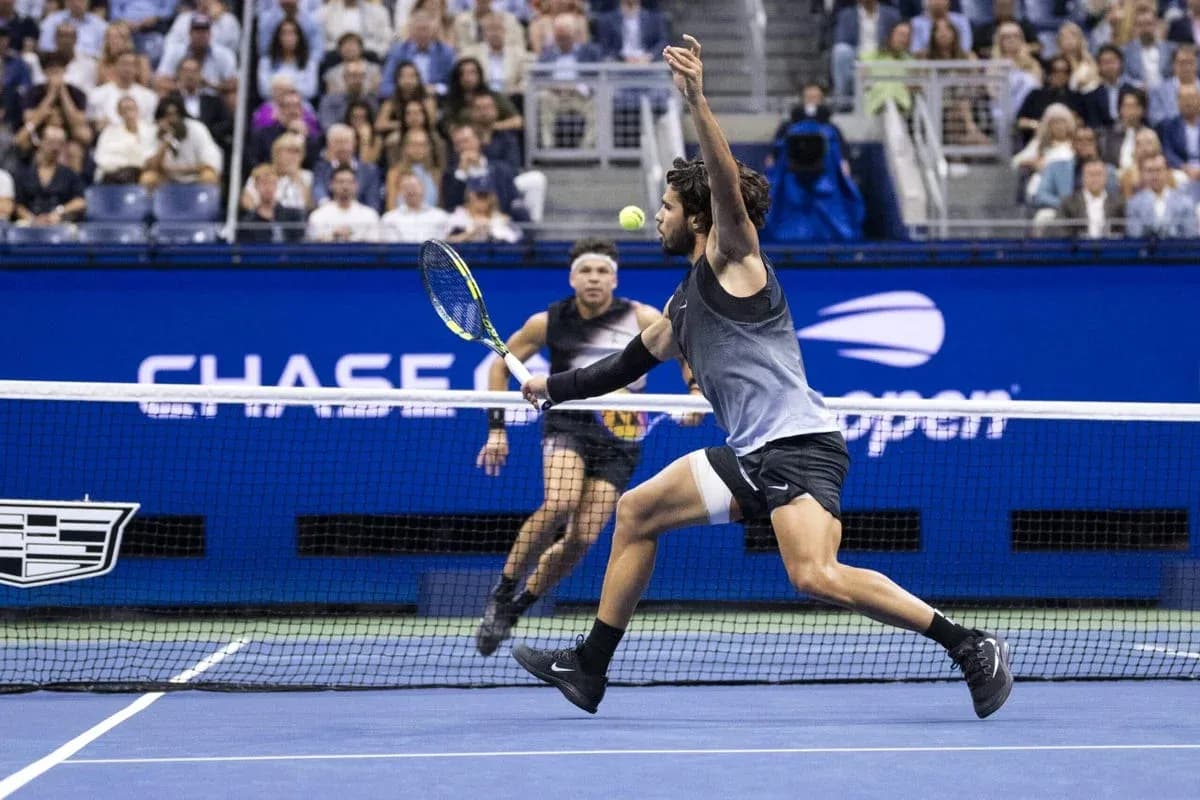
The tiebreak turned chaotic. Both men sprayed errors, then produced a point that jolted the stadium awake — lunges, scrambles, a desperate, floating lob from Shelton that left Alcaraz sliding with his back to the net. Shelton took that point and a 5-3 lead.
Alcaraz then did what he so often does. He flipped the switch.
He rushed Shelton into a backhand miss, ripped a backhand up the sideline, followed with a forehand into open space, then closed the set with one of those full-court, breathless exchanges that have already become his signature. Shelton pulled off an outrageous tweener save, but it only delayed the inevitable. First set, Alcaraz.
Shelton had done the work. He had nothing to show for it. Again.
The Momentum Turns
This time, the letdown never came.
Instead, the first set seemed to drain Alcaraz. Over the next set and a half, his level dropped in a way rarely seen on this stage. In the second set alone, he racked up 17 unforced errors against just eight winners. Shelton broke once. Then twice. Then a third time.
Scoreboard: 6-1 Shelton. Match level.
By the time Shelton surged through the third, 6-3, the pattern was clear. The American was on the front foot, battering Alcaraz with body serves and heavy drives into the corners, forcing the Spaniard to chase shadows. Alcaraz tried to rouse himself, pumping his fist, yelling at the night sky, anything to drag his body and mind back into the fight.
At 5-3, Shelton serving for the third set, they produced another absurd rally — angled drop shots, wild sprints, Alcaraz finally threading a twisting forehand winner while running toward the back wall. It was the sort of point he usually rides into a surge.
Shelton refused to let it become a turning point.
He walked to his towel. His father and coach, Bryan, leaned over the video board and extended a hand. A simple touch. Keep going. Keep running.
Shelton slapped it, stepped back to the line, and fired. Three big serves, three errors from Alcaraz. Set Shelton. He led two sets to one and stood a set away from the biggest win of his life.
Alcaraz’s Last Stand
Alcaraz slumped in his chair, head buried between his knees. When he rose for the fourth, he looked spent, legs heavy, eyes dulled. Shelton sensed it and swung hard for the knockout.
A forehand miss from Alcaraz gifted Shelton a chance to break. Shelton pushed a backhand long. Another loose shot from Alcaraz into the net handed him a second opportunity. Shelton sent a forehand wide.
Two missed chances. Two open doors left unwalked through.
Shelton looked calm, almost detached. Alcaraz was giving him so many looks. Surely another would come.
It didn’t. The champion finally bared his teeth.
Alcaraz serve-and-volleyed behind a rocket return, feathered a drop volley, forced another error, and let out a guttural roar. The match flipped in an instant. Shelton’s radar wobbled. Alcaraz drove him from sideline to sideline, broke for the first time since late in the opening set, and rode the wave to a 6-1 fourth set.
It was closing in on 2 a.m. Roughly 10,000 fans still clung to their seats. The match that had threatened to be a rout had become a marathon. Shelton, who had already played a graveyard shift earlier in the tournament after a three-hour Williams sisters doubles match, now found himself deep in another one.
This time, the stakes were far higher.
A Fifth Set for the Record Books
Fifth set. 2-2. Alcaraz carved out break point and stalked the baseline, sensing the finish. He lashed a forehand, pressed forward.
Shelton refused to fold.
He hopped back, rose, and crushed an overhead so violently that Alcaraz tumbled to the court. Shelton then pounded down another serve, held, and whipped the crowd into a frenzy, racket raised, demanding more noise. The “U-S-A” chant rolled around Ashe.
At 2:45 a.m., Bryan Shelton was on his feet again. Father, coach, witness to the night his son tried to bend history.
By 2:51, they had passed the previous record for latest finish at the U.S. Open — the 2022 quarterfinal between Alcaraz and Jannik Sinner, a match that had felt like a glimpse into the sport’s future. Now, Alcaraz was back under the lights, this time fighting to escape a different kind of storm.
Shelton earned three chances to serve for the match. Three looks at the door.
On the first, he floated a chip approach instead of ripping it. As the ball kissed the court, the net post lights flashed red. Just out. On the second, Alcaraz ripped a running crosscourt passing shot. On the third, Shelton yanked a backhand into the net.
3 a.m. arrived. So did the tiebreak.
Tiebreak at Dawn
At 3:20 a.m., nearly 14 hours after the first ball of the day had been struck in Arthur Ashe Stadium, the two men walked back to the baseline for a 10-point shootout. The stadium buzzed with a strange, wired energy. Chants of “Let’s go Ben” ricocheted from the upper deck. The beep of garbage trucks outside preparing the grounds for sunrise cut through the lulls.
Shelton jumped ahead 3-1. Then the errors crept in again — three in four points. Alcaraz seized on them, plus one huge forehand, to quiet the noise and edge back into control.
Just when it looked like the Spaniard might slip away with it, he faltered. A forehand flew long. The “Let’s go Ben” chorus swelled again. Shelton unloaded on another serve, unreturnable, heavy with purpose.
At 8-7, serving, the match finally sat where Shelton had wanted it all night: on his racket.
He went body first, jamming Alcaraz, pushing the champion off balance. One more point. One more swing.
Ace. Down the middle. Clean. Final.
Shelton let out a roar to the diehards who had stayed with him through the night, the ones who had watched him turn a signature weapon into a breakthrough he had never found before against a player of Alcaraz’s stature.
An American man has not lifted a Grand Slam trophy in 23 years. On Sunday, one will stand in the U.S. Open final. Shelton’s next step comes against Frances Tiafoe.
If this was the night the party truly began, the question now is simple: how far can it go?