Asofa-Solomona's Brutal Knockout of Gallen Sparks Controversy
Paul Gallen has worn plenty in his time. This one turned stomachs.
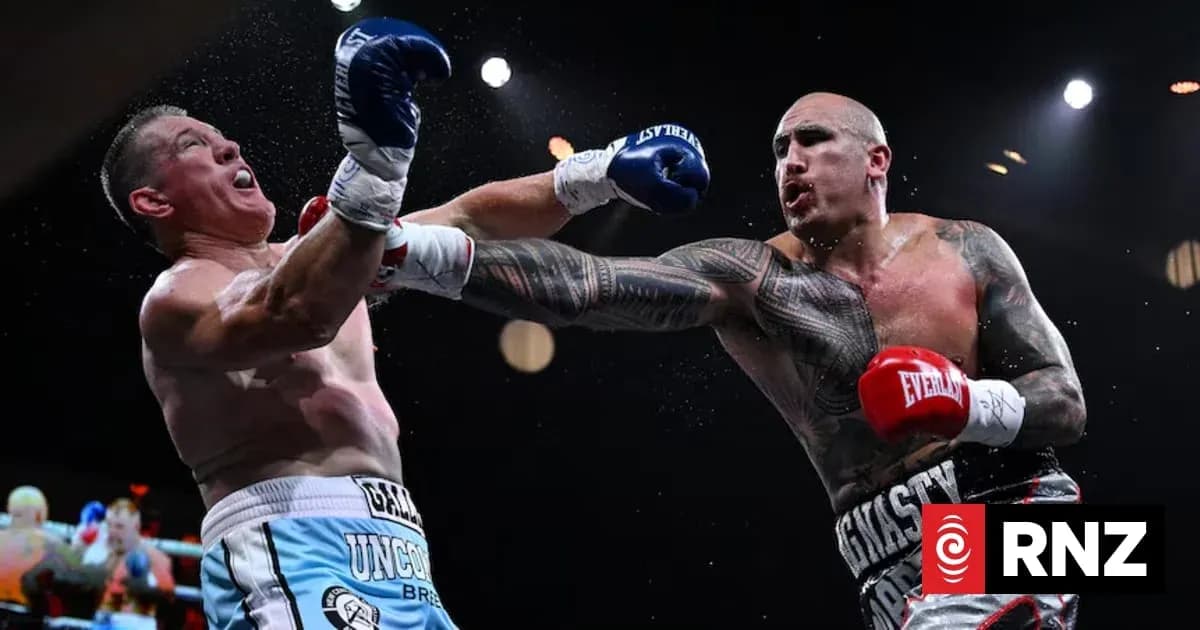
The replays told the story. Nelson Asofa-Solomona’s right hand detonated on Gallen’s face with such violence that hardened fight men struggled to look. Michael Ennis, who once packed into scrums alongside Gallen at Cronulla, looked rattled as he admitted on air he could barely watch. Tim Tszyu called it “frightening”.
In real time, it was worse.
“Oh jeez, oh no!” commentator Ben Damon gasped on Main Event as the punch landed flush on Gallen’s blank, frozen features. Ringside, Danny Green’s instincts kicked in.
“The last one was the worst one, boys,” he blurted out.
“That was the one he didn’t need,” Green added, as Damon spoke over him: “That’s no good.”
“The last one was a bad one,” Green repeated, almost in disbelief.
“That’s hard to watch,” Damon said, his voice shaking.
The contest officially lasted just two minutes and 56 seconds. In that short, savage burst, Asofa-Solomona showed both why he believes he can climb boxing’s Penrose stairs, and why there are serious questions about whether he should.
The opening minute was measured, almost polite. Then the mood changed in an instant. Asofa-Solomona uncorked a thunderous right hand that staggered the 45-year-old Gallen, sending him lurching back towards the ropes. Sensing vulnerability, the giant forward-turned-fighter pounced, a left-right combination driving Gallen squarely against the strands.
Gallen’s head rolled back. His arms flailed. For Asofa-Solomona, an opening for the uppercut flashed into view.
He took it.
The uppercut crashed through with hideous force, snapping Gallen towards the edge of unconsciousness. A second uppercut followed, even more brutal, and this one clearly sent him over the brink.
That should have been the end.
It wasn’t. A third shot grazed Gallen’s famously granite chin as he sank to the canvas, legs folding under him like a discarded marionette, body slumping into a seated heap at the base of the ropes.
Still Asofa-Solomona swung.
As referee Chris Condon hurled himself between them, a black-shirted barrier finally arriving to protect a man who had already taken too much, Asofa-Solomona drove another sickening blow toward the head of his defenceless opponent.
This is where the debate begins. It is boxing, after all. A sport built on controlled brutality, where the objective is, quite literally, to concuss another human being for entertainment.
Earlier in the night, Paulo Aokuso had landed a beautifully timed left hand on Mobin Khahrazeh that had commentators purring. That, too, was a punch that shut the lights off. That, too, was celebrated.
Isn’t that the point? To knock your opponent out. To inflict enough damage that they lose consciousness. To end the fight in emphatic fashion.
Yes. It is.
But even inside the sanctioned barbarism of modern combat sports, there are lines. There are rules that recognise a basic duty of care once an opponent can no longer protect himself.
They are not obscure. They sit in almost every rule book worth opening. The Australian National Boxing Federation is clear:
“Some fouls for which a referee may penalise or disqualify a boxer are: (a) Hitting an opponent who is down or is rising from a knockdown.”
There is nuance here. Eight seconds passed between the first of those crushing punches and Condon’s intervention, but the four uppercuts came in a blur — around two-and-a-half horrifying seconds. In that window, a charging, inexperienced heavyweight, fighting for his future, had almost no time to process what he was seeing.
Yet Gallen was down. More than that, he was out.
Across generations and weight classes, hundreds of fighters have learned the unwritten rule: when a man is gone, you stop. Hitting an unconscious opponent crosses a line that most in the sport still recognise. It betrays the strange, fierce brotherhood that begins when two fighters touch gloves in the ring.
Asofa-Solomona didn’t stop. Adrenaline surged. The red mist stayed.
His wild leap into the crowd moments later underlined just how fired up he was. Security and officials scrambled as the 202cm forward charged toward a spectator.
There was context, as he explained afterwards. At the post-fight press conference at the TikTok Entertainment Centre, Asofa-Solomona said he had been racially abused.
“Someone was doing an ape gesture. I stood on the ropes and it looked like someone threw something at me,” he was reported as saying.
“If I had my time back, I would, because that’s not on. But what that guy did to me, in terms of that gesture, is not on either.”
On that front, there is no debate. Nobody should ever be subjected to racist taunts. Nobody has the right to dictate how a person “should” react when hit with that kind of filth. It is foul, vindictive, uneducated sludge, and it stains everyone who indulges in it.
The punches are different. Those, Asofa-Solomona can control. That, he must.
If he is serious about this new life in the ring, about climbing those endless, illusory steps of boxing’s Penrose staircase, he will have more chances to end fights with a single shot. The power is there. The menace is real.
Next time he lands that knockout blow, he needs to know when enough is enough — and pull his fists back before they turn damage into something far darker.