Aryna Sabalenka Survives Thrilling Quarter-Final Against Noskova
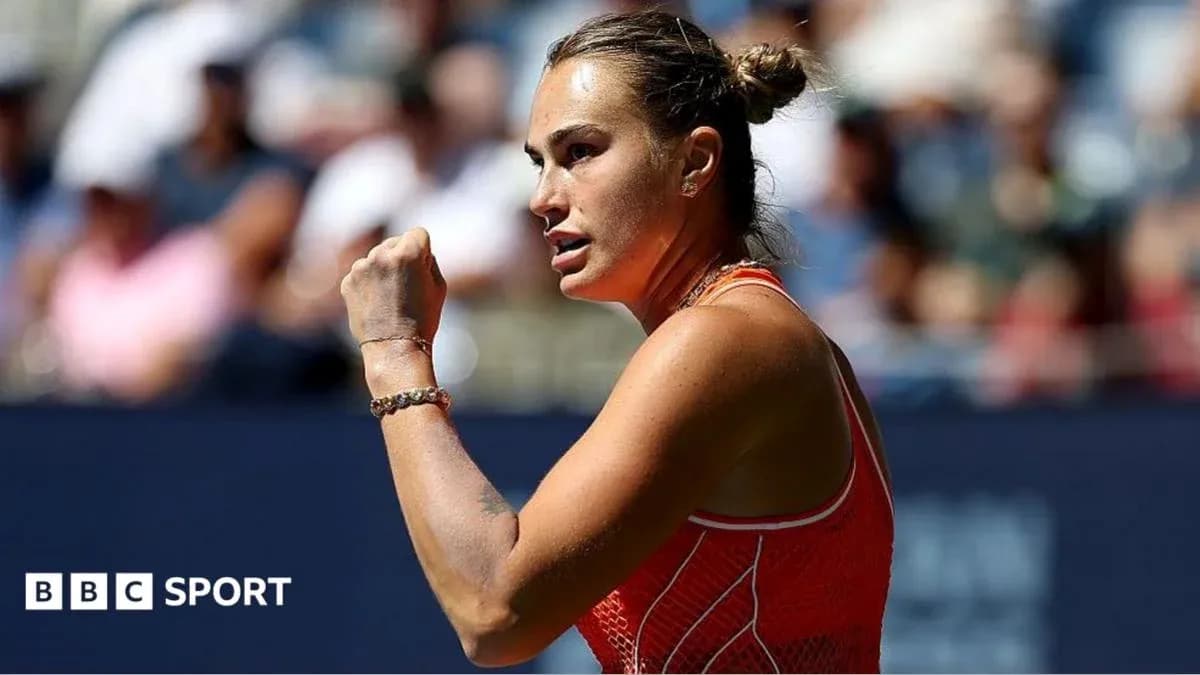
Aryna Sabalenka looked up at the Arthur Ashe scoreboard and, for a fleeting moment, believed her reign in New York was finished.
It wasn’t. Not yet.
The two-time defending US Open champion dragged herself back from the brink against Wimbledon winner Linda Noskova, surviving a wild, nerve-jangling quarter-final to win 7-6 (7-1) 3-6 7-6 (10-7) and reach a sixth straight semi-final at Flushing Meadows.
It took her just under two and a half hours. It took every ounce of nerve she had left.
A champion on the edge
For the first time this fortnight, Sabalenka was pushed to a deciding set. For the first time, she looked genuinely vulnerable.
She trailed 4-2 in the third. She trailed 2-0 in the deciding tie-break. The match – and her title defence – hung by a thread.
“I honestly thought that that's it, the match is over,” she admitted afterwards. That thought seemed to free her. Once she let go of the fear, she started swinging with the abandon that made her the most destructive force on hard courts at the start of the season.
From there, the comeback gathered speed.
Noskova, the sixth seed and riding an 11-match Grand Slam winning streak, had out-hit and out-cleaned the top seed for long stretches. She finished with more winners, fewer unforced errors and saved seven of nine break points. On most days, those numbers send a defending champion home.
Sabalenka refused to go.
Fast start, frayed edges
Early on, it looked like a routine defence of the crown. Sabalenka broke in Noskova’s opening service game, bullied her way to a 5-2 lead and stepped up to serve for the set.
Then the first crack.
A double fault at a key moment – one of four in the match – helped Noskova break back and drag the set into a tie-break. Sabalenka reset instantly, dominating the breaker 7-1, but the pattern was set: her power would give her control, her serve would keep inviting Noskova back in.
The second set underlined it. Sabalenka created three early break points and squandered all of them. At 3-2 down, serving at 30-40, another double fault handed Noskova the break. This time, the Czech did not blink, closing out the set and forcing a decider that felt like a momentum swing.
Sabalenka’s history in these moments is well known. The French Open quarter-final collapse from a set up still hangs in the air when she tightens. Her temper, her tension, her tendency to unravel have cost her before.
On Tuesday night, they threatened to again.
Noskova surges, Sabalenka steadies
The third set turned ugly for the world number one in a hurry. Two more double faults, a third break of serve conceded, and suddenly Noskova was serving at 3-2, then holding to love for 4-2. The Belarusian’s shoulders sagged. The crowd sensed an upset brewing.
That was the moment the champion finally settled.
Sabalenka cut out the cheap errors, went after her returns, and began to drag Noskova into heavier, more physical exchanges. The pressure started to squeeze. She reeled off three games in a row to flip 2-4 into 5-4, and while Noskova held firm to force the tie-break, the dynamic had shifted.
The breaker itself carried its own drama. Noskova jumped to a 2-0 lead. Sabalenka, again, looked at the edge. Then came the surge: fearless hitting, deeper returns, and a refusal to back off her second serve.
Her reward? A 10th consecutive US Open tie-break win, a streak that stretches back to 2021.
She finished it with a second serve that told the whole story – not a roll-in, not a safety net, but a bold, flat ace under suffocating pressure. A shot that belongs to a player who has decided she will live with the consequences of aggression.
History, rankings and a familiar stage
This was Sabalenka’s 19th straight victory at the US Open. She has not lost here since the 2023 final and now becomes the first woman since Serena Williams in 2016 to reach six consecutive semi-finals in New York.
She also, for now, clings to the world number one ranking. That grip may be brief. If world number two Elena Rybakina beats Zheng Qinwen on Wednesday, Sabalenka will be dislodged regardless of how far she goes this week.
On court, though, the numbers tell a different story: this is a player who has rediscovered her hard-court edge in the one place she has never failed in a quarter-final. Six times she has reached this stage at the US Open. Six times she has gone through.
That reliability has been missing elsewhere. Since March, this was only her second quarter-final win. Titles in Brisbane, Indian Wells and Miami set a ferocious standard early in the year, but she couldn’t carry that dominance onto clay or grass. Early exits in Toronto and Cincinnati hinted at a player searching for rhythm.
In New York, she has found something close to her true level again.
Noskova’s brave stand
Noskova leaves with a defeat that will sting but also with a performance that underlines her status as a major threat on every surface.
She matched the champion blow for blow, often outplaying her in the baseline exchanges and showing the composure of a far more seasoned player. Her run of 11 consecutive Grand Slam singles wins is over, but the impression she left on Ashe is unlikely to fade quickly.
On another night, with a little less resilience on the other side of the net, she would be the one preparing for the semi-finals.
What comes next
Sabalenka now turns to an all-American obstacle: either third seed Jessica Pegula or 26th seed Emma Navarro await in the semi-finals as she chases a fourth straight US Open final.
She has the scars of recent collapses and the evidence of back-to-back comebacks in New York this week – Taylor Townsend in the previous round, Noskova here – sitting side by side in her story.
Which version of Aryna Sabalenka will walk onto Ashe next: the one who once let emotions drag her under, or the one who just stared down defeat and answered with a second-serve ace for a place in yet another semi-final?