Arthur Gea's Heartbreaking Exit from US Open Quarter-Finals
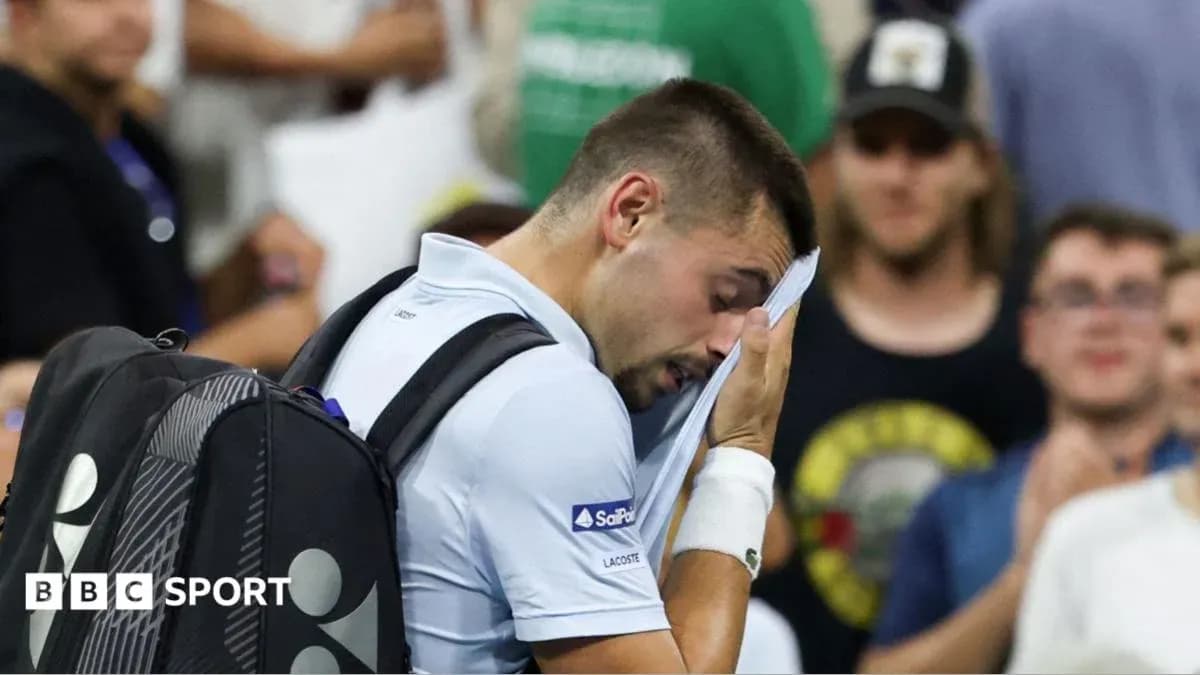
Arthur Gea stood one point from history. Three hours later, he was out of the US Open.
The 21-year-old Frenchman, a lucky loser who had already turned a second chance into a deep run, saw a place in the quarter-finals slip through his fingers in brutal fashion against Botic van de Zandschulp. What began as a fairytale almost became a landmark: no lucky loser has ever reached a Grand Slam quarter-final. Gea came as close as it gets.
He had match point in the third-set tie-break. He served for the match in the fourth. He lost in five.
Van de Zandschulp, somehow still standing after being pushed to the brink, clawed his way back to win 3-6 6-7 (0-7) 7-6 (9-7) 7-6 (7-3) 6-4 after five hours and 13 minutes – the fourth-longest match ever recorded at Flushing Meadows. It was the sort of contest that drains both players and leaves the crowd unsure whether to applaud the winner or console the loser.
Gea, ranked 87 in the world, was never supposed to be in this position. When the US Open entry list closed, his ranking left him outside the main draw. He went through qualifying, top seed in that draw, and then lost in the final round to American Nishesh Basavareddy. At that point, $66,000 in qualifying prize money and a long flight home looked like his lot.
Then Casper Ruud pulled out injured on the eve of the tournament. Gea’s name came back off the board and onto the big stage.
He seized it. Wins over Juan Manuel Cerundolo, Zachary Svajda and Michael Zheng carried him into the last 16 and turned him into one of the stories of the first week. The run will still change his year, and likely his career: as the 13th lucky loser to fall in the fourth round of a major, he leaves New York with $480,000 instead of that modest qualifying cheque.
But it will sting. Against the world number 70, he had the match in his hands. The third-set tie-break offered him a match point and a direct route into history; he couldn’t land the final blow. Serving for it in the fourth, his arm tightened again. Van de Zandschulp, who admitted he had “no clue” how he pulled off what he called a “crazy comeback”, kept forcing him to play one more ball, one more point, one more nerve-shredding rally.
The Dutchman finally broke clear in the fifth, closing out a contest that felt less like a tennis match and more like a test of endurance. His reward is a second US Open quarter-final and a showdown with the top seed, Alexander Zverev.
Zverev finally finishes early – and wants more night lights
For once, Zverev did not have to grind past midnight. After three consecutive late-night epics that ended at 1:55am, 2:15am and 1:09am, the French Open champion wrapped up his fourth-round win over Luciano Darderi in relative comfort and, by New York standards, broad daylight.
He dismissed the Italian 21st seed 6-2 6-2 7-6 (7-3), tightening the screws early and only allowing Darderi a foothold in the third set. The tie-break there was sharp, controlled, a reminder of why Zverev carries the number one seeding into this fortnight.
When it was over, the clock had not yet struck midnight. For Zverev, that almost felt strange.
“I don't know what to do with myself because it's before midnight – I might go back to the practice courts or go to a bar,” he joked, leaning into his new status as the unofficial king of the night session. He has no intention of giving up that slot, either. “I will request the night match for sure. I've rented this court out from 11pm until 2am for two weeks so I hope they will continue putting me on at [night] time.”
Now he gets Van de Zandschulp, a player who arrives with heavy legs but a light conscience after surviving one of the wildest marathons of the tournament.
Blockx battles through pain to make Belgian history
Earlier on Monday, another young name forced its way into the New York conversation. Alexander Blockx, the 28th seed from Belgium, looked close to breaking point against Francisco Cerundolo – not because of the scoreboard, but because of his own body.
He complained of rib pain from the opening stages and struggled most on serve. The discomfort grew as the match went on, yet he found a way to manage it, and then to use the tension of the moment to sharpen his focus rather than blur it.
Blockx beat the Argentine 6-3 4-6 7-5 7-5, sealing his first Grand Slam quarter-final and becoming the first Belgian man ever to reach the last eight at the US Open. It took stubbornness as much as shot-making.
“It was really tough from the beginning of the match. I was struggling a lot, especially while serving. It kept getting worse throughout the match,” the 21-year-old said. “I was really close to retiring, to be honest. I was just hanging in there, but if I would have lost the third set, I think the chances were really high of me retiring. I'm glad that I kept on playing.”
If his ribs allow, he will face Karen Khachanov on Wednesday. The Russian, ranked 50 in the world, needed five sets of his own to get past Learner Tien, dashing American hopes of a historic home surge. Khachanov recovered from two sets to one down and a lost third-set tie-break to win 7-5 4-6 6-7 (6-8) 6-1 6-4, ending Tien’s bid to become part of a quartet of US men in the last eight for the first time since 1995.
So the quarter-finals in New York will not belong to a lucky loser, nor to a wave of homegrown contenders. Instead, they carry a different kind of intrigue: a top seed who thrives under the lights, a Dutchman fresh from a five-hour escape, a Belgian playing through pain, and a Russian rediscovering his edge over five sets.
The margins are brutal here. Gea learned that the hard way. The question now is who handles them best when the stakes rise again.