Alexander Zverev: From Doubt to Dominance in Tennis
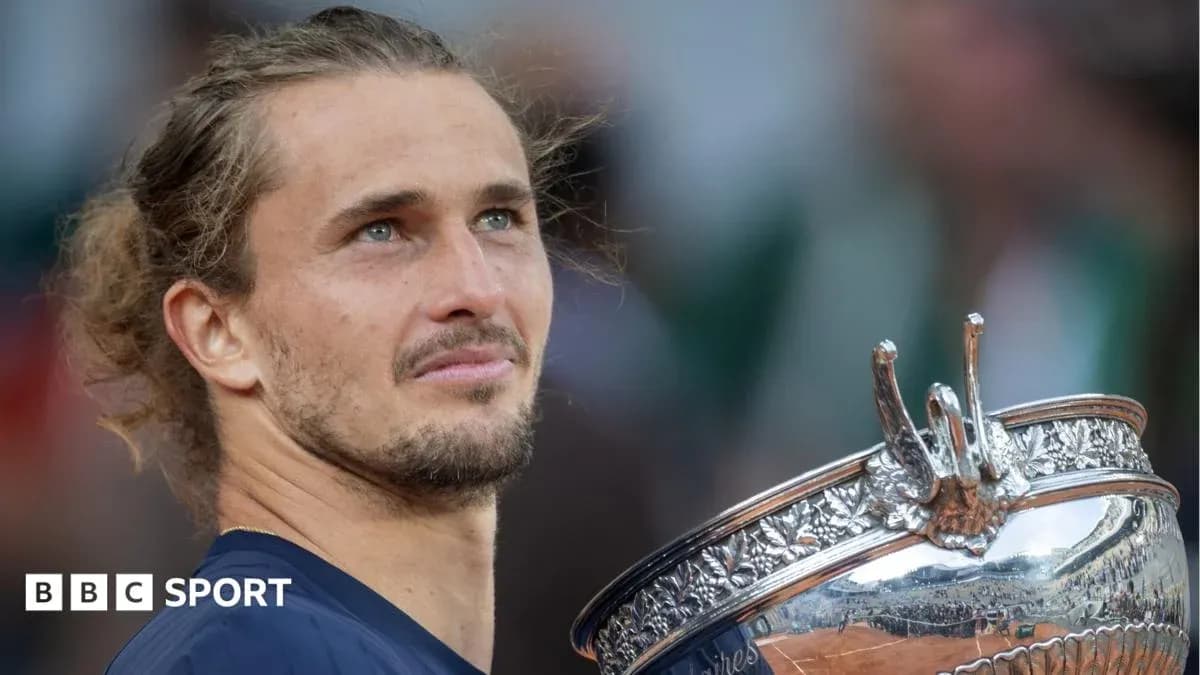
Alexander Zverev used to carry one of the harshest labels in tennis: the best man never to win a Grand Slam.
He ends 2026 as a two-time major champion and the sport’s deserved world number one. The wait was long. The climb was messy. The story is anything but simple.
A late-arriving number one
At 29, Zverev has become the oldest man in more than half a century to reach world number one for the first time. His surge to the summit has been powered by titles at Roland Garros and the US Open, and a run to the Wimbledon final that showcased the most complete tennis of his career.
This is not a bolt from the blue. Before this season, he was already an Olympic champion, a two-time ATP Finals winner and a former world number two, with three Grand Slam finals behind him. But those majors defined him for the wrong reasons.
None cut deeper than the 2020 US Open final. Two sets up on Dominic Thiem, Zverev froze. His arm tightened, his serve deserted him, and two double faults in a fifth-set tie-break turned a coronation into a collapse. The match became shorthand for his inability to carry his free-swinging tour form into the moments that mattered most.
That reputation has been chasing him for years.
A reset in Mallorca
Zverev decided this season had to be different. He vowed to hit bigger, take more risk, open the court with variety rather than retreat into safety. The catalyst came in an unlikely setting: 10 intense days in Mallorca in July 2025 with Rafael Nadal and Toni Nadal.
"I wanted to see and then hear a new vision of what tennis in their mind looks like – and how my tennis, in their mind, looks like," he explained. Nadal had been across the net from him for a decade. Now he watched from the side, dissecting patterns, exposing habits, pushing Zverev towards a more daring version of himself.
The change was not instant and not smooth. In the French Open final against Flavio Cobolli this June, the old tension crept back in. Zverev cramped. The ghosts from New York hovered. This time he held his nerve, ripped through the deciding set 6-1 and finally lifted the trophy that had seemed to mock him for so long.
From there, the dam broke.
A family-built champion
His rise has always been a family project. His father, Alex Zverev Sr, has been a constant figure in the player box, a stern, familiar silhouette in every big match. His older brother Mischa, who once shared practice courts with Andy Murray while a toddler Alexander watched from the side, now sits beside their father as part of the coaching team.
The dynamic is unusual, and Zverev has never hidden that the closeness comes with distance.
He has said the relationship with his father works precisely because they spend "zero time together" away from the court. His parents, both former professionals, tried to steer him towards other sports when he was young. Football, field hockey, anything that spared them from coaching their own son. They knew the grind. They knew the cost.
"They are very smart. They've been through it. They've been tennis players themselves," he has recalled. The result is a player forged inside the game yet determined to own his own decisions.
Diagnosed with type 1 diabetes at the age of four, Zverev has also managed a chronic condition throughout his career. His breakthrough at Roland Garros felt like a reward for years of disciplined work, invisible routines and stubborn persistence.
The grass, the hard courts, and the rivalry to come
The numbers now match the ambition. French Open champion. US Open champion. Wimbledon runner-up. On the lawns of the All England Club, he produced arguably his highest level of the year before falling in four sets to Jannik Sinner on Centre Court, playing bold, front-foot tennis that he knows must become the norm against the sport’s new predators.
He will need it. Sinner has beaten him 10 times in a row. Carlos Alcaraz remains another looming obstacle. If all three are fit at the start of next season, the challenge for Zverev is clear: turn 2027 into a genuine three-way battle for the biggest prizes, not a brief cameo at the top.
A career shadowed by serious allegations
Zverev’s sporting story cannot be told without the shadows that surround it.
In October 2020, his former partner Olga Sharypova accused him of physical violence and controlling behaviour. Zverev denied the allegations from the outset, calling them baseless. There were no criminal proceedings, but the ATP opened a major independent investigation, handled by third-party investigators.
In January 2023, the ATP announced it had found "insufficient evidence to substantiate published allegations of abuse". The governing body said that, based on a lack of reliable evidence and eyewitness reports, and conflicting statements from Sharypova, Zverev and other interviewees, the investigation could not substantiate the claims.
The case prompted structural change. A director of safeguarding was appointed, and this year the ATP launched a new safeguarding programme, setting out a global framework for preventing and responding to abuse, including harassment, bullying, domestic violence and other forms of misconduct.
The controversy did not stop there.
In October 2023, a German court issued Zverev with a penalty order and fined him 450,000 euros (£392,000) for bodily harm against another ex-girlfriend, Brenda Patea. Zverev denied the allegations and contested the order, triggering a public trial in Berlin in May 2024.
A week into proceedings, the court terminated the case before reaching a verdict, saying there had been a settlement between Zverev and Patea. "The decision is not a verdict and it is not a decision about guilt or innocence," the court said, adding that a decisive factor was the witness’s wish to end the trial. Patea has not publicly commented on the settlement.
On the day the settlement was announced, Zverev reached the French Open final. He had earlier described the trial as a chance to prove his innocence. Asked if he regretted settling before a verdict, he responded bluntly.
"That's what dropping the case is. That is innocence," he argued. "They're not going to drop the case if you're guilty at the end of the day. I don't know what translations you have, but that's what it means. Done. We move on. I never ever want to hear another question about the subject again. That goes out to everybody."
The public has not always obliged. He was heckled in 2025 at both the Australian Open and the Munich Open over the allegations, a reminder that for many fans the legal outcomes have not closed the moral debate.
Flashpoints and fury
Zverev’s record is not spotless on court either. In 2022, he received an eight-week suspended ban from the ATP after a notorious outburst in Acapulco. Furious over a line call in a deciding tie-break of a doubles match alongside Marcelo Melo, he smashed his racquet into the umpire’s chair four times, swore at Alessandro Germani and accused the official of destroying the match. One of his swings came perilously close to the umpire’s foot.
He was thrown out of the Mexican Open for unsportsmanlike conduct. Zverev later apologised, saying it was "difficult to put into words" how much he regretted his behaviour. The suspended ban was never activated, as he avoided further fines for disrespectful or aggressive conduct over the following 12 months.
The contradictions remain stark. A player who can look icy and controlled under pressure has also lost his temper in spectacular fashion. A champion whose discipline and resilience have carried him to the top of the sport continues to face questions about his behaviour away from the court.
The complicated standard-bearer
Now, as the new standard-bearer for men’s tennis, Zverev sits in a place once occupied by the likes of Nadal, Novak Djokovic and Roger Federer – but with a far more complicated public image. His tennis has never looked more complete. His ranking has never been higher. His record at the majors finally matches the talent that insiders have talked about for a decade.
The question is not whether Alexander Zverev has earned his place at the top of the sport. On results, he has.
The real question is what kind of world number one men’s tennis is willing to live with in the years ahead.