Alexander Zverev: From Best Player Without a Grand Slam to World Number One
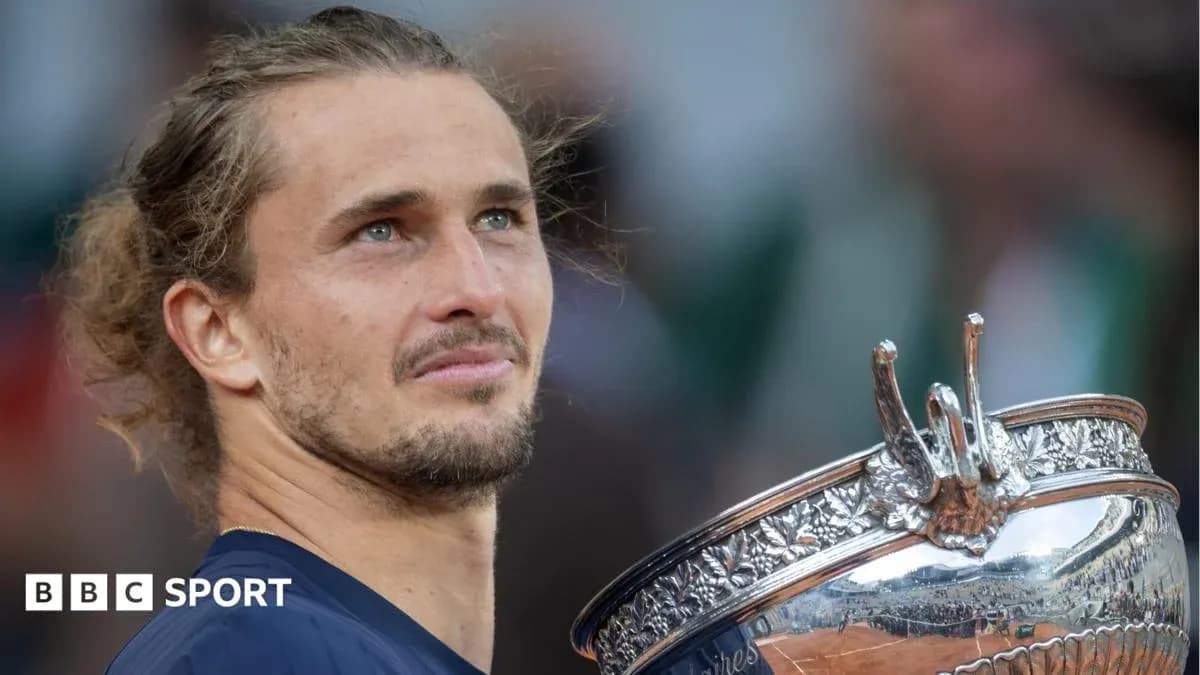
Alexander Zverev used to carry one of tennis’ most unforgiving labels: the best man never to win a Grand Slam. He will close 2026 as a two-time major champion and the sport’s new, and deserved, world number one.
It has taken him longer than most. It has also made him the oldest man in more than half a century to reach the top of the rankings for the first time. At 29, with the French Open and US Open trophies finally locked into his cabinet, the numbers have caught up with the talent.
The journey has never been simple, on or off the court.
A long-awaited breakthrough
Zverev has lived with type 1 diabetes since he was four. The condition has shaped his routines, his training, his entire professional life. It did not stop him from climbing, but it did make the climb more complicated.
By January, he was already an Olympic champion, a two-time ATP Finals winner and a former world number two. He had appeared in three Grand Slam finals and lost them all. One of them left a scar that took years to fade.
In the 2020 US Open final, he led Dominic Thiem by two sets to love and still found a way to lose. The match slipped away in a fifth-set tie-break, Zverev double-faulting twice as Thiem cramped and staggered yet somehow held firm. It was the kind of collapse that sticks to a player’s reputation.
The pattern hardened. On the ATP Tour he could be free, bold, devastating. On the biggest stages, the arm tightened. The serve flickered. The attacking instincts that define his best tennis retreated into caution.
This season, he decided that version of himself had to go.
He vowed to hit through the ball, to live with the risk, to mix his patterns in rallies instead of retreating behind the backhand cross-court. The pledge was not born in a vacuum. It came from 10 days in Mallorca in July 2025 with Rafael and Toni Nadal.
“I wanted to see and then hear a new vision of what tennis in their mind looks like – and how my tennis, in their mind, looks like,” Zverev said of that trip. Nadal had spent a decade trying to solve him from the other side of the net. Now he could dissect him as a spectator.
Those conversations did not erase nerves. They did, though, give him a blueprint for what to do when the tension arrived.
Paris, finally
The French Open proved the test. In the final against Flavio Cobolli, Zverev’s body betrayed him again. Cramp crept in, memories of New York surely not far behind.
This time, he did not fold.
He reset, shortened the points, trusted the bigger cuts he had promised himself. The deciding set ran away from Cobolli 6-1. After years of near-misses and self-inflicted wounds, Zverev finally held a major trophy and did so on clay, the surface that had often exposed his doubts as much as his strengths.
The win in Paris unlocked more. By September, he was also US Open champion and had reached the Wimbledon final, where he produced what he himself called his best tennis of the year in a four-set defeat to Jannik Sinner on Centre Court. He played that match on the front foot, aggressive and daring, and left with a clear message about what his future must look like.
He will need the same approach to solve the two men who now stand between him and a monopoly on the sport’s biggest prizes.
A rivalry still to be written
For all his success in 2026, Zverev’s record against Sinner is a glaring red mark: 10 straight defeats. Carlos Alcaraz, the other pillar of men’s tennis’ new era, has also found ways to hurt him in key moments.
If all three are fit when 2027 begins, the season sets up as a genuine three-way rivalry for the majors. For Zverev, the challenge is clear: keep the new, risk-taking version of his game when the pressure peaks, not just when he is cruising through early rounds.
His support system remains rooted in family. His father, Alex Sr, still anchors the coaching box. His older brother Mischa, who once had a young Alexander sitting courtside as he practised with Andy Murray as a junior, now works alongside their father after retiring from the tour.
The dynamic is unconventional. Zverev says his relationship with his father functions because they spend “zero time together” away from tournaments. There was no pushy tennis parent at home, no ultimatum.
“The big difference with my parents is that they never forced me to do anything,” he has recalled. They nudged him toward other sports, especially football and field hockey, partly so they would not have to coach him. “They are very smart. They’ve been through it. They’ve been tennis players themselves.”
The result is a player forged in a tennis family, yet adamant that the drive comes from within.
Allegations and investigations
The story of Alexander Zverev cannot be told solely through rankings and trophies.
In October 2020, his ex-partner Olga Sharypova accused him of physical violence and controlling behaviour. Zverev rejected the allegations, calling them baseless. No legal case followed, but the ATP launched a major independent investigation, handled by third-party investigators.
After interviewing Sharypova, Zverev and others, the ATP announced in January 2023 that there was “insufficient evidence to substantiate published allegations of abuse”. The governing body cited a lack of reliable evidence and eyewitness accounts, along with conflicting statements, and said it could not substantiate the claims.
The fallout reshaped the tour’s approach. The ATP appointed a director of safeguarding and, this year, introduced a new global safeguarding programme, promising a clear framework for preventing and responding to abuse, harassment, bullying, domestic violence and other misconduct.
Another case soon followed. In October 2023, a German court issued Zverev a penalty order and fined him 450,000 euros for bodily harm against another ex-girlfriend, Brenda Patea. He denied the allegation and contested the order, triggering a public trial in Berlin in May 2024.
One week into proceedings, the court terminated the case after a settlement between Zverev and Patea. The court stressed the decision was not a verdict and not a ruling on guilt or innocence. A key factor, it said, was Patea’s wish to end the trial. She has not commented publicly on the settlement.
The timing was stark. The settlement became public on the day Zverev reached the French Open final. Earlier in the tournament, he had framed the trial as a chance to prove his innocence. Asked afterwards whether he regretted settling before a verdict, he replied: “That’s what dropping the case is. That is innocence. They’re not going to drop the case if you’re guilty at the end of the day.”
He closed the subject sharply: “Done. We move on. I never ever want to hear another question about the subject again. That goes out to everybody.”
Crowds have not always obliged. Zverev was heckled in 2025 at the Australian Open and in Munich over the allegations, a reminder that public opinion does not reset with a ranking update.
Temper and line-calls
Zverev’s disciplinary record on court has also drawn scrutiny. In 2022, at the Mexican Open in Acapulco, he smashed his racquet four times into the umpire’s chair after a doubles defeat, one swing coming perilously close to the umpire’s foot. Furious over a line call in the deciding tie-break, he swore at Alessandro Germani and accused him of ruining the match.
The ATP found him guilty of a “major offence” and handed him an eight-week suspended ban. Zverev apologised, saying it was “difficult to put into words” how much he regretted the outburst. The suspension was never activated because he avoided further fines for disrespectful or aggressive behaviour, or verbal or physical abuse, over the following 12 months.
All of this – the titles, the collapses, the medical challenges, the allegations, the investigations, the temper – now sits behind the number one next to his name.
He stands at the top of men’s tennis as both its new standard-bearer and one of its most divisive figures. The question for 2027 is not just how many more majors Alexander Zverev can win, but what kind of champion the sport is willing to accept.