Alex de Minaur's US Open Struggles as Dane Sweeny Shines
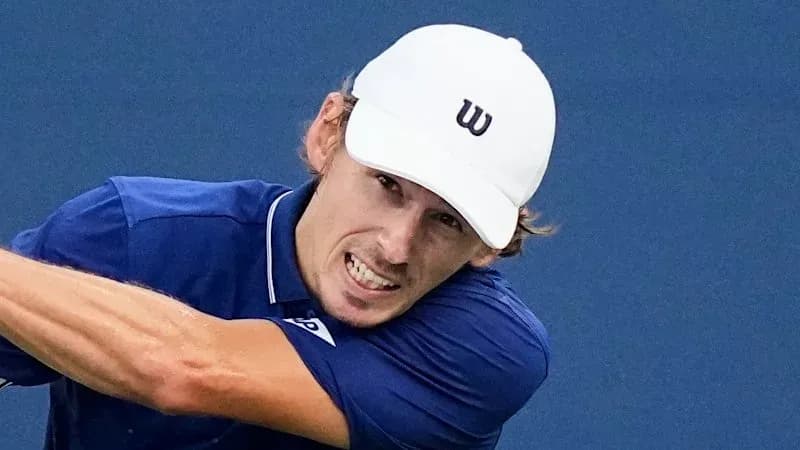
Alex de Minaur’s season of promise is suddenly teetering.
The world No.7 walked off Louis Armstrong Stadium on Friday in New York with a straight-sets defeat, a flat racquet and a ranking under threat, beaten 6-4, 7-5, 6-2 by a surging Botic van de Zandschulp in the US Open second round.
For a player who built his reputation on reliability and resilience at the majors, this was a jarring full stop to his least productive grand slam year since 2023. A quarter-finalist here the past two seasons, he exits in the second round for the first time in five years and could soon be out of the top 10.
“My level today wasn’t good enough. It’s pretty straightforward,” de Minaur said, not bothering with excuses.
He tried to compete his way into form. The attitude was there, the legs were there. The feel was not. “I was making a lot of errors, which is not really my normal game style,” he said. “It felt like the more I tried, the more intensity, the more fired up I was getting, I just kept on making unforced errors … [it was] a tough day at the office.”
From dream start to grinding reality
This wasn’t how 2026 was supposed to look for Australia’s No.1. De Minaur opened the season with a flourish, then pushed through to a second Australian Open quarter-final in January. That run hinted at a player ready to park himself in the game’s elite.
Since then, the climb has stalled.
He fell in the third round at Roland-Garros, the fourth round at Wimbledon, and has gone beyond the quarter-finals at any event only once since February. A painful loss to Flavio Cobolli at Wimbledon left him talking about how failing to step up on that stage “breaks me inside”. The body language in recent weeks has looked like a man still searching for that version of himself.
In New York, the numbers told the same story. His serve, under the microscope all year, cracked again. Seven double faults, just four aces, 11 break points faced and five breaks of serve conceded. For a player who usually lives off his margins and discipline, the error count cut deep.
The match turned on the sort of moments de Minaur usually owns.
He dropped the opening set and then double-faulted to fall behind 4-3 in the second. A slice of luck in the next game — a scrambling backhand that clipped the net cord and died for a winner — opened the door. He clawed back to level, then nudged in front, the crowd sensing one of his trademark momentum swings.
The pressure finally told – on him, not his opponent.
Serving at 5-5, de Minaur fought through a marathon game, saving four break points, dragging van de Zandschulp into long exchanges, only to surrender on the fifth. The Dutchman’s decisive break came off a mishit ball that landed short and forced the Australian forward, setting up a passing shot. Van de Zandschulp even apologised. De Minaur still walked to his chair knowing he should have done more with the chance.
Two sets down, history weighed heavily. In 27 previous attempts, he had never come back from that position. That record didn’t budge.
He left the court between sets and returned trying to ignite something, anything. Instead, a loose forehand in the third game cost him his serve again. Two break points in the next game slipped away, and when van de Zandschulp punched through for a second break in the set, the contest was effectively over.
On paper, this was an upset. In reality, it was a meeting of two players heading in opposite directions. Van de Zandschulp, a power hitter who had already taken out Carlos Alcaraz at this tournament two years ago, arrived in New York with his game humming. De Minaur did not.
Sweeny seizes the stage
On a chaotic day for Australian tennis at Flushing Meadows, one of the smallest men in the draw delivered the biggest jolt.
Dane Sweeny, a 170-centimetre wildcard ranked 123 in the world, stormed into the third round with the win of his life, dismantling Lorenzo Musetti 3-6, 6-1, 6-2, 6-2. A first top-20 scalp. A first run to the last 32 of a slam. A night that dragged his career out of the shadows.
Sweeny was supposed to be grinding through US Open qualifying. Instead, late withdrawals nudged Alexei Popyrin into the main draw on ranking and shifted Tennis Australia’s reciprocal wildcard to Sweeny. He has turned that sliver of opportunity into a breakthrough.
His opening-round win came when Corentin Moutet retired with an arm injury trailing 7-6 (7-4), 6-4, 3-0. This time there was no asterisk. Just relentless hitting and stubborn defence.
Musetti, a dual grand slam semi-finalist, started like the star he is, taking the first set and dictating with his variety. Then his body began to betray him. From early in the third set, the Italian looked visibly ill, repeatedly hunched in the corners, taking an off-court medical timeout at 3-0 down and struggling to keep his energy up.
Sweeny never blinked.
He twice gave back breaks of serve, only to rip them straight back, refusing to let Musetti off the hook. The fourth set followed the same pattern. Musetti donated an early break and spent the rest of the set chasing a man who refused to slow down.
Sweeny’s only previous taste of this level had been a straight-sets defeat to Ben Shelton in the second round of this year’s Australian Open. That felt like a ceiling. This feels like a beginning.
“I’m so grateful to be able to even compete in grand slams,” he said. “I put a lot of work in. The tennis journey is such a rollercoaster, and I’m so incredibly grateful to play in front of an awesome crowd and to soak up this moment. To win, and to get a couple of wins, is awesome.”
The journey has already tested him. Barely two years ago, he walked away from the sport for several months during a brutal slump, just when he thought he was close to cracking the big time.
“That’s the beautiful thing about pursuing something so hard like tennis,” he said. “Tennis can change on the flip of a coin. You’ve just got to keep persevering, and that’s what I did. I wasn’t getting results for a long while, but there’s a law of probability. I knew it was somehow going to swing in my favour if I just kept going, and I did.
“Now I’m here, and it’s the best decision I ever made to come back after that two months.”
He is now guaranteed more than $400,000 in prize money and sits at a provisional career-high live ranking of No.109. Next comes another seeded Italian, Luciano Darderi, and another chance to stretch this unexpected run.
For now, Sweeny stands as the last Australian left in the singles draws at Flushing Meadows.
Kyrgios banned, Popyrin and Schoolkate fall
Off the court, Australian tennis absorbed another jolt.
The International Tennis Integrity Agency confirmed that Nick Kyrgios had accepted a one-month suspension for out-of-competition use of cocaine. The ban, reduced from three months after he agreed to enter a treatment program, relates to a night out before he played in Mallorca.
Kyrgios, who apologised last month to family, friends and fans for what he called a “huge mistake”, admitted to using cocaine socially. His suspension officially ended on Thursday, subject to him completing the treatment program, but he has forfeited his prize money and ranking points from Mallorca.
Former doubles partner and long-time rival Stefanos Tsitsipas said after his first-round win in New York that the news did not surprise him and that he had been aware of the situation.
On court, the Australian men’s campaign thinned out quickly.
Qualifier Tristan Schoolkate threatened to script another upset when he grabbed the first set from Roland-Garros finalist Cobolli, only for the No.5 seed to respond with a 3-6, 6-3, 6-4, 7-5 victory.
Popyrin, who had ridden that late entry into the main draw, faded after a flying start against Alejandro Tabilo. He took the opening set 6-2 but lost his edge in the key moments, dropping consecutive tiebreaks 7-4 and 7-3 before the 25th-seeded Chilean left-hander ran away with the fourth set 6-2. Popyrin left the court looking dispirited, his bright beginning to the match a distant memory.
Around the grounds, the upset theme spread. Third seed Felix Auger-Aliassime went out in four sets to Karen Khachanov, while Coco Gauff, Iga Swiatek, Taylor Fritz and Naomi Osaka all moved safely through.
So the Australian story in New York now splits in two. At one end, de Minaur, a top-10 player suddenly fighting to hold his place and his confidence. At the other, Sweeny, the undersized battler who walked away, came back, and now finds himself carrying a nation’s hopes into the second week.
Which arc will define Australia’s season when the hard courts fall silent?