2026 U.S. Open Preview: Legends Return and New Challenges Await
The gates swing open on a familiar stage today, but the 2026 U.S. Open does not feel familiar at all.
Flushing Meadows, under a clean blue New York sky, is bracing for a fortnight where old legends return, long droughts hang in the air and the men’s game arrives with more questions than certainties.
Day 1: Pegula opens, Medvedev looks for redemption
By noon on Arthur Ashe Stadium, Jessica Pegula will walk back into the arena that nearly crowned her two years ago. The 2024 U.S. Open finalist starts this year’s campaign against Elena-Gabriela Ruse, the first ball on the sport’s biggest regular stage at 12 p.m. ET.
She knows the court, she knows the noise, and she knows what it feels like to be one match away from the trophy. Now she has to live with that and try to go one better.
Daniil Medvedev follows with a very different kind of burden. The 2021 champion, once the man who cracked Novak Djokovic’s bid for the calendar Grand Slam, is trying to erase the memory of last year’s first-round exit when he faces Hugo Gaston. For a former champion, that sort of early departure lingers. Today is about resetting the story.
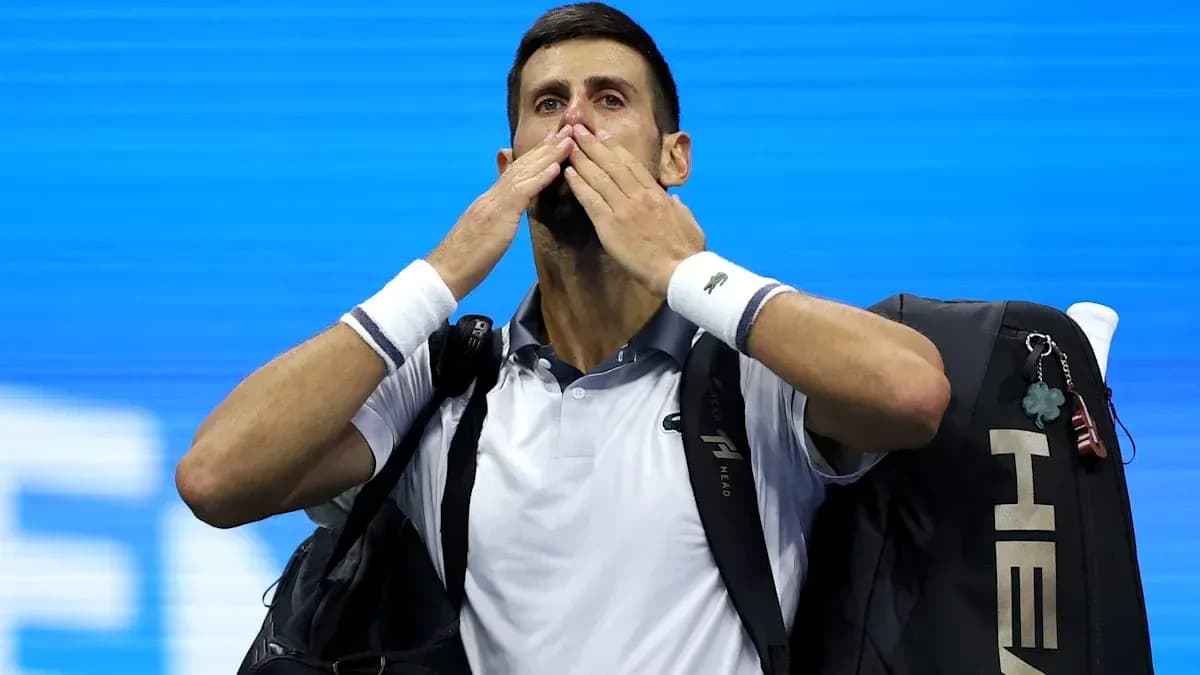
When night falls, the spotlight hardens. Novak Djokovic and Venus Williams headline the evening session, a pairing that says everything about where tennis has been and where it still refuses to stop.
Djokovic, 39, has played just one match since Wimbledon but remains within touching distance of a 25th Grand Slam title. Venus, also 39, walks into what could be one of her final New York campaigns, still chasing competitive moments rather than nostalgia.
Venus, Serena and a doubles reunion that matters
The last time Venus and Serena Williams played doubles at a major, it felt like a side dish to the main event. That was here in 2022, the year Serena “evolved” away from tennis, and the sisters lost in the first round to a Czech pair featuring a then-17-year-old Linda Nosková. Doubles was an extra that week, a bonus feature grafted onto Serena’s farewell singles tour.
This time, it carries real weight.
Wimbledon never got its Williams reunion; Serena’s knee injury in her first-round singles loss to Australian Maya Joint forced her out of the doubles there. New York, as it so often has, gets the moment instead.
Venus still has a marquee singles assignment against fellow American and former Grand Slam champion Sofia Kenin in the first round, but the emotional center of her tournament may well be the doubles court. Serena isn’t playing singles, so all of her competitive energy, all of her attention, goes into partnering her sister.
Recent evidence suggests this isn’t just a farewell act. Serena’s mixed doubles run with Carlos Alcaraz earlier this summer offered a blend of lighthearted chemistry and serious shot-making. At the Cincinnati Open, the Williams sisters pushed Marta Kostyuk and Peyton Stearns to a third-set tiebreak, coming within a handful of points of a comeback win.
Whatever the result in New York, the advice is simple: watch them. Soak in every changeover, every shared glance, every big-point routine. Because at some stage, a match point will land on the wrong side of the net, and that might be it.
A 23-year American wait meets a wounded field
On the men’s side, the tournament opens with a number that has stalked U.S. tennis for two decades: 23.
That’s how many years it has been since an American man won a Grand Slam singles title. Andy Roddick’s 2003 U.S. Open triumph stands alone in the modern era. Every generation since has worn that drought like a shadow.
If the streak is ever going to break, this is the sort of draw that invites belief.
World No. 1 Jannik Sinner is out with a knee injury. Carlos Alcaraz, the defending champion, hasn’t played in four months after wrist surgery. Djokovic is 39 and largely idle since Wimbledon. Alexander Zverev, the top seed, stumbled through his hard-court tuneups.
The door is not wide open, but it is no longer locked.
Taylor Fritz arrives as the D.C. Open champion. Ben Shelton claimed the Canadian Open. Frances Tiafoe came within a set of the Cincinnati Open title. Those trophies came without Sinner and Alcaraz in the fields and with Djokovic losing his opener in Cincinnati, but form is form. These Americans are winning big matches on hard courts, on this side of the Atlantic, in this part of the season.
Tiafoe, who has heard about the 23-year gap for as long as he has been relevant, dismissed the idea that a weakened field changes the basic task.
“Still gotta beat seven guys, however way you slice it,” he said on Friday.
The other subplot: New York has turned into a fortress that no champion can keep. Since Roger Federer’s fifth straight title in 2008, no man has successfully defended the U.S. Open. A fully fit Alcaraz would have been the runaway favorite to try. Now he walks in with a rebuilt wrist and no one, including him, quite knows how it will respond to two weeks of five-set tennis.
Women’s draw: Gauff surging, Sabalenka targeted
If Cincinnati is the dress rehearsal for New York, Coco Gauff delivered a statement performance. She dominated the field there, a run that has her poised to climb back into the top three of the WTA rankings from her current No. 4 and chase a second U.S. Open title.
She knows exactly what this court can give her. She also knows who stands in her way.
Aryna Sabalenka remains the central figure in the women’s draw, the player everyone else must dislodge. Pegula, beyond her early assignment on Ashe, will be eyeing another crack at Gauff after losing to her in Cincinnati. Mirra Andreeva, already a Roland Garros champion this season, arrives looking to turn a breakthrough year into something historic with a second major.
Then there is Iga Świątek, chasing a seventh Grand Slam crown but only a second on hard courts. Her 2022 U.S. Open title proved she can translate clay-court dominance to this surface. New York offers the chance to underline that point.
A men’s landscape without its expected duopoly
Not long ago, the future of men’s tennis looked neatly packaged: Sinner and Alcaraz, trading blows in finals, a modern duopoly. They split last year’s big titles — Alcaraz at Roland Garros and the U.S. Open, Sinner at Wimbledon — and when Alcaraz completed the career Grand Slam at the Australian Open, it felt like the script was written.
Then the script burned.
Alcaraz injured his wrist in April, needed surgery, and missed Roland Garros and Wimbledon. Sinner, expected to dominate in his absence in Paris, fell in the second round, opening the path for Zverev’s long-awaited first major. Sinner rebounded to win Wimbledon, only to be sidelined now with a knee issue.
So the U.S. Open arrives without Sinner and with a version of Alcaraz no one can quite forecast.
That uncertainty creates oxygen. Zverev, now world No. 2, has a clear shot at a first title in New York. World No. 6 Flavio Cobolli, buoyed by a lively run to the final of the revamped mixed doubles event alongside Belinda Bencic, looks increasingly comfortable on big stages. World No. 4 Felix Auger-Aliassime stands as the highest-ranked North American on the ATP Tour and will hope that a friendly continent, if not a home crowd, can push him deep.
Shelton and Fritz, both hovering just inside the top 10, lurk as threats to blow up the draw.
And above them all, still, is Djokovic. Thirty-nine years old. Twenty-four majors. One more needed to hit 25 and move the sport into a number no one even dared to imagine in the era before him.
Morning calm before the New York noise
For now, the chaos is theoretical. At 9 a.m. ET, the USTA Billie Jean King National Tennis Center sits in a rare pocket of calm. The gates stay closed until 9:30. Vendors stock stands. Staff run last checks before tens of thousands stream through.
On the practice courts, players steal quiet hits before the city wakes up around them. Paula Badosa walks by with her coaches, heading to tune her game away from the coming din.
The sun is already doing its part. At 71.6 F (22 C) with a forecast high of 82 F (28 C), the conditions are almost perfect. Hard-court weather. Long-rally weather. Five-set weather.
Less than 90 minutes to first ball.
The droughts, the comebacks, the farewells — all of it is about to move from speculation to scoreboard.