Max Verstappen's Challenge with Red Bull: A Season of Frustration
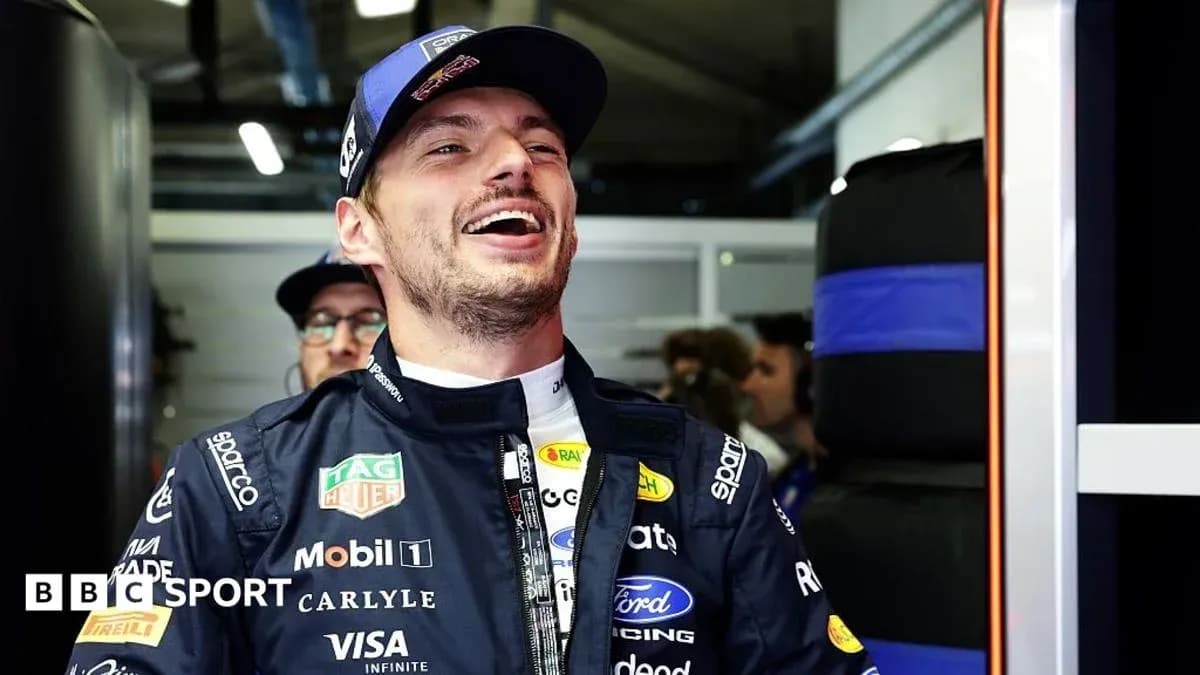
Max Verstappen sits down, feels the stale heat in Red Bull’s Monza hospitality, and immediately reaches for the fan.
“It’s too hot in here,” he says, nudging it towards us.
The air is heavy, the room uncomfortable, and it fits the mood. Verstappen is in no mood for pleasantries. Not this season. Not with this car. Not with these rules.
He’s always been direct. Here, on the eve of the Italian Grand Prix, he is ruthless.
A champion stuck in the wrong fight
Verstappen’s new two-year extension with Red Bull, signed just before Zandvoort, should have been a statement of long-term certainty. On paper, it keeps him at the team until the end of 2030. In reality, the familiar performance clauses still sit there like a quiet escape hatch.
He’s earning more. He’s committed on paper. But if Red Bull cannot drag themselves back into a title fight, the door to “pastures new” remains ajar.
Where is his head, then, in a season where he is not the man to beat?
“Of course it’s not where I want to be,” he says. “We are not in a title fight. We are just trying to find more performance.”
The verdict on the RB? Brutal.
“Overall we’re just lacking a bit of performance. The car is not where I want it to be feeling-wise, and the through-corner balance is too hit and miss between entry, mid and exit.
“It’s just fundamentally something in the car that we need to try and work on for the next year.”
This is not a one-off complaint. The balance issues, the inconsistency, the sense that Red Bull have lost their way a touch under this ruleset — it’s been bubbling for a while.
“That’s exactly that,” he says. “There’s also things that we talk about within the team, like how can that happen, how can we fix it? Some people have left, new people have come in. With the new people, we are discussing what we can do about it. Is that just some changes, a different philosophy? All these kind of things.”
He knows this season is a write-off in championship terms. The car won’t be transformed overnight. This is about harvesting data, swallowing frustration, and betting on 2025.
“Changes need to happen to the car for next year. We will not be able to change that for this year, but we just need to try and get a lot of learnings to do better next year.”
Why stay?
Given all that, his decision to re-sign with Red Bull looks, from the outside, like a leap of faith.
He doesn’t see it that way.
“It comes down to also feeling well within a team. This is like a second family to me,” he says. “The belief that you can turn things around, you can build towards hopefully a better future with other people, new people.
“I feel good here. So this, for me, is the right place to be.”
He insists Red Bull didn’t have to sell him a grand vision.
“I always said to them: ‘Don’t stress about it, just work on the car.’ Because the faster the car goes, the easier the decision is anyway.”
They knew he was talking to others. He admits as much.
Mercedes last year. McLaren this year. Serious conversations, not just polite paddock gossip.
“Of course, any kind of chat you take seriously. They’re all very respectful chats. There’s nothing wrong with that.
“I felt that staying was, for me, the right choice. You have to follow your heart.”
He could have walked away earlier in his Red Bull career, when the team lagged behind Mercedes.
“If you have a little bit of patience, you do end up winning. I feel like that’s my approach now as well.”
The easy route, he says, would be to chase the fastest car and collect more titles somewhere else.
“It’s easy to run to the fastest car and then do it all again. But it’s not how I am. You cannot be the captain of the ship and as soon as there is something not working, you jump off the ship.
“It’s been a bit downwards from the dominant years, but I don’t mind also rebuilding it. It’s another challenge as well.”
The pure racer at the Nordschleife
Ask him for the highlight of his year and he doesn’t pick a grand prix. He goes straight to the Nurburgring 24 Hours.
“Probably the Nordschleife,” he says, and his voice lifts. “It was super-cool to be able to do an endurance event with my team-mates, the guys that won with the car throughout the main season.
“We knew that we were going to be really strong. We peaked at the right time, but unfortunately the car retired. It was an incredible experience. And pure. Pure motorsport.”
His first stint, charging from 10th to the lead in treacherous, drizzly conditions, lit up the race.
“I was enjoying it. Not easy conditions. It started to drizzle. The track was slippery. Crashes. Code 60s.
“Some people were like: ‘Let’s see how he will do in the race under pressure with all these kinds of scenarios that he has never done before.’
“But I have done them a million times on the simulator. I have done so many laps and 24-hour races on the simulator. I never felt out of depth or whatever. I was fully zoned in. I just had a great time.
“Once I was in the race, you switch to another level. I was just in a zone. It’s really enjoyable.”
He wants to go back and win it. And not just that.
“All the endurance races. Eventually, of course also Hypercar. I don’t want to rush it. I want to do it in the right environment. On my terms. And competitive.”
Le Mans with Fernando Alonso? The rumour is real.
“We’ve talked about it,” Verstappen says. “I mean, look at Fernando. He’s 45 and he’s still flying. Especially for Le Mans, with his experience, it could be a good option.
“It needs to fit our schedules. It needs to make sense. It needs to be on my terms. And there needs to be a real chance to go there and win it.”
“So unnatural”: Verstappen vs F1’s hybrid era
For all his love of competition, Verstappen’s relationship with modern Formula 1 machinery is strained. He has been open all year about his dislike of the current and future engine rules.
At Suzuka, he even asked himself out loud: “Is it worth it?”
What kept him from walking away?
“Hoping that it will be better in the future. Accepting where we are at the moment. Still the love for the sport. Not at the moment the driving. But the love for the sport.
“I love competition, naturally. I just hope that in the coming years, towards 2030, it can only get better. And to start to make the best of it, because these are the rules for the next four or five years.”
He wants fans to understand why so many drivers have bristled at the current hybrid emphasis and the constant need to manage energy.
“In the history of the sport, normally the driver that is the most committed, the latest on the brakes, earlier on throttle, committing in the high speed, they get rewarded, because you just gain that time in the corner.
“But now you’re constantly thinking about, ‘In this corner I might have to hold in a bit. Go later on throttle. Or brake earlier. Or lift off. And then I have more top speed.’ Stuff like that. It’s so unnatural. It’s so not how it should be.”
Then comes the line that will sting inside the paddock.
“No disrespect. And I hope no-one picks up on this. But look at Yuki. He jumps in the Racing Bulls car at the Dutch Grand Prix. Never driven the car before. Immediately competitive.
“Liam jumps from the Racing Bulls to the Red Bull – immediately competitive. It’s because these cars are numb to your driver inputs.
“Of course, yes, you still have to do a good lap. And you still have to commit. The fastest drivers will always come out on top. But it’s really, really limited, like a choke hold or something. You’re held back.”
F1 has already accepted it needs to rebalance the internal combustion engine and electrical power. The split is due to move to 60-40 in favour of the engine by 2028.
Verstappen wants more. Much more.
“It has to go back to a V8, just for drivability already. When you drive the old cars, you cannot imagine the difference in how the engine responds, or the drivability you get. And how terrible or horrible it actually is now compared to just having a V8.”
Even last year’s turbo-hybrids, the best of the current breed, don’t come close for him.
“Also horrible, the feeling compared to a V8. The V8 is so much better. It is so much more free, lighter. Cars are so heavy nowadays.
“It is better to just have a smaller V8 engine, much lighter. Try to really limit the battery size to maybe like a kind of push-to-pass battery. But you should not have it involved or any kind of proper normal performance running.”
And yes, in an ideal world, he would ditch the turbo altogether.
“Ideally not, because that introduces turbo lag.”
So what keeps him here, in a formula that, mechanically at least, he so clearly dislikes?
“I have been lucky that the years before have been quite decent. Not how I wanted it to be with the battery side of things.
“But just the emotion of the V8, of the V10, back in the day, when I was a kid. You walk around, you hear these cars go out, you have goosebumps.
“Even if you go 300km/h compared to now sometimes 350, 360, it doesn’t matter.
“It is the emotion of the noise that you get from these cars, of the vibration. It is just another level. And I really hope that that thing will come back.”
The “winning machine” who won’t play politics
From the outside, Verstappen can look like an emotionless points-collecting device. Inside, the picture is very different.
“I am a winning machine when I need to be,” he says. “But I can also switch off, and enjoy my life outside of racing.”
Inside a team, he is relentless.
“Anything racing-related, of course I am a winning machine. I demand a lot from the people in the team. They also expect me to perform and do the best job I can.
“That is what you get paid for at the end of the day. We have the same target. The same goal.”
He knows he can sound harsh. He has no intention of changing.
“Of course I can be very outspoken. But that is what I like. That is also with our culture.
“And that is how I approach my life also outside of F1, with my GT3 team. We do not hold back. At least for me, you need to be like that to really get the best out of everyone.”
Why is that honesty non-negotiable?
“I just want to be myself. I know there are a lot of politics in Formula 1, and I understand also between the teams there are a lot of politics.
“You will always speak for yourself in terms of where you think you might have an advantage or not as a team. That is normal. Also with the engines and the chassis, it is the same thing.
“When it is good, it is good. When it is bad, it is bad. You will hear it from me because that is how I like to operate. And I am not holding back from that.”
So he stays. With a car he doesn’t like, in an era he doesn’t believe in, at a team he still calls family. Waiting for Red Bull to rebuild, for the rules to shift, for F1 to rediscover the raw edge he fell in love with as a boy standing by the fence, listening to V10s.
He’s not here for comfort. He’s here for the fight – and for the chance that, by 2030, the sport finally sounds and feels like racing again.