The Challenge of the Singapore Grand Prix: A Year-Round Race
By 1am on Monday, the Padang falls silent. The final guitar riff has died, the last burst of fireworks has drifted into the humid night, and the scream of Formula 1 engines is already a memory.
On the Marina Bay Street Circuit, the real sprint is only just starting.
The Four-And-A-Half-Hour Race
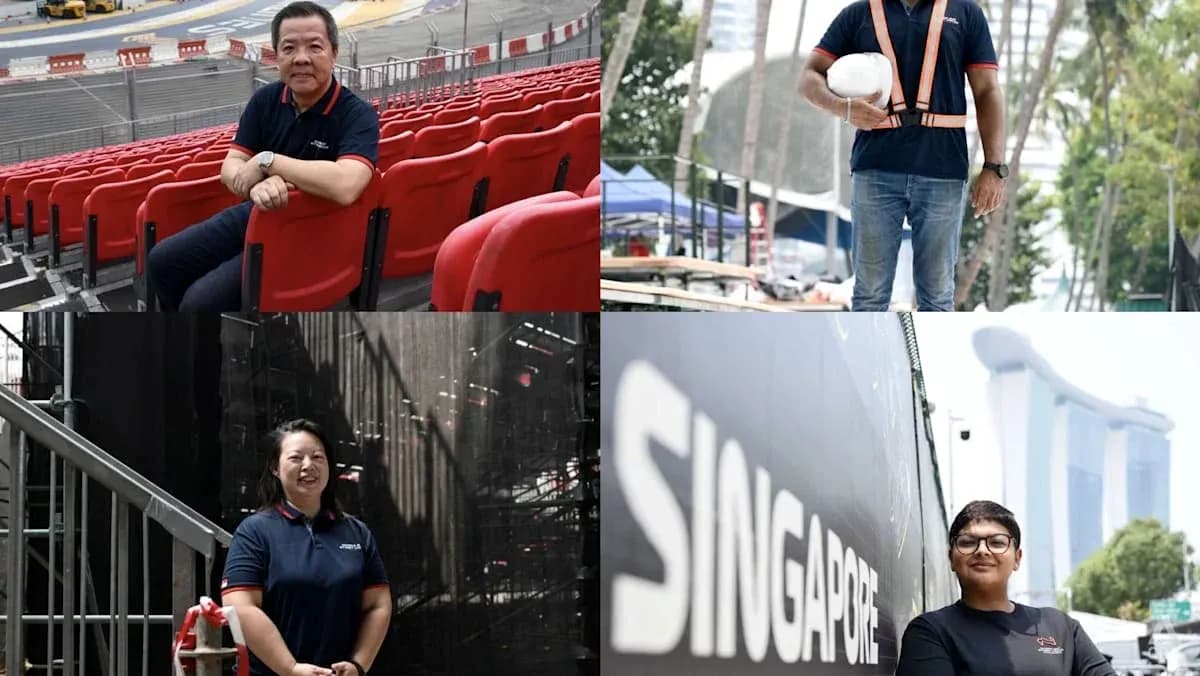
Senior manager Shiv Raj Panday and his technical crew have four and a half hours to do what seems impossible: peel back a world-class street circuit and hand it back to the city before dawn.
By 5.30am, the same lanes where cars blasted past at over 300 km/h must be ready for buses, taxis and sleepy commuters. Esplanade Drive, Connaught Drive, the arteries of downtown traffic – all open, all safe.
This has been the ritual since 2008, the year Singapore lit up Formula 1 with its first night race. The only pause came in 2020 and 2021, when the COVID-19 pandemic forced the lights to go out.
For everyone else, the Singapore Grand Prix is three nights of noise, neon and champagne. For Singapore GP, the race promoter, it is 362 other days of grind.
A Three-Day Show, A 365-Day Job
Inside Singapore GP’s offices, the season never really ends. A staff of about 70 full-timers rolls straight from one edition into the next.
Raj’s technical team spends months on feasibility studies and planning before a single barrier goes up.
“We will take at least about two, three months to plan, before commencing set-up and build of the circuit,” he said.
Space is tight in Marina Bay. Every year, his department puzzles over the same question: how to squeeze more into the same footprint without compromising safety or the fan experience. Raj knows the terrain well – he spent more than a decade working for one of the race’s contractors from 2010 to 2023 before joining Singapore GP.
This year’s race, from Oct 9 to Oct 11, is the latest it has ever been held in the calendar. The current contract, renewed for a fourth time in January 2022, keeps Singapore on the Formula 1 calendar through to 2028. That long runway brings security, but not comfort. The bar only goes up.
Ticketing: The “Endless” Puzzle
Ask ticketing and accreditation director Clarence Lai how long it takes to prepare for the race, and he doesn’t bother with numbers.
“Enormous,” he calls it.
Most people see a three-day event. His team sees a loop that never stops. “Super early bird” sales for one year launch in race week of the year before, then roll into regular sales, last-minute buyers, accreditation for vendors and contractors – and then, just as the chequered flag falls, the cycle restarts.
Lai, who first worked as assistant director from 2011 to 2013 before returning as director in 2022, oversees everything related to access. His department calculates seating capacity, decides whether new grandstands are needed, and reviews how fans move, sit and spend across the park.
Last year, Singapore GP pushed mobile ticketing. It was not a gimmick; it was protection. Before that, duplicate PDF tickets hawked by third-party sellers posed a real risk.
Mobile passes have helped choke off scams. The job now is to keep refining the system while the physical infrastructure beneath it shifts every year.
Selling the Same Race, Differently
For senior director for marketing and partnerships Sasha Rafi, the race weekend is the loudest part of the job, but not the most important.
Right after each edition ends, her team sits down to dissect it: what landed, what missed, what needs to change. Marketing, sustainability, stakeholder engagement with government and private sector partners – nothing escapes the post-mortem.
“Even before the race takes place, we are already planning for next year,” said Sasha, one of Singapore GP’s earliest hires back in October 2007.
Her brief is simple to state and hard to execute: make the same race feel new every year.
That means scanning what’s happening in tech and entertainment, tracking what people are willing to spend on, and keeping a close eye on global events. Wars, economic shocks, regional instability – any of it can hit demand for a discretionary, international event like Formula 1.
One of this year’s big plays is built around a format change on track. Singapore hosts one of six sprint races on the F1 calendar, with sprint qualifying on Friday and the sprint itself on Saturday. The sprint is short and sharp – 100 km, roughly a third of a full race, about 30 minutes, no pit stops.
Singapore GP has created a new two-day sprint bundle to tap that.
“We have looked at bundling and packages of different kinds over the years,” said Sasha. This time, the team is breaking from its usual three-day or single-day offers to court fans who don’t want the full weekend but don’t want to miss the sprint either.
She also confirmed that super early bird tickets for the 2027 race will go on sale this year. The long game never stops.
Building and Unbuilding a City Circuit
The Marina Bay Street Circuit is a living thing. Parts of it start to appear one and a half months before the race: grandstands rising over familiar roads, fencing closing off everyday shortcuts, bridges and platforms taking shape in the shadow of office towers.
That’s when the headaches begin.
Even if a grandstand returns to the same location year after year, the rebuilt structure can throw up surprises. Rows might be missing. Layouts might shift. Dimensions might not match last year’s drawings.
Lai’s team walks every stand, checking for missing seats, wrong labels, damaged chairs battered by wind and rain. In a permanent stadium, the bowl is fixed. In Marina Bay, everything is temporary, exposed and vulnerable.
On the ground, Raj fights the clock and the city’s daily routines.
Sometimes, key stakeholders still need the space he wants to occupy. Corporate events, public functions, traffic flows – his team must thread their work through these constraints, negotiating the earliest possible handover times.
Connaught Grandstand is a prime example. Perched at the end of Esplanade Bridge, it sits along a live road. On race week, Raj’s crew closes the road in the early hours of Wednesday morning, races to build as much as they can, then clears out before the morning rush.
The same choreography plays out in reverse on Sunday night. As the last fans drift away, the priority is to reopen key stretches of track as public roads. Esplanade Drive has to be ready for 5.30am. No excuses.
Training a Small Army
Operations director Melissa Phua has been with Singapore GP since 2008. Her remit extends beyond fences and barriers to people – thousands of them.
A big part of her year is spent in classrooms and training grounds with students from the Institute of Technical Education and Republic Polytechnic. Close to 1,000 of them fan out across the circuit park each year as grandstand and gate officials, or as staff looking after the general welfare of patrons.
They are the ones who answer questions, direct traffic, calm tempers and deal with the unexpected.
Phua’s team also designs the safety plan for the human tide that surges into and out of Marina Bay each night. The key performance indicator is brutally clear: everyone must leave safely, and they must feel like they were looked after.
The toughest test comes after the nightly concerts at the Padang. Tens of thousands pour towards the MRT stations, desperate to catch the late trains home.
“So we are on the ground, making sure that all the necessary gates are open and everyone leaves according to the planned routes for effective dispersal,” she said.
Those routes are not always what spectators expect. Some are diverted away from the path they used to enter the circuit park. Frustration can flare.
“It’s about making sure that ushers are there and we are there on the ground, making sure that nobody gets yelled at or gets crushed,” Phua said. The work is unglamorous, but one mistake can undo an entire weekend.
From “Elitist” Curiosity to Global Fixture
When Sasha first started, Formula 1 in Singapore was an unknown quantity.
“When I first started, Formula 1 wasn't something that was known to most Singaporeans. It was seen in the first few years by some as an elitist sport,” she said.
The early marketing push had two fronts: explain F1 to locals and sell Singapore to international audiences.
To break the “elitist” tag, Singapore GP broadened its product range. It built offerings for hardcore sports fans, corporate visitors networking in hospitality suites, and locals who cared more about the entertainment line-up than the grid.
“We were the first circuit in Formula 1 to actually inject entertainment into the racing experience that you get over the weekend,” Sasha said.
That formula has since been copied around the world, but Marina Bay’s mix of cityscape, night racing and big-stage acts remains distinctive.
The challenge has evolved. The race is now firmly established, but the calendar has swelled to 24 Grands Prix. Singapore is no longer selling the idea of F1; it is fighting to stay the destination of choice for repeat visitors.
The city itself keeps changing too. In 2023, the track layout shifted behind the Floating Platform, as one of F1’s largest grandstands made way for the development of NS Square. The team had to adapt sightlines, capacity and the on-site experience.
Chasing Lost Seats, Protecting Views
For Lai, every change in track or infrastructure triggers a cascade of ticketing decisions.
The removal of the Bay Grandstand has left a hole that has yet to be fully filled. His team has spent years trying to claw back those lost seats, searching for ways to maximise capacity without compromising vantage points.
This year, the grandstand at Turn 2 – just after the cars blast out of the pit straight – will be merged from two structures into one larger stand. Additional viewing platforms will sit alongside it, designed to squeeze more fans into prime viewing positions.
Unlike a fixed venue such as the National Stadium, there is no permanent seating bowl to rely on. Everything must be designed, built, checked and then torn down again. Every year.
“It's unlike a fixed venue, let's say, the National Stadium. The seats are always there, so most of the time you won't go wrong, it will not disappear,” Lai said.
In Marina Bay, anything can disappear. Or move. Or shrink.
A City Made Strange
When the barriers go up and the roads close, downtown Singapore becomes unfamiliar even to those who work there.
“Even for ourselves, when we close up the track, it can be unfamiliar at times as the path isn't as straightforward,” Phua admitted.
The circuit park twists and redirects the natural flow of the city. Locals have to re-learn their routes. Foreigners, arriving with no mental map at all, lean heavily on signage and staff.
On race weekend, the area may look like a festival ground. Underneath, it is a carefully engineered maze, designed to keep people moving and safe.
Phua remembers 2022, when heavy rain delayed the start of the race by an hour. Plans had to flex. Crowds had to be held, informed, reassured. Every delay rippled through transport timings and staffing.
It was a reminder that for all the precision and planning, nature still has a say.
The Long Game to 2028
By dawn on Monday, the first phase of the teardown is done. The city wakes, the traffic flows, and the circuit recedes into the background.
Inside Singapore GP, the clock has already reset.
There are tickets to sell for 2027, a sprint format to leverage, a changing skyline to navigate, and a global audience to convince that, out of 24 races, this is still the one worth crossing continents for.
The engines may only scream for three nights a year in Marina Bay. The race to keep Singapore relevant runs all year, and there is no chequered flag in sight.