Monza: The Heartbeat of Formula 1
On a late summer day in 1950, Formula 1 crowned its first world champion at Monza. Giuseppe Farina, in the mighty Alfa Romeo, won the Italian Grand Prix and with it the inaugural drivers’ title. An Italian, in an Italian car, sealing the championship on Italian soil. No-one else has ever repeated that particular feat. Monza started as a dreamland for the home hero.
Three years later, the grid told a story of what the sport would become. Giuseppe Farina, now in Ferrari red and closest to the camera. Juan Manuel Fangio in a Maserati. Alberto Ascari on the far side, another Ferrari. Between them, they would carve up the first eight world championships. Fangio took the 1953 race. Ascari walked away with that year’s crown. The names on the timing sheets were the same; the balance of power shifted with every season.
By 1956, the track’s notorious banking framed the drama. Fangio, Stirling Moss and Peter Collins thundered around the steep concrete, cars dancing on the edge of control. Moss, in a Maserati, won the race, but the story lay in the scarlet cars behind. Collins handed his Ferrari to Fangio mid-race, sacrificing his own chances so the Argentine could bank crucial points. They shared second place. Fangio secured his fourth world title. Loyalty, calculation and cold ambition, all played out at 200mph.
Monza has never just been about speed. It has also been about loss. In 1961, Ferrari’s Wolfgang von Trips arrived on the brink of becoming world champion. Two laps into the race, he collided with Jim Clark’s Lotus. Von Trips’ Ferrari flew into a packed embankment, killing the German and 14 spectators. The photograph of him before the start captures a man seemingly on the verge of history. By the end of the afternoon, the story had turned into one of the sport’s darkest days.
Away from the chaos on track, Monza has long been a family stage. In 1967, Graham Hill sat in the Lotus pit, calmly adjusting his helmet and visor. Around him, his family gathered: wife Bette and their children, including a six-year-old Damon Hill standing at the front. One world champion preparing for another race, the next one unknowingly watching on. The circuit doesn’t just shape careers; it shapes generations.
Before the chicanes arrived, Monza was a slipstreaming lottery. In 1969, Jackie Stewart in a Matra hurled himself out of the final corner and won a drag race to the line. Jochen Rindt’s Lotus, Jean‑Pierre Beltoise’s Matra and Bruce McLaren, in his own car, all flashed across almost together. Less than two tenths of a second covered the top four. It was pure Monza: no margin, no safety net, just a blur of colour and noise.
One year later, the noise fell silent. Nina Rindt sat in the pits in 1970, stopwatch in hand, timing her husband Jochen during practice. Shortly afterwards, on the approach to Parabolica, a likely suspension failure on his Lotus sent him into a fatal crash. Weeks later, Rindt became Formula 1’s only posthumous world champion. Monza had given him some of his greatest drives. It also took him away.
The finishes stayed wild. In 1971, Peter Gethin in a BRM edged a five‑car sprint to the flag. Ronnie Peterson’s Lotus, Francois Cevert’s Tyrrell, Mike Hailwood’s Surtees and Howden Ganley in another BRM all chased him home. Six tenths of a second covered the first five. It was the kind of result that reads like a misprint, but at Monza it made perfect sense.
Not every race here is about horsepower. In 1973, team owner Frank Williams organised a fun run around the circuit for drivers and team members. James Hunt led the pack visually, bare-chested and unmistakable. Williams, suited and determined, ran behind him and ended up winning the £750 prize. On a track that usually rewards engines, a future titan of team management won on foot.
By 1976, Monza was the backdrop for one of the bravest returns the sport has seen. Niki Lauda arrived with the scars of his near-fatal Nurburgring fire still fresh and visible. Just six weeks after the accident, still in severe pain, the Ferrari driver climbed back into the car to keep his title fight with James Hunt alive. Lauda finished fourth that day, extending his lead. Hunt would eventually snatch the championship by a single point, but Lauda’s drive at Monza became a defining image of his career: damaged, defiant, unbroken.
Two years on, tragedy struck again. At the start of the 1978 Italian Grand Prix, a multi-car accident erupted behind the leaders. Ronnie Peterson’s Lotus was left wrecked, the Swede trapped with serious leg injuries. Fellow drivers pulled him from the car. The injuries did not look life-threatening. Yet delays in treatment proved fatal; Peterson died from an embolism the next morning. His team-mate Mario Andretti clinched the world title that same day. Later, Andretti captured the brutal contradiction of the sport in one line: “Unfortunately, motor racing is also this.”
Monza can also flip a season on its head in a heartbeat. In 1988, McLaren had dominated the year, winning every race up to Italy. They were on course for another until Jean‑Louis Schlesser, standing in for Nigel Mansell at Williams, tangled with Ayrton Senna as the Brazilian tried to lap him with two laps to go. Senna spun out. The door swung open for Ferrari. Gerhard Berger led Michele Alboreto home for an emotional one‑two. The tifosi erupted, a red sea in the grandstands. The win came just weeks after the death of team founder Enzo Ferrari, turning joy into something deeper, almost devotional.
The same chicane wrote another chapter in 1993. Senna again, this time in a McLaren, collided at the start with a Williams driven by Damon Hill. Both cars survived. Hill regrouped, picked off the opposition and won the race. The corner that had cost Senna so dearly in ’88 and bruised him again in ’93 became a symbol of how thin the line is between disaster and recovery.
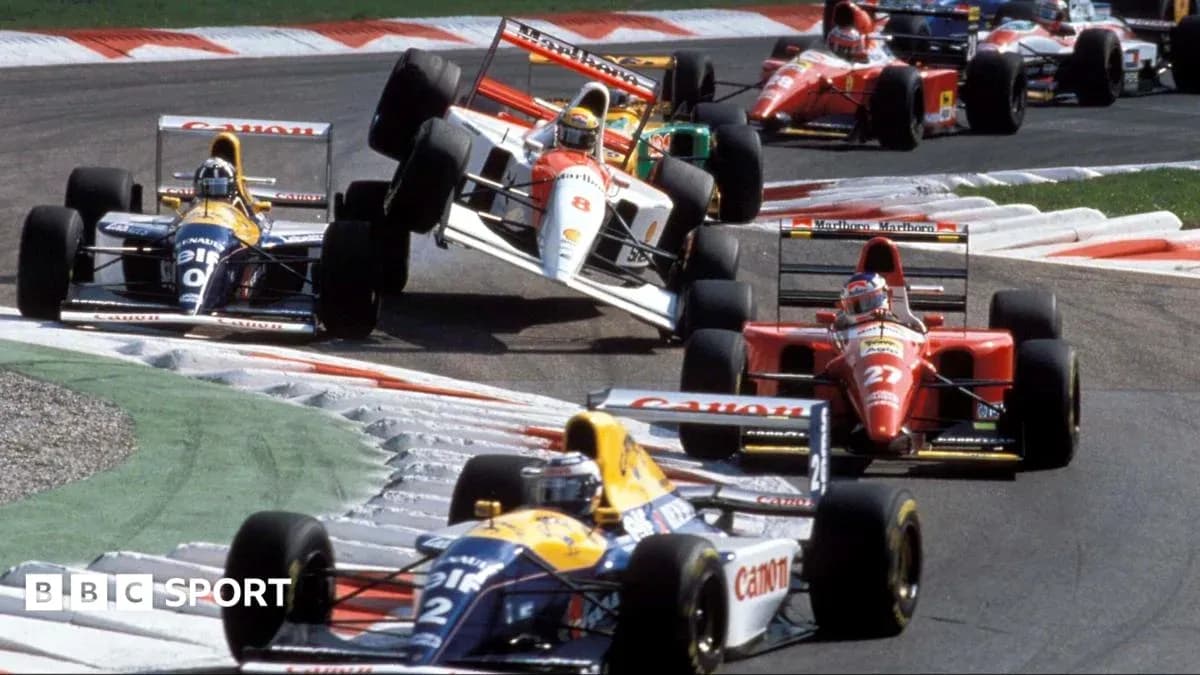
Even the midfield has its own Monza folklore. Late in the 1993 race, Christian Fittipaldi’s Minardi clipped his team-mate Pierluigi Martini as they charged to the finish. Fittipaldi’s car somersaulted through the air, upside down, before crashing back onto its wheels and sliding across the line on momentum alone. Both drivers walked away. Fittipaldi still took eighth place, one spot behind Martini, in one of the most surreal finishes the circuit has ever seen.
For title contenders, the place gnaws at the nerves. In 1999, Mika Hakkinen spun out of the lead in his McLaren and broke down in tears, convinced he had thrown away the championship. The mistake looked monumental in the moment. The Finn recovered over the remaining races, eventually beating Ferrari’s Eddie Irvine to the title. Monza had shaken him, but it had not broken his season.
A year later, the circuit belonged to Ferrari again. Michael Schumacher won the 2000 Italian Grand Prix and the tifosi flooded the start‑finish straight in a red tide. It felt like more than a single victory. It was a critical step on his way to the first of five consecutive drivers’ titles with Ferrari, a partnership that would define an era. Monza, once more, served as a key marker on the road to dominance.
The first chicane has never lost its appetite for chaos. By 2011, with modern cars and carbon fibre, the opening lap still resembled a traffic jam at 200km/h. Drivers jostled for position, cars bounced over kerbs, several pointed in completely the wrong direction. The scene underlined a simple truth: no amount of technology can entirely tame the desperation of 24 drivers fighting for the same strip of tarmac.
In 2021, that desperation boiled over in the title fight between Max Verstappen and Lewis Hamilton. Their season bristled with flashpoints, and Monza delivered one of the most dramatic. At the first chicane, the two collided as they battled for position. Verstappen’s Red Bull was launched up and onto Hamilton’s Mercedes, the rear of the car landing on the Briton’s cockpit. The halo device, once controversial, showed its worth in stark, brutal clarity. It likely prevented a serious injury, perhaps worse.
From Farina’s first crown to Verstappen and Hamilton’s airborne clash, Monza has traced the full arc of Formula 1: glory and grief, inches and eras, noise and silence. The old banking still stands, crumbling and unused, a concrete monument to a time when bravery bordered on madness. The modern cars still scream past it every September, chasing tenths and titles on a circuit that never forgets.