McLaren Unveils H-Wing for Italian Grand Prix at Monza
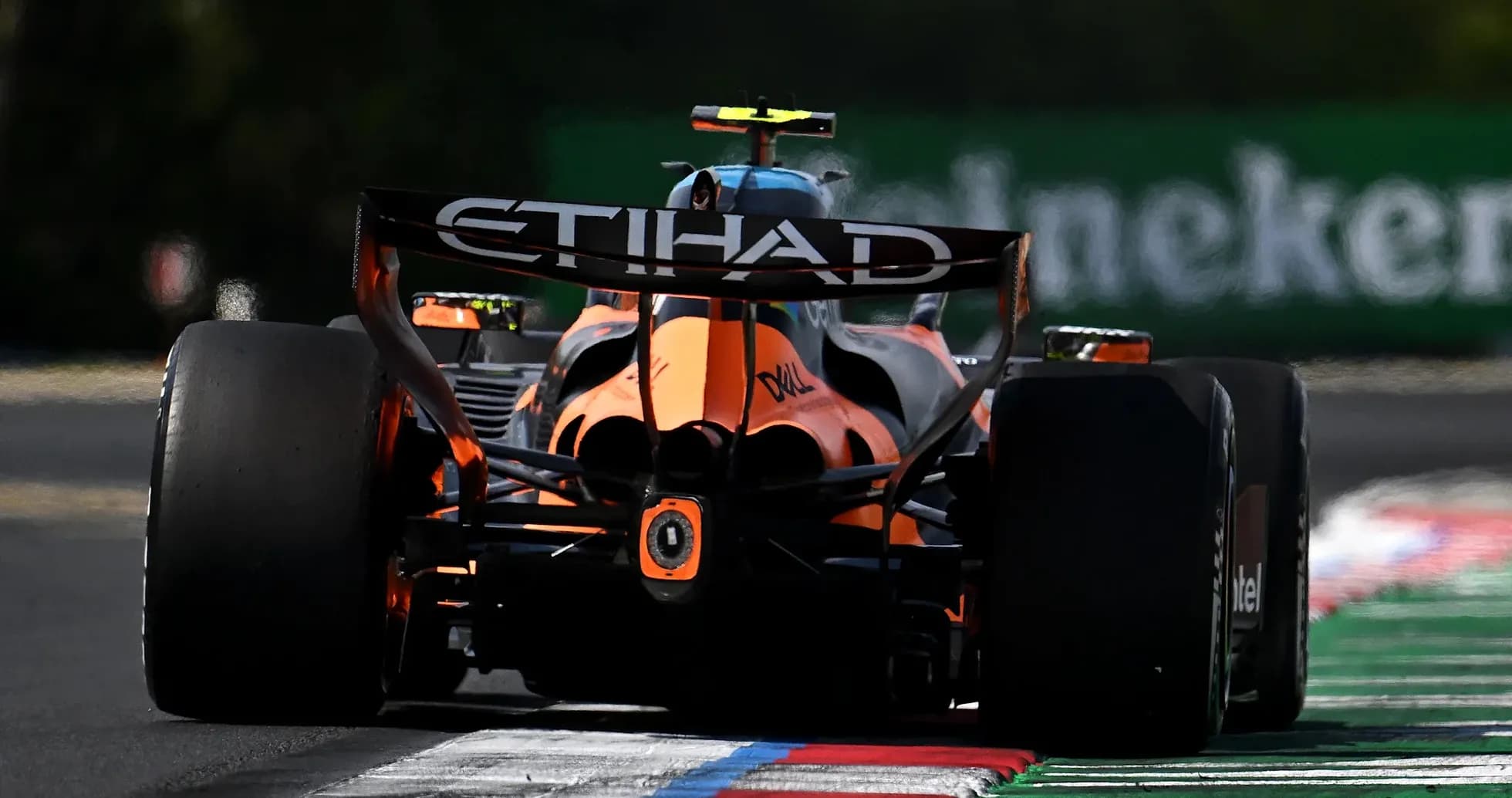
McLaren arrive at Monza with momentum, confidence – and a very visible statement of intent bolted to the back of the MCL40.
The team have confirmed they will roll out a fresh low-drag rear wing package for the Italian Grand Prix, headlined by the first race weekend appearance of their much-talked-about ‘H-Wing’ concept. It’s the latest twist in this season’s rear-wing innovation race, and it lands at the circuit where straight-line speed matters more than almost anywhere else on the calendar.
A nod to the past on a car built for the present
The name is no marketing accident. McLaren have deliberately tied the ‘H-Wing’ to one of their most infamous technical breakthroughs: the 2010 F-duct.
Back then, the F-duct system helped redefine how teams managed drag and top speed, its name taken from the ‘F’ in the sponsor branding beside the inlet on the chassis. The new device follows the same logic.
“The H-Wing’s naming convention pays homage to McLaren’s innovative F-duct, which debuted in 2010 and took its name from the ‘F’ in the branding positioned alongside the system’s inlet on the car,” the team explained in their event preview.
“In the same spirit, the H-Wing is named after the ‘H’ in Etihad Airways branding displayed on the rear wing as part of the team’s partnership with the airline.”
The wing itself is part of a wider low-drag configuration tailored to Monza’s long straights and heavy braking zones. McLaren have already flirted with rotating rear-wing concepts, trialling a design in Free Practice 1 in Hungary, after Ferrari first unleashed their so-called ‘flip-flop’ rear wing in pre-season and Red Bull responded with their own version at Round 4 in Miami. Now, McLaren are ready to commit to running their interpretation across the Italian Grand Prix weekend.
Low drag, high stakes
Technical Director of Applied Engineering, Neil Houldey, spelt out the scale of the challenge that Monza presents – and why this particular package matters.
“Monza presents a unique challenge, with its long straights placing a premium on drag reduction, while the heavy braking zones demand stability and the chicanes require good ride performance,” he said.
That trade-off defines the weekend. Strip off too much wing and the car flies down the straights but becomes skittish under braking and over the kerbs. Add too much downforce and you’re a sitting duck on the main straight. McLaren’s new low-drag rear wing specification, with the H-Wing as its headline feature, is designed to walk that tightrope.
Houldey also highlighted a factor that often goes unseen from the grandstands: energy management.
“Energy will also be limited around the lap, so understanding the best way to recharge and deploy it will be an important focus during practice. Managing overtakes will therefore be particularly important, as different approaches to harvesting and deploying energy could create a yo-yo effect, with cars trading an advantage at different points around the lap.”
In other words, this isn’t just about raw top speed. It’s about where and when that speed arrives. A car that harvests aggressively early in the lap might be vulnerable at one straight but lethal on the next. Teams will be juggling battery levels, drag reduction, and track position in a constant tactical calculation.
Fine margins at the front
McLaren head into Italy after a strong run of form, but Houldey is under no illusions about how narrow the window for success is at the sharp end of the grid.
“That said, the margins at the front remain extremely tight, so the accuracy of our pre-event simulation and simulator work will be critical in giving us a strong baseline,” he noted. “From there, we need clean practice sessions to refine the car and maximise the car-and-driver combination.”
Clean Fridays matter here. With a new rear-wing spec, minor aerodynamic tweaks, and what the team describe as “previously declared parts that are specific for such a unique track layout”, every lap of practice becomes a data-gathering mission. Any disruption – red flags, weather, traffic – can leave a team chasing balance into qualifying.
“This weekend, we have brought what we believe is needed to be competitive, including a new low-drag rear wing specification, including the first use of our H-Wing, alongside some small aerodynamic and low-drag options that we will evaluate before deciding the final specification for Qualifying,” Houldey said.
So the final configuration is not locked in. McLaren will treat the early sessions as a live experiment, cycling through options, trimming drag here, adding stability there, until the stopwatch points them in one clear direction.
More to come from the MCL40
For all the attention on the H-Wing, McLaren insist this is just one step in a longer development path.
“Overall, we know there is still more performance to unlock from the MCL40, both through maximising the package we already have and through further upgrades planned for the races ahead,” Houldey added.
That line tells its own story. McLaren see Monza not just as a one-off low-drag test, but as another checkpoint in a season-long push to squeeze every last tenth out of a car that has already dragged them into regular contention at the front.
The question now is simple: at a circuit that exposes any weakness in power, drag, and efficiency, will the H-Wing turn McLaren’s recent form into something even more formidable – or simply set the stage for the next upgrade waiting in the wings?