Madrid Welcomes Formula 1: Royal Family's Historic Appearance
The engines weren’t the only thing drawing the crowds at Madring. As Formula 1 roared back into Madrid for the first time in 45 years, the spotlight briefly shifted from the pit wall to the royal box – and then straight down to the paddock.
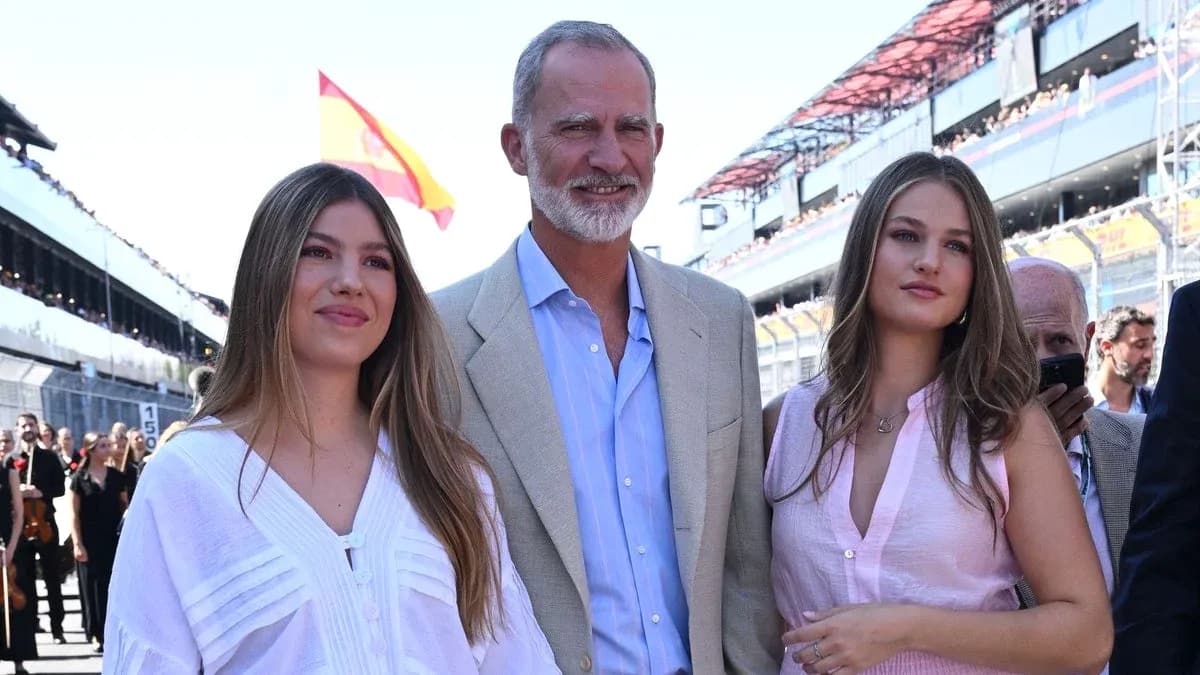
King Felipe arrived at the new semi-street circuit flanked by Princess Leonor and Infanta Sofía, turning a landmark sporting weekend into a defining public moment for his daughters. Fresh from attending the funeral of Norway’s King Harald V, Felipe swapped black tie for paddock passes and sunglasses, bringing his long-declared love of motorsport to one of the season’s most anticipated races.
This was no casual drop-in. For Leonor, 20, and Sofía, 19, it was their first official appearance at a Formula 1 Grand Prix – and it came on the very day the championship finally returned to the Spanish capital.
A First Official Lap of the Paddock
The royal trio’s entrance set the tone. Felipe, in a beige jacket over a light-blue open-collar shirt, navy trousers and dark sunglasses, cut the figure of a head of state entirely at ease in the noise and chaos of race day. Queen Letizia stayed away from the circuit, leaving the King and his daughters to share a rare, relaxed public outing on their own.
Leonor and Sofía stepped into the paddock with the kind of polished ease that suggested this debut had been carefully prepared but not over-rehearsed. The sisters posed alongside Fernando Alonso and Madrid’s own Carlos Sainz, two standard-bearers of Spanish motorsport whose presence underlined the significance of the day for the country’s sporting identity.
The symbolism was hard to miss: Spain’s present and future on the grid, flanked by the nation’s future queen and her sister at a newly built circuit designed to anchor Formula 1 in Madrid for years to come.
Inside the Garage: A Close-Up With the Safety Car
The most revealing images of the visit came away from the cameras’ main glare. Guided by circuit officials, Felipe, Leonor and Sofía stepped into the garage for a detailed look at the Formula 1 Safety Car, the Mercedes-AMG that quietly underpins every Grand Prix.
They leaned in, examined the car, listened. The briefing covered technology, performance and the meticulous preparation required for one of the most crucial vehicles on the track. No helmets, no grid drama, just three members of the Royal Family concentrating on the technical heart of the sport.
Between explanations, the dynamic was clear. Felipe stayed close to his daughters, pointing out details, sharing observations. Leonor and Sofía responded with easy conversation and quick smiles, the three of them tracking the on-track action and the paddock bustle together. For a family often seen in ceremonial settings, it was a notably unguarded snapshot: a king and his daughters simply enjoying a major sporting event in their own capital.
Paddock Style With a Royal Finish
The sisters’ first official F1 appearance also doubled as a quiet style statement.
Leonor chose a soft, understated look for her debut: a sleeveless dusty-pink top with a fitted smocked waist, paired with flowing high-waisted white wide-leg trousers. A matching clutch tied the outfit together, light and summery but formal enough for an institutional appearance.
Sofía went all in on white. Her long-sleeved V-neck blouse and wide-leg trousers formed a clean, monochrome line, broken only by a slim brown leather belt and a coordinating clutch that added just enough contrast. Side by side, the sisters matched the setting: modern, crisp, and unmistakably prepared for the cameras without surrendering to the theatrics of the grid.
Felipe’s relaxed tailoring did the rest. The beige jacket, open collar and sunglasses gave him a sportier edge, a deliberate step away from palace formality and into the rhythm of a race weekend.
A Confirmed Date With the Spanish Grand Prix
This was not an improvised visit. The Royal Household had trailed the appearance in advance, confirming that “Don Felipe, accompanied by the Princess of Asturias and Infanta Sofía, will attend the Formula 1 TAG Heuer … on Sunday, September 13, at the new circuit.”
A separate statement reinforced the institutional weight of the day: “His Majesty the King, accompanied by Their Royal Highnesses the Princess of Asturias and Infanta Doña Sofía, will attend the Spanish Grand Prix.”
It also marked one of the last public engagements for the sisters before they return to their academic routines. Leonor has begun a Political Science degree at Carlos III University of Madrid, taking on university life in the same city that has just welcomed back Formula 1. Sofía, meanwhile, will head back to France for her second year of college, this time at Forward College’s Paris campus.
For both, Madring was a brief pause between lectures and exams – but one loaded with symbolism and visibility.
Madring Steps Onto the World Stage
The setting itself carried heavy historical weight. The Royal Family’s presence at the newly opened Madring semi-street circuit framed a weekend that ended a 45-year wait for Formula 1’s return to Madrid.
The last time the capital staged a Grand Prix was 1981 at Jarama, a race remembered for Gilles Villeneuve’s victory and the tight, twisting track that defined an era. Madring is a different proposition: a 5.4-kilometer layout that weaves through the city and includes the much-discussed “La Monumental” turn, a corner that has already become a talking point among drivers and fans.
Spanish supporters filled the stands and lined the fences, splitting their loyalties between the enduring appeal of Fernando Alonso and the home-city pull of Carlos Sainz. For Sainz, the build-up carried a sting. He arrived at Sunday’s race on the back of a difficult qualifying session and did not hide from it, calling it “a very bad qualifying session.” The honesty matched the mood: Madrid had delivered a showpiece, but the sport’s demands remained ruthless.
A Royal Thread Through Spain’s Sporting Highs
For Leonor and Sofía, this F1 debut was not an isolated one-off. Sport has been woven into their public lives from the start, and their presence at Madring felt like a natural extension of a long-running pattern.
They have stood alongside Spanish athletes in some of the country’s defining modern sporting moments. Most recently, they celebrated Spain’s triumph in the 2026 World Cup final, joining the team’s festivities and adding royal weight to a night that already belonged to the history books.
Those joyous, spontaneous scenes sit alongside an increasingly structured institutional agenda: the traditional reception at Marivent Palace, high-profile appearances such as their meeting with Pope Leo XIV at the Royal Palace, and now official visits to major international events on home soil.
Their relationship with Spanish football stretches back to childhood. In 2010, a four-year-old Leonor and three-year-old Sofía tried to lift the World Cup trophy at Zarzuela Palace after Spain’s victory in South Africa, standing next to Iker Casillas in an image that quickly became iconic. Two years later, they reprised the scene after Spain’s Euro 2012 win, by then a little older but already familiar with the spotlight.
As teenagers, their role evolved. In 2022, they travelled to Brentford for the Women’s European Championship – their first official trip abroad without their parents – to support Spain. A year later, Sofía was on the pitch in Sydney celebrating with the national team after its historic Women’s World Cup win, again placing the Royal Family at the heart of a landmark moment for women’s sport.
Their itinerary has kept expanding. At the Paris Olympics in 2024, they could be seen backing Spanish stars such as Rafael Nadal and Carlos Alcaraz, reinforcing the message that their support is broad, not confined to a single discipline.
The commitment runs deep enough to reshape schedules. During the 2026 Princess of Girona Awards, organizers moved the ceremony to an earlier slot so that the entire Royal Family could watch Spain’s crucial match ahead of the World Cup final. Protocol gave way to football, and nobody pretended otherwise.
From stadiums and Olympic arenas to the roar and precision of the Formula 1 paddock, Leonor and Sofía have become familiar faces wherever Spain’s athletes chase history. Felipe has set the tone, attending events such as the Formula E race at Jarama in March.
At Madring, on a hot Sunday in the capital, that shared passion met a new chapter for Spanish motorsport. The circuit is built for the future. So, increasingly, are the roles of the two young women walking its paddock with royal credentials around their necks.