Lando Norris Triumphs in Challenging Interlagos Race
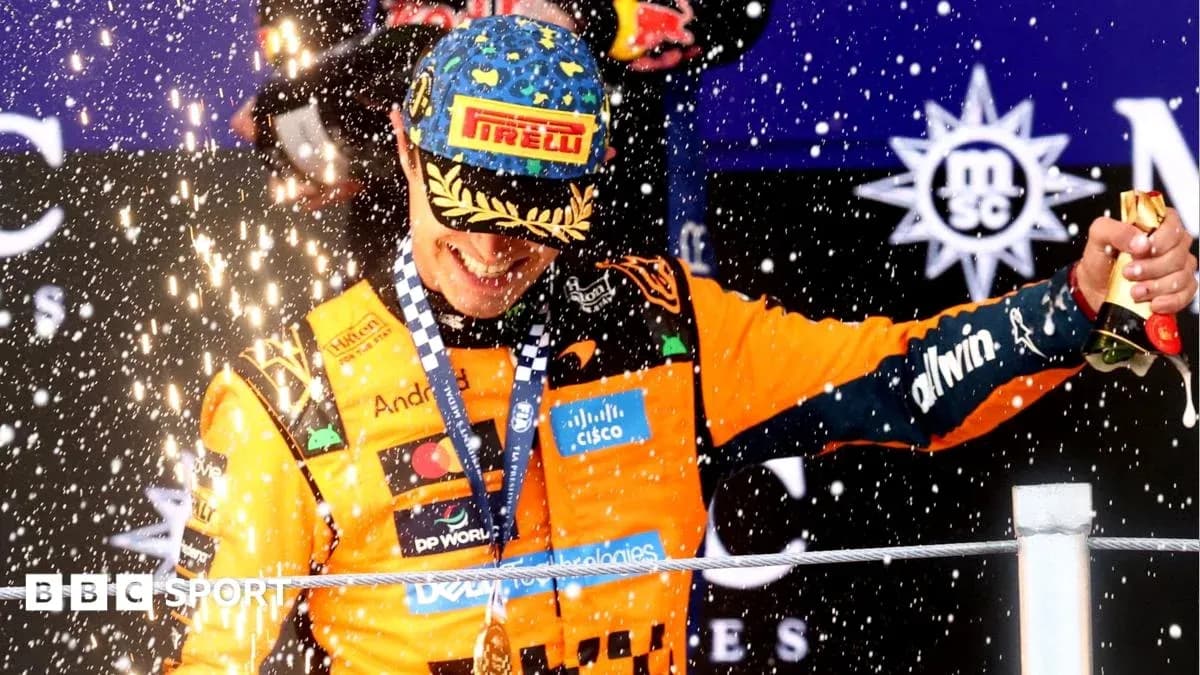
Lando Norris walked off the Interlagos podium with champagne in his hair, fireworks in his ear and a smashed bottle in his hand. It was just about the only thing he broke all afternoon.
His trademark celebration went sideways – the leap from the top step, the swing of the bottle to crack it open on the podium floor – and the glass gave way. As he lifted the jagged neck to the crowd, he backed straight into the plume of sparks from the stage pyrotechnics. Max Verstappen and Isack Hadjar showed no mercy, soaking him with their own bottles.
No harm done. Andrea Stella quickly confirmed his driver was fine, and Norris looked as sharp in the pen as he had on track. He called it “one of the hardest races of the year in terms of focus needed every lap and therefore one of the best.”
He was not exaggerating.
A race that never settled
Interlagos did what Interlagos does. A wet track at the start, a drying line that demanded judgement on every corner, then more rain late on just when everyone thought they had it figured out.
Through all of it, Norris barely put a wheel wrong. He made newly crowned world champion Kimi Antonelli look human for the first time this season, then kept Verstappen – charging from 21st on the grid – at arm’s length when the race threatened to turn into one of those familiar Red Bull rescue acts.
That Norris’ drive from pole to victory overshadowed Verstappen’s climb to second from the back says enough.
It had not started perfectly for the Briton. When the lights went out, Antonelli launched superbly from the front row and sliced past Norris into Turn One. In the early laps, the Mercedes disappeared. Within 13 tours, the Italian had built an eight‑second cushion and looked in complete control.
Then the track began to come back to Norris.
As the surface dried, McLaren rolled the dice first. Norris stopped for slicks a lap earlier than Antonelli. The undercut was brutal. A seven‑second deficit vanished in a handful of laps. With warm tyres and rising confidence, Norris latched onto the Mercedes’ gearbox and forced the issue.
Under that pressure, the new champion cracked.
Three laps after the stops, Antonelli spun at Turn One, the rear snapping without warning. Norris swept into the lead and never looked like giving it back.
“A lot was thrown at everyone on a day like today, but it was probably one of our best races in terms of execution and pit stops, timing of things,” Norris said. “We boxed one lap early on to the slicks. I came out and was right behind him and forced him to push a little bit more, and obviously he went into a mistake and I could capitalise on it.
“From my side, just not making any mistakes, which is so easy to do on a day like today. Certainly up there with one of the best I’ve ever had.”
McLaren’s reminder
For Norris and McLaren, this was more than a win. It was a statement that the early‑season stutter and recent slump had not dulled their edge.
The team had started the year on the back foot after diverting resources to secure last season’s title double, slipping behind in development on the 2026 car. By mid‑summer they had clawed their way back, Norris stringing together back‑to‑back victories either side of the summer break and coming within a breath of another in Madrid.
Then the field surged again. McLaren lost ground, particularly on Saturdays, and the narrative shifted away from Woking.
Interlagos changed that. New parts on the car, a circuit that played to the MCL’s strengths, and a driver who thrives on a greasy, knife‑edge track combined to drag Norris back to the front.
Stella did not hold back in his assessment.
“When Lando operates at his best, he’s definitely one of the best drivers on the grid,” the team principal said. Mixed conditions, he added, are where Norris often looks “one of the fastest in finding the limit.”
The evidence was everywhere on Sunday. When the track hovered between wet and dry, Norris extracted more grip than anyone. He read the available traction, adjusted to the imperfect balance, and lived on that thin line without stepping over it.
“You’re never going to have the perfect conditions,” Stella said. “So adaptability is actually probably the most important feature that you may want to possess as a driver. When there’s a need to understand what’s best, how to operate, he’s definitely a master.”
Verstappen’s charge, then a ceiling
For a while, Verstappen looked like the lurking threat that would tear up the script.
A penalty for exceeding his engine allocation dumped the four‑time champion down to 21st on the grid, four places lower than the starting slot from which he had won here in similar drizzle two years ago. Within 15 laps he was already up to fifth, less than 15 seconds behind Antonelli, just as the switch to slicks loomed with 56 laps still on the board and more rain on the radar.
At that point, it felt ominous.
But once everyone bolted on dry tyres, the Red Bull lost its bite. Verstappen could not live with Norris’ pace, even when the rain returned heavily near the finish.
“That first stint went really, really well,” Verstappen said. “We got very quickly back into the top 10, and the pace wasn’t bad.
“But as soon as I switched to the slicks, I had an extreme amount of oversteer in the car in the high‑speed corners, which made it super difficult to drive.
“So, we need to understand if something broke on the car, some kind of aero loss or whatever, because this was not normal.”
He left Brazil satisfied with second, but convinced more had been on the table with a healthy car.
“I actually did most of the race with a car that was not in good shape, and to finish second, of course, is fantastic,” he said. “Maybe next year I’d love to start a bit further up front instead of starting from the back or the pit lane.”
Antonelli’s rare mistake, Mercedes’ bigger prize
Antonelli had arrived in Brazil as the sport’s youngest ever world champion after sealing the title a week earlier in Mexico. For a time, it looked as if he would crown that achievement with a dominant win.
He controlled the early laps in the wet, then, once on slicks, began to rebuild his rhythm as tyre temperatures came up. Then came the spin that changed his afternoon and opened the door for Norris.
“Very disappointing because we were on for the win up to that point,” Antonelli admitted. “Once I was able to get some temperature, I was getting to the rhythm, but yeah, the spin came, which still is something I need to look at because I don’t know why I lost the rear so quickly as well, like no warning, nothing.”
His pain was matched in the other Mercedes.
George Russell had carved his way from seventh on the grid to third, tucking in behind Norris and looking like the one man capable of matching the McLaren on raw pace. Then he threw it away. A spin exiting the pits turned a 1.2‑second gap to Norris into a 20‑second chasm. His shot at victory vanished with a flick of opposite lock.
Even so, fourth for Russell and fifth for Antonelli were more than enough for Mercedes to clinch the constructors’ championship. Title number nine. Their first since 2021.
Antonelli quickly parked his own frustration.
“I’m going to put all this aside for now because the team, you know, take the title, we take the title for the team and they all deserve it,” he said. “I’m very proud to be part of this group and this team who has done and still does so much for me and I’m very happy for them.”
Wolff’s warning about the new era
Toto Wolff allowed himself a moment to enjoy the return to the summit, but his eyes were already on the bigger picture.
Mercedes had dominated the first half of the season. Then the field closed. Upgrades introduced in recent races did not deliver the expected step, and the team found itself in a four‑way dogfight.
“Look at the last few races,” Wolff said. “We haven’t won.
“Then today at the beginning of the race, Kimi was just storming away. It looked like this could be ours. But the competition has been getting tougher between Ferrari, McLaren, Red Bull and ourselves.
“It’s four teams that can win races and will be challenging for a world championship. And I have no doubt that this is going to be very difficult for us next year.”
He is proud Mercedes have clawed their way back after the bruising years of the ground‑effect era, but he is not expecting another stretch of dominance to match the Lewis Hamilton years.
“Looking back, those last four years were very difficult between getting it wrong and then kind of understanding why it was wrong and then realising, no, we didn’t understand,” Wolff said. “It wasn’t that bad at all when you look at the sheer numbers, but it felt not good.
“The resilience of the team, the people that held together in those tough times is a factor. So it feels really good sealing those two titles. Not many sports teams have done that after consecutive run of championships, then a difficult spell and then coming back.”
Then came the reality check.
“It looks like the most maybe competitive era that is about to start, because the teams have become so professional in capability, in resource, that this kind of runaway seasons, I don’t see them any more, whether it’s four in a row or eight in a row,” he said. “You can see how quickly it goes from being dominant. And within a few races, you realise that your upgrade doesn’t work and you fall back and you’re just third on the road.
“It’s great for the sport. I wished it was the era of Mercedes and me running away with another few championships. I don’t think it’s the reality.”
On a wild, wet‑dry day at Interlagos, Norris showed he is ready for that reality. The question now is whether McLaren – and everyone else – can keep finding performances like this when the margins get even thinner.