Lando Norris Claims Pole Position in Barcelona
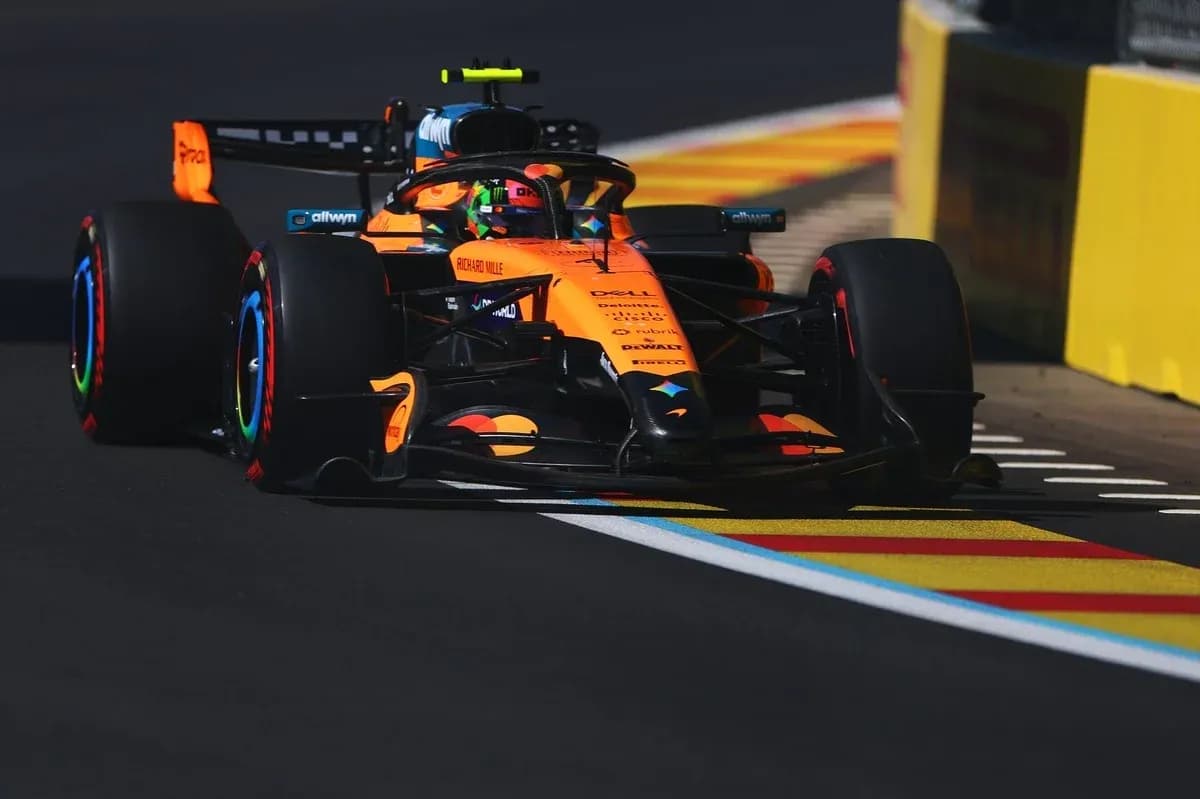
Lando Norris climbed out of the McLaren in Barcelona convinced he’d blown it.
“Sorry, I fucked up man,” he told race engineer Will Joseph over the radio, cursing himself for a wild slide at the final corner that, in his mind, had wrecked the lap.
Moments later, the timing screens told a very different story.
Pole position. By 0.011s. Torn from Kimi Antonelli’s grasp at the Spanish Grand Prix with a lap Andrea Stella would simply call “a masterpiece”.
A lap from nowhere
Nothing about McLaren’s weekend suggested this was coming.
Mercedes had owned practice, Ferrari lurking just behind. In Q1 and Q2, the Silver Arrows were trading blows with Red Bull for top spot. McLaren, painted in papaya but looking decidedly ordinary, sat a couple of tenths back, their weaknesses obvious in the opening sector’s low-speed corners and over the kerbs.
The car looked awkward. The stopwatch was unforgiving. Pole felt like someone else’s conversation.
Even in Q3, Norris didn’t immediately threaten. After the first runs, he was only sixth, 0.446s off Lewis Hamilton’s benchmark. The gap was big, the deficit familiar. Oscar Piastri, in the sister car, would eventually end up seventh, 0.470s slower than Norris. On raw pace, this was not the fastest package in Barcelona.
Then Norris lit it up.
On his second attempt he found 0.701s, a huge chunk of time at this level, and edged ahead of Antonelli by the width of a fingernail. The lap came from the outer edge of risk, where grip is a rumour and one misjudged input usually means gravel, not glory.
Norris thought he’d crossed that line.
By the time he arrived at the final corner, he admitted he “got a bit excited in the car” and over-attacked the entry. The rear stepped out, the car snapped, and for a split second he was convinced he was heading for the wall. Somehow he caught it, gathered it up, and powered to the line.
He was still furious with himself.
Joseph, though, had seen enough sector times to know this might be special. He told Norris to wait. There was a chance. Norris, still replaying that last corner in his head, called himself a “fucking idiot”.
The engineer’s verdict was cooler, and far more accurate.
“It wasn’t your best final corner, but it’s still pole, so well done,” Joseph said. It took Norris a while to accept he wasn’t the victim of an elaborate joke.
Precision on the limit
Stella has watched telemetry for 450 grands prix. That’s thousands of laps, hundreds of drivers, all manner of conditions. This one, he said, ranks among the most impressive he has ever seen.
McLaren had spent the weekend chasing balance in the first sector. The car struggled over kerbs, fought its drivers in low-speed corners, and demanded absolute commitment to extract anything close to its potential. Stringing it all together over a single lap looked like threading a needle in a storm.
On that final run, Norris threaded it.
“The lap really was just perfect,” he explained. “Good exits, good kerbs, just getting all the little things that are very important around here correct. And I did that only on my last lap and it all worked out.”
Stella went deeper. What struck him was not just the speed, but the detail.
On the telemetry, the lap stood out for its “precision”: braking points nailed to the metre, entry speeds pushed to the edge, kerbs attacked with millimetric accuracy, throttle applied with ruthless timing. Corner after corner, the car danced on the edge without overstepping it.
Until that final turn.
McLaren’s analysis showed that Norris actually lost more than three-tenths of a second in the last quarter of the lap. Strip away that mistake and it would have been a clear, commanding pole, not one snatched by 0.011s.
Stella saw cause and effect. The error wasn’t clumsiness; it was the bill arriving for everything Norris had demanded from the tyres earlier in the lap.
“He just paid the price of the fact that the lap was coming, like, one second faster than any other lap,” Stella said. The tyres were “tired”, overheated and overused by the relentless attack. Norris hurled the car into the final corner with the same ferocity he’d used elsewhere, without fully accounting for how much life the tyres had left.
The result was inevitable: oversteer at entry, the ideal line gone, time bleeding away.
And yet, the clock still stopped with his name at the top.
Attacking mode, no regrets
Stella was clear: this wasn’t some calculated gamble at the final corner. Norris didn’t know he was in trouble. He was simply in “attacking mode”, locked into the kind of lap where a driver refuses to leave anything on the table.
The risk nearly broke him. Instead, it broke the session.
From a car that had no right to be on pole based on the weekend’s form, Norris dragged a lap that stunned even those who know him best. Piastri’s seventh place and sizeable gap to his team-mate underlined just how much Norris had extracted from a tricky package.
McLaren arrived in Barcelona as outsiders in qualifying. They ended Saturday with Stella calling his driver’s work “a masterpiece”, and with a pole position earned not through dominance, but through audacity, precision and a final-corner scare that almost turned triumph into rubble.
Norris walked away knowing he hadn’t been perfect.
He didn’t need to be. On this day, at this track, with those tyres and that car, his imperfect lap was still good enough to beat them all.