George Russell's Engine Strategy: Waiting for Power Upgrade
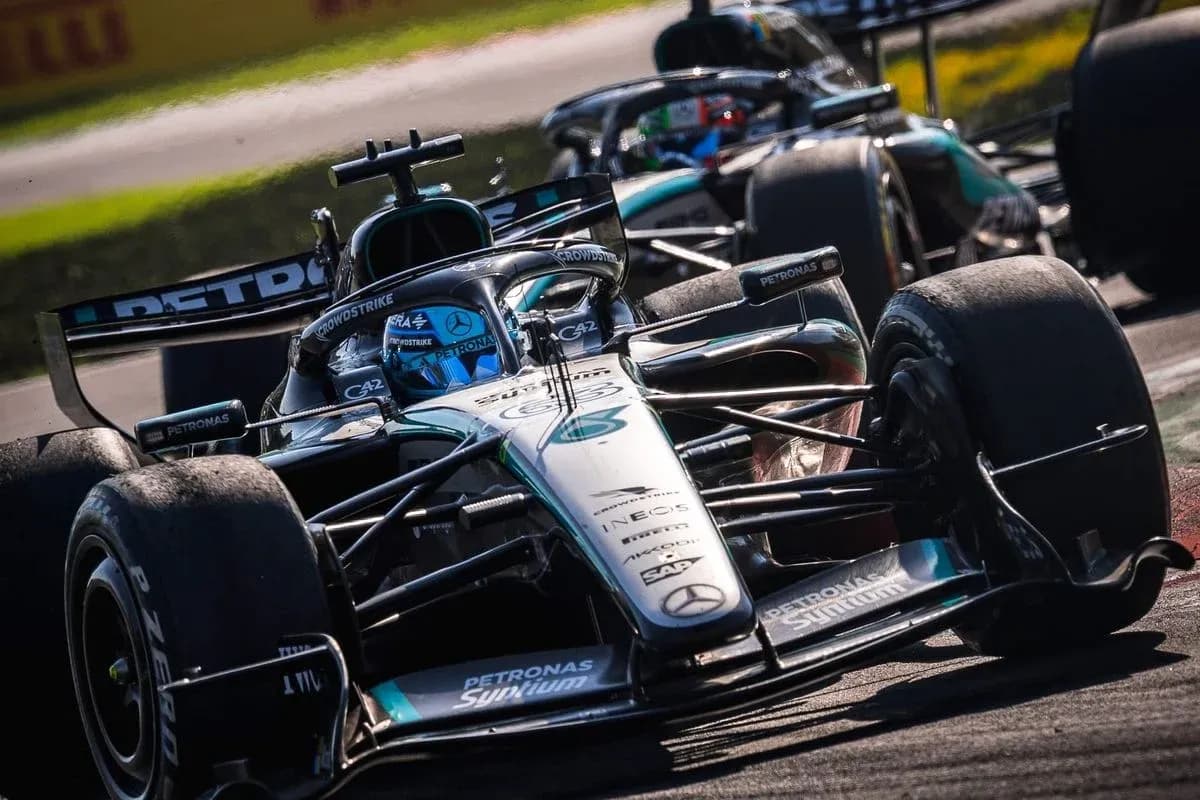
George Russell is prepared to wait for pain if it means getting more power.
Mercedes has decided to delay his inevitable Formula 1 engine penalty until its new ADUO-upgraded power unit is ready, a move that could push the change back to around the United States Grand Prix.
In a season where reliability problems hit early and hard, both Russell and team-mate Kimi Antonelli have already blown through their in-season power unit allocation just to stay on track for the full campaign. Someone had to bite the bullet first. Antonelli did it at Monza.
The Italian GP weekend looked like the obvious moment for Russell to follow suit. Long straights, overtaking opportunities, and a proven template: Antonelli started 19th with fresh components and still sliced his way through the field to win. Baku, with its huge main straight, then emerged as the next logical candidate.
But Mercedes has changed course.
One penalty, not two
The team wants to align Russell’s grid drop with the introduction of its updated power unit, developed under F1’s Additional Development and Upgrade Opportunities (ADUO) framework. That system has given Mercedes extra scope to tweak its engine mid-season, and the team intends to make it count.
The complication? Russell is already at the ceiling for several key components. He has maxed out his internal combustion engine, turbocharger, energy store, and control electronics. Any fresh parts now automatically mean a grid penalty.
If he took a standard new unit in the next races and then switched again to the ADUO-spec power unit later, he would be hit twice.
Speaking at the Spanish GP, Russell made it clear the strategy was always to avoid that scenario. The plan is simple: take the pain once, when the upgraded hardware is ready.
He admitted there was never a serious intention to mirror Antonelli’s Monza decision. The idea of taking an extra engine there, only to be forced into another change for the ADUO spec, held no appeal. From his point of view, it “makes zero sense”.
Waiting for the upgrade
Mercedes has not yet locked in when the ADUO step will debut. Initial hopes pointed toward the next run of flyaway races in Azerbaijan, Malaysia and Singapore. That now looks optimistic.
The upgraded specification is instead understood to be targeting the late-season triple-header in the Americas: the United States, Mexico and Brazil, starting in Austin on October 23-25. That timing would put Russell’s penalty deep into the decisive phase of the championship, but crucially with the benefit of an improved power unit package, believed to include a revised turbo.
When Mercedes does finally roll out the new spec, Antonelli will have access to it as well.
The championship leader took a more measured approach at Monza. His change there was not a full power unit swap: Mercedes limited it to a new internal combustion engine, battery and control electronics. That choice gives Antonelli breathing room later in the year. He can still fit a new turbo, MGU-K, exhaust and ancillaries without triggering a penalty.
Russell does not have that luxury.
Knock-on effect for customer teams
Any step Mercedes makes with its works power unit cannot stay in-house. Under F1 rules, any improvement in specification must also be offered to its customer teams.
There is a catch, though. At the first event where the ADUO upgrade appears, each customer outfit will only receive a single unit. That restriction will force some tough internal decisions up and down the pit lane about which driver gets the new hardware first.
For Mercedes, the decision is already clear. Russell will take his hit when the upgraded engine is ready. Antonelli has his path mapped out. The clock now ticks toward Austin and a crucial power play in the final stretch of the season.