BRM Revives Its Legendary P351 for Racing
The name British Racing Motors carries a particular weight in motorsport. Before Lotus, before Williams, before McLaren took over the modern era, BRM stood as Britain’s first Formula 1 team, founded in 1949 by Raymond Mays and Peter Berthon. By 1962, Graham Hill had dragged the team to the summit of the sport, delivering both the Constructors’ and Drivers’ titles.
But BRM never wanted to be just a Grand Prix outfit. It wanted to conquer everything.
The Ambitious Outlier
Out of that ambition came one of the most intriguing curiosities in endurance racing history: the BRM P351.
Built as a Group C sports prototype, the P351 was designed for the brutal world of long-distance racing, with the 1992 World Sportscar Championship and the 24 Hours of Le Mans as its natural hunting grounds. It was a one-off, a singular machine intended to punch at the level of Peugeot and Toyota.
It barely got the chance.
Transmission problems crippled its big moment at Le Mans. The car retired early, its race over before the story could properly begin. Yet in the brief window when it did run, the P351 showed its teeth. On the Mulsanne Straight at Circuit de la Sarthe, it clocked 216 mph (348 kph), right in the slipstream of the era’s heavyweights.
Then it faded. A flash of speed, a footnote in the results sheet, and an oddity for the anoraks.
Built for Glory, Then Rewritten
The original P351 was a serious piece of kit. BRM constructed it around a carbon-composite monocoque, the kind of advanced architecture you’d expect from a top-flight prototype. Power came from an in-house, naturally aspirated 3.5-litre V12 engine, a howling statement of intent from a team that once ruled Formula 1.
But endurance racing can be unforgiving. After its early outings, the car’s story took a sharp turn. In the 1990s, it was reworked: the BRM V12 was pulled, a Nissan twin-turbo V6 went in, the roof came off, and Pacific Racing fielded the car under a new identity – the BRM P301.
Same chassis lineage. Very different animal.
Back Where It Belongs
Somehow, against the usual script, the original racer found its way back to BRM in late 2024. That alone felt unlikely. What followed was even more so.
The team set about reversing time.
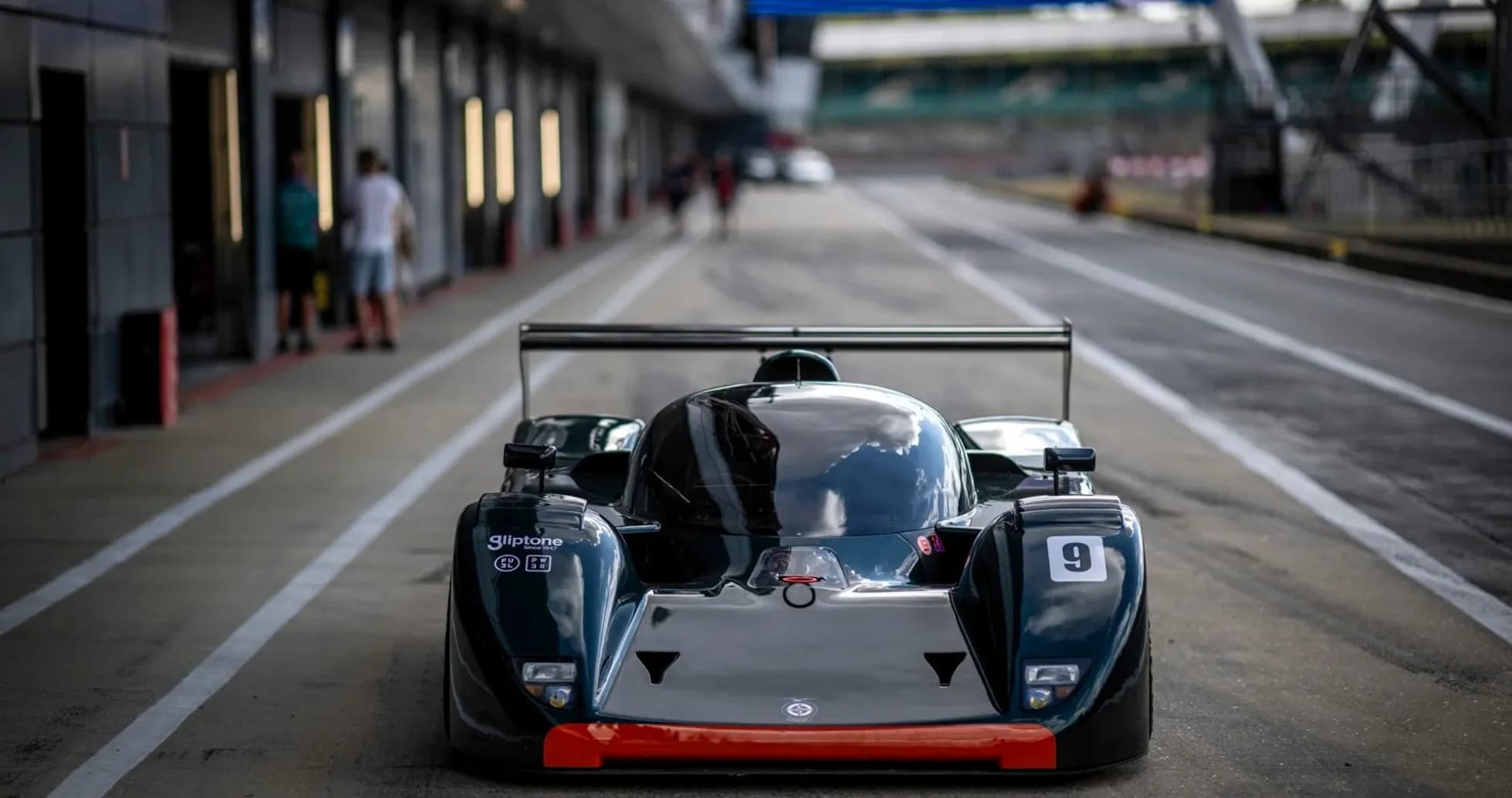
The P351 has now been fully restored to its original specification and has just been unveiled at Silverstone, the same circuit where it once ran in period. Gone is the open-top P301 guise. Back is the closed-cockpit, Group C silhouette that BRM first imagined.
This isn’t a static museum piece, either. BRM has no intention of leaving it under soft lighting and velvet ropes.
The V12 is back. So is the original transmission layout, both completely rebuilt by Dawson Racing. The car now runs on sustainable fuel, a neat collision of past and present: a 1990s prototype repurposed for a modern racing landscape that’s wrestling with its environmental footprint.
The message is clear: this car is going racing again.
Rebuilding a Ghost
One of the trickiest elements to resurrect was the roof. When the car became the P301, its closed cockpit disappeared. To bring the P351 back to its true form, BRM had to reverse-engineer the roof using surviving original paperwork and period photography.
No CAD files. No digital archive. Just documents, images, and a determination to get the lines right.
The project has drawn in support from several major partners. Motul, Goodyear, and SKF Automotive are among the companies that have backed the restoration, plugging modern expertise into an old-school racer.
The result is a car that looks, and crucially is intended to behave, like the machine that should have made a bigger mark in 1992.
A Second Shot at a First Impression
BRM has yet to confirm exactly where the P351 will race, or who will be trusted with the wheel. What is clear is that it will not simply circulate at gentle demo pace for the cameras. The plan is competition, not nostalgia laps.
The P351 once arrived at Le Mans as an unknown quantity and left as an unfulfilled promise, remembered more for what it might have done than what it actually achieved.
Now it returns with its original heart, its original form, and a very modern twist in its fuel. The question is no longer whether it will run again.
It’s whether, three decades on, it can finally deliver the legacy it was built for.