Alan Jones: Remembering the Formula 1 Champion Who Defied Danger
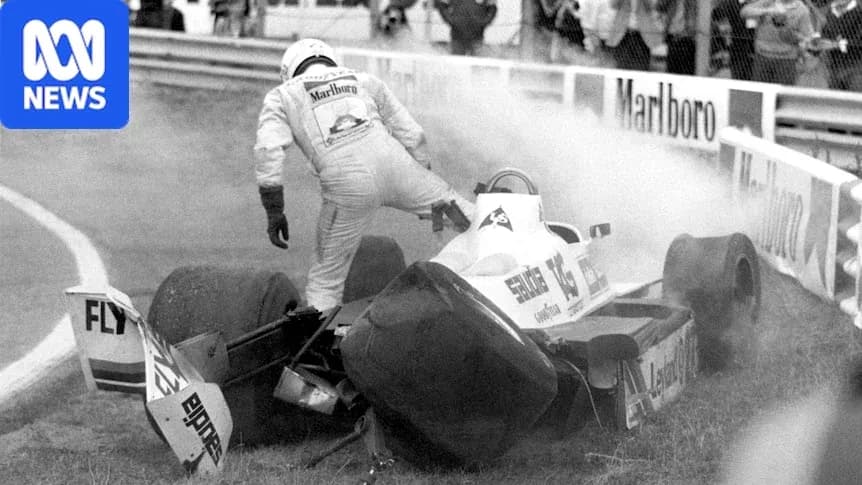
Alan Jones, the blunt, hard-edged Australian who muscled his way to the 1980 Formula 1 world title, has died at 80. The tributes rolling in speak to his grit and his success. The story of his career, though, is inseparable from the brutal, unforgiving era that shaped him.
He didn’t just race in dangerous times. He came of age in the years when Formula 1 routinely asked its drivers to stare death in the face and keep their foot down.
Baptism of fire in Barcelona
Jones’s first F1 start came at the 1975 Spanish Grand Prix at Montjuïc, a weekend that still sits in the sport’s darkest chapters.
Even before a wheel turned in anger, the alarm bells were ringing. Drivers walked the Barcelona street circuit and saw barriers that looked hastily assembled, bolts not properly secured. Members of the Grand Prix Drivers Association downed tools and refused to practice, convinced the place was a trap.
The strike didn’t last. With the cars already in the Montjuïc stadium and rumours swirling that the Guardia Civil might seize them if the event collapsed, the grid eventually formed. The race went ahead.
Jones, in a Hesketh, qualified 21st. His debut lasted three laps before a collision put him out. On any other day, that would have been the story for a rookie. On this day, it was a footnote.
On lap 26, race leader Rolf Stommelen’s Hill-Ford suffered a rear wing failure. The car snapped away from him, speared into the barriers and launched into the crowd. Five spectators were killed. Stommelen survived but with serious injuries. The race staggered on for four more laps before officials finally called it off.
Amid the carnage, history still found a way to write a different line. Lella Lombardi finished sixth and became the first – and still the only – woman to score Formula 1 world championship points. Even that milestone, though, sat under a heavy shadow. For Jones, Formula 1 had revealed its true cost on day one.
A drive born from disaster
Jones’s path back into the sport a couple of years later came in circumstances no one would ever wish for.
After falling out with Team Surtees at the end of 1976, he started 1977 on the sidelines. His career at the top level looked uncertain. The call that changed everything came in the wake of another horrific accident, this time at Kyalami in South Africa.
Shadow driver Renzo Zorzi had pulled off to the side of the main straight with a fuel leak. A small fire broke out. Two marshals sprinted across the track carrying fire extinguishers, trying to reach the stricken car. One driver managed to jink away at the last moment.
Tom Pryce did not see them.
At full speed, Pryce’s Shadow hit 19-year-old marshal Frederik Jansen van Vuuren. The impact killed the teenager instantly. The heavy extinguisher he was carrying smashed into Pryce’s helmet and killed the Welshman on the spot. It was the kind of scene that defined the era: brave volunteers, rudimentary procedures, and no margin for error.
Race winner Niki Lauda was preparing for the podium when a Goodyear representative quietly pulled him aside and told him Pryce was dead. Celebration turned to numb disbelief.
In the aftermath, Shadow needed a replacement. They turned to Jones for the next race in the United States. Out of the wreckage of another tragedy, his F1 career was reborn.
Later that season, he delivered a breakthrough. At the 1977 Austrian Grand Prix, Jones drove superbly to claim his maiden victory – and Shadow’s only win in Formula 1. That afternoon in the Styrian hills announced him as a serious force and set the stage for the championship years that followed.
Williams glory and the Ferrari “what if”
By 1979, Jones had found his perfect home.
Williams, still an emerging force, gave him the tools and the trust. He repaid them with raw speed and a refusal to back down. Between 1979 and 1981 he won 11 grands prix and, in 1980, the world championship. It was the peak of his powers: a hard-charging Australian in a no-nonsense British team, battering the establishment.
Yet his story could easily have run in Ferrari red.
Before that Williams partnership took flight, Ferrari sounded him out. The Italian team made it clear: if they couldn’t land Mario Andretti, Jones was next on the list. Andretti ultimately stayed with Lotus and won the 1978 title. Ferrari turned instead to a young Canadian, Gilles Villeneuve.
Jones went to Williams. Villeneuve went to Maranello. Two careers, two paths, both defined by speed and risk.
The sport’s cruelty cut into that Ferrari story in 1982, a year after Jones first stepped away from Formula 1. Villeneuve died in qualifying for the Belgian Grand Prix after hitting the rear of a much slower car, his Ferrari launched into the air before disintegrating, throwing him clear.
Not long after, Didier Pironi suffered appalling leg injuries in Germany when he ploughed into the back of Alain Prost’s Renault in poor visibility. Another Ferrari, another violent reminder of how little protection drivers had when things went wrong.
Jones later said Ferrari contacted him to fill in for the final races of that 1982 season. He hesitated, took too long to give an answer. Ferrari moved on and chose another replacement. It became one of the great “what ifs” of his career – a second act in scarlet that never happened, framed once again by loss.
A champion from the sport’s hardest years
By the time Jones retired for good in 1986, the toll of his era was stark.
Five drivers had been killed on Formula 1 grand prix weekends during his active years. Two more died in testing. Australian Brian McGuire lost his life at Brands Hatch in 1977 while driving an F1 car. These weren’t distant names on a list. They were colleagues, rivals, sometimes friends. Drivers strapped in each weekend knowing exactly what was at stake.
The sport slowly began to change. Circuits were altered, cars strengthened, procedures tightened. After Jones’s departure, Formula 1 went through a rare spell without fatalities – until the 1994 San Marino Grand Prix shattered the illusion of safety.
That Imola weekend claimed Roland Ratzenberger in qualifying and Ayrton Senna in the race. The shock forced the sport to accelerate its safety revolution. Barriers moved back, run-off areas expanded, cockpit protection improved. The lessons of the 1970s and 1980s, the years of Jones, finally began to harden into rules.
Since then, only one driver has died as a result of an incident during a Formula 1 race weekend: Jules Bianchi, who suffered fatal injuries after sliding off in wet conditions at Suzuka in 2014 and hitting a recovery crane that had come onto the circuit to retrieve Adrian Sutil’s car.
The response again reshaped the landscape. Race control procedures changed. Recovery vehicles faced stricter protocols. On the cars themselves, the most visible symbol of the modern era arrived: the Halo.
The curved, wishbone-style structure above the cockpit has already justified its existence several times over. It played a decisive role in Romain Grosjean’s fiery crash in Bahrain in 2020, when his car split the barriers and burst into flames. It helped protect Lewis Hamilton when Max Verstappen’s Red Bull landed on top of his Mercedes at Monza in 2021. It was there again when Guanyu Zhou’s Alfa Romeo skated upside down through the gravel and into the catch fencing at Silverstone in 2022.
Those escapes, astonishing in their own right, are the product of decades of painful learning – learning written in the careers and the losses of drivers like Alan Jones.
He leaves behind 12 grand prix wins, a world title and a reputation as one of the toughest racers of his generation. He also leaves a reminder: the modern, safer Formula 1 that fans enjoy today was built on the courage of those who drove when survival was never guaranteed.