Alan Jones' Historic Win at the 1977 Austrian Grand Prix
The engines howled on the grid at the 1977 Austrian Grand Prix, the mountains echoing back the noise as Formula One’s golden age lined up in perfect formation.
On pole, the home idol: Niki Lauda. A year removed from the inferno at the Nürburgring that burned his face and very nearly ended his life, he sat in the Ferrari, scarred but unshaken, the embodiment of cold, ruthless control.
Just behind him, James Hunt. Blond, glamorous, chaotic. The Englishman Lauda once admitted was the only driver he ever envied.
In third, Mario Andretti, the American superstar with a CV that read like fantasy: future F1 world champion, four-time IndyCar king, Daytona 500 winner.
And buried back in 14th place on the grid, in a car that had never tasted victory, sat Alan Jones. A 30-year-old from suburban Melbourne, an eleventh-hour replacement that season after the tragic death of Tom Pryce in South Africa. No aura, no mystique, no movie-star sheen.
Just a stocky bloke who could drive the wheels off anything.
Jones, who died on Thursday aged 80, was never going to win any beauty contests in the paddock. Colleagues and commentators called him overweight, laconic, sometimes underprepared. He didn’t stalk the garages with Lauda’s icy intensity or Hunt’s swagger.
But he had something that can’t be polished or marketed: raw, unfiltered talent.
That overcast August afternoon at the Österreichring, he used it to tear up the script.
Rain had washed over the circuit before the start, splitting the field. Some gambled on wet tyres. Others, eyeing the clearing skies, bolted on slicks and braced for the early laps.
Lauda, on wets in the Ferrari, slid backwards, the car squirming on the greasy surface. Up front, Andretti pounced, slicing past both Lauda and Hunt after a minor tangle between the two headline acts.
Eyes went straight to the American. At the same time, another story brewed further back: Gunnar Nilsson, the Swede, stormed from 16th to second on wets, carving through the field as if he’d found grip no one else could see.
Amid the chaos, Jones threaded his Shadow forward, almost unnoticed. From 14th to fourth, he picked off rivals one by one, his slick tyres skating on the edge of disaster. It was the sort of call that could make you a hero or an idiot in a handful of corners.
The sun finally broke through. The track dried. The race turned.
Nilsson’s advantage evaporated as quickly as his tyres. He dived into the pits, his shredded wets finished. Moments later, Andretti’s Lotus detonated in a plume of smoke, engine failure ripping away his control of the race and his shot at victory.
That left Hunt in front, with Jones looming in his mirrors.
Lauda, now armed with fresh rubber and a car that suddenly behaved, launched a familiar charge. He scythed through the pack with clinical precision, climbing to third and closing fast.
Race Dynamics
So the race distilled into a perfect snapshot of the era: Hunt and Lauda, the combustible duo later immortalised in the film Rush, separated by a stocky Australian in a black Shadow that wasn’t supposed to be there.
Jones didn’t posture. He didn’t gesture. He just drove.
Then the day exploded.
Hunt’s McLaren let go in a burst of sparks and flame, his car rolling to a smoky halt at the side of the circuit. Marshals sprinted in, drowning the wreck in extinguisher dust. In the grey cloud that followed, the entire narrative of the race flipped.
Out of that haze, Alan Jones emerged as the new race leader.
He still had to finish it. Lauda was coming, relentless and precise, but Jones refused to blink. Lap after lap, he kept the Ferrari at bay, coaxing every last ounce of speed from a Shadow that had never before seen the front of a Grand Prix.
When the chequered flag fell, the underdog from Melbourne crossed the line to claim his first Formula One victory. It would be the first of 12 in his career.
For Shadow, it was everything. The only win the team would ever record in its eight-year F1 existence.
Mechanics and team staff poured onto the track, disbelieving and ecstatic. The circuit announcer tried to make sense of what had just happened, his voice betraying the surprise.
“The first Grand Prix win for Alan Jones, and the first Grand Prix win for the hard-working Shadow team,” he declared.
“And, we think, the first Grand Prix win for Australia in seven years.”
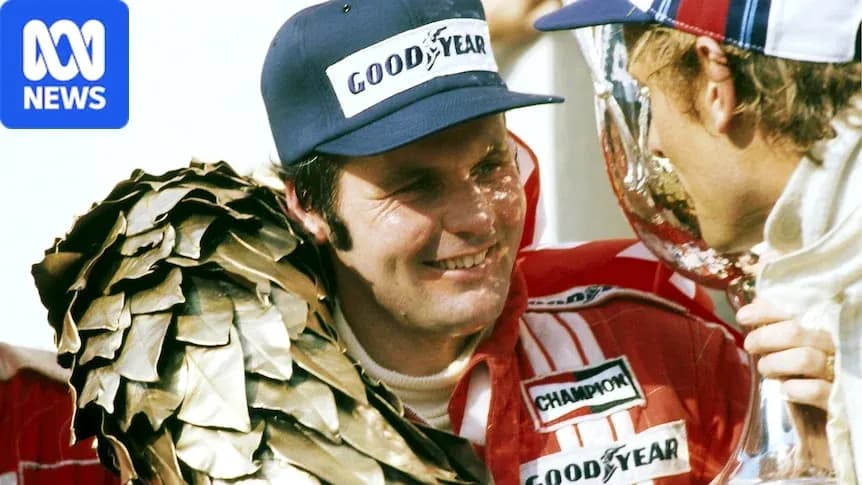
Down in pit lane, Jones found himself at the centre of a storm he never courted. With his then-wife Beverley on one arm and a bottle of champagne in the other, he planted a huge kiss on her, then gave the bottle a shake and a pop, urged on by Bev’s grin.
He took a long pull from the champagne before being shepherded to the podium, where officials draped a golden wreath around his neck. A brass band struck up in the background, soundtracking a moment that would later grow into one of the sport’s great half-myths.
“[The win] was a bit of a surprise to everybody,” Jones later told Wide World of Sports co-host Daryl Eastlake.
“In fact they had trouble finding the Australian national anthem, so some drunk played Happy Birthday on a trumpet.
“That’ll give you an idea how prepared they were for me to win.”
The audio from that day tells a slightly different story.
Somewhere in the distance, trumpeters blasted out La Cucaracha and a grab bag of other tunes before finally launching into Advance Australia Fair as Jones took his trophy. The official anthem at the time, God Save the Queen, never played, despite having been reinstated as Australia’s national song in 1976 after Gough Whitlam’s brief adoption of Advance Australia Fair in 1974.
Maybe, in the noise and the chaos and the shock, Jones simply misheard Advance Australia Fair as Happy Birthday. Maybe he didn’t hear it at all, his mind locked on the blur of faces and the weight of the moment. Maybe he just didn’t recognise an anthem that had been swapped in, swapped out, then swapped back again in the space of a few years.
What can’t be disputed is what came next.
Over the following seasons, as Jones rose to the top of the sport and claimed a world championship, Formula One organisers became intimately familiar with the Australian anthem. They heard it again and again as he stamped his authority on circuits across the globe.
In an era defined by larger-than-life characters and cinematic rivalries, Australia’s contribution wasn’t a matinee idol or a playboy champion. It was a man who looked more like a bank clerk than a leading man, climbing into a car and driving with a ferocity that belied his unassuming frame.
That was Alan Jones. No gloss. No myth-making required.
Just a legacy that still makes Australian motorsport fans stand a little taller whenever they hear those opening bars of Advance Australia Fair.