WBO President Defends Mandatory Challenger Status for Janibek Alimkhanuly
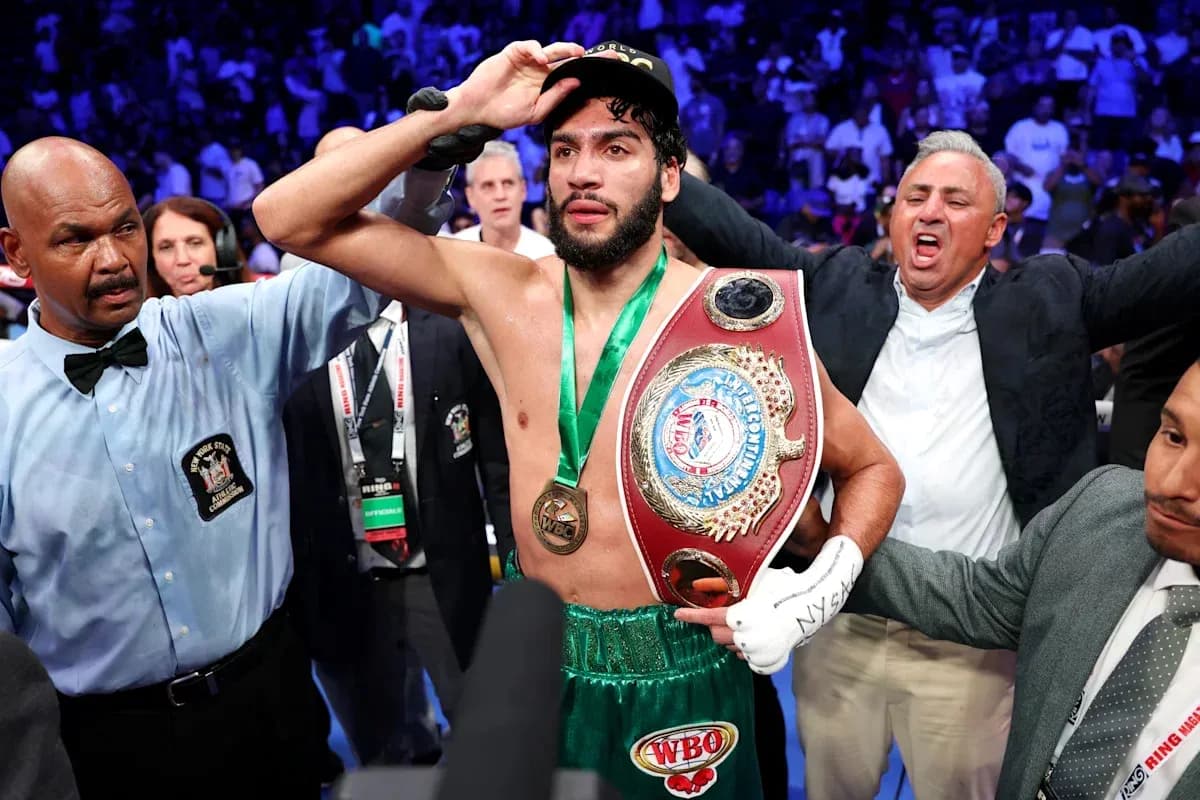
WBO president Gustavo Olivieri has hit back hard at Hamzah Sheeraz, flatly rejecting the champion’s claim that “corruption” lies behind Janibek Alimkhanuly being named mandatory challenger at super middleweight.
Sheeraz, the WBO titleholder at 168 pounds, publicly blasted the organization after it installed Alimkhanuly as his next mandatory despite the Kazakh star failing a VADA test late last year and never having boxed at super middleweight.
To Olivieri, the accusation cut deep — and crossed a line.
“I respectfully but unequivocally disagree with his assertions, particularly any suggestion of ‘corruption,’ improper ‘motives,’ or decisions influenced by ‘personal relationships,’” he told Uncrowned, after Sheeraz’s comments on Ariel Helwani’s show ignited the row.
Sheeraz calls it “a joke”
Sheeraz did not tiptoe around his feelings.
Speaking to Helwani, he branded the WBO’s move “a joke” and “disgraceful to the sport of boxing,” arguing that the body was effectively “rewarding someone who has [tested positive].”
He went further, calling the decision “corrupt” and claiming it was “all based off relationships,” insisting the ruling “has come out of nowhere and is extremely not right for the sport of boxing.”
That interview forced the WBO to move from silence to explanation. The governing body responded with a detailed breakdown of how and why Alimkhanuly ended up at the front of the line at 168.
WBO: Janibek’s case is different
At the heart of the WBO’s defense is context.
Alimkhanuly, then the unified WBO and IBF middleweight champion, tested positive with VADA for a banned substance just days before a planned three-belt unification with Erislandy Lara in December. The fight was scrapped. He never walked to the ring.
Olivieri stressed that point as a key distinction.
“Zhanibek never stepped inside the ring in connection with the anti-doping matter. The bout did not proceed,” he said, arguing that this “materially distinguishes his case” from situations like Ryan Garcia vs Devin Haney, where the contest went ahead and the findings came from a completed championship bout.
In the WBO’s view, those are “fundamentally different factual circumstances” and cannot be treated as the same kind of case.
The organization also leaned on Alimkhanuly’s status as a first-time offender. During disciplinary proceedings, he submitted mitigating circumstances, including medical evidence, for the WBO to consider. Despite that, Olivieri pointed out that the WBO went beyond the sanction issued in his home country.
The Kazakhstan Professional Boxing Federation suspended Alimkhanuly for six months. The WBO doubled that, handing down a 12‑month suspension and explicitly reserving the right to modify it later.
That is exactly what it did. After reviewing “the complete record,” including what it described as Alimkhanuly’s cooperation and compliance with conditions, the WBO terminated the suspension early.
From Olivieri’s perspective, that brought the doping matter to a close. Once the ban ended, he insists, it had no bearing on Alimkhanuly’s eligibility to be named mandatory.
A precedent the WBO says is long-standing
The WBO’s second pillar of defense rests on precedent. This, Olivieri argued, is not a one-off favor; it is how the organization has operated for years.
The body has long allowed its recent champions to move up or down in weight and receive preferential ranking treatment, including being placed straight into a mandatory position, sometimes without a single fight in the new division.
Keyshawn Davis is the example Olivieri put on the table.
Davis lost his WBO lightweight title in June 2025. He then moved to super lightweight, boxed twice in non-title fights, and jumped again to welterweight. Despite never having fought at 147 pounds, he was ranked No. 1 and ultimately named mandatory challenger for Devin Haney.
That case, the WBO argues, underlines that this isn’t about who is “in good standing” in a broader sense. Even a fighter coming off a difficult or controversial spell can still benefit from champion’s privilege when changing divisions.
Davis, Olivieri suggested, is just one of many. The principle, he maintained, is consistent.
Why Janibek over Bank?
The final part of the WBO’s argument is competitive merit.
On paper, both Alimkhanuly and Jacob Bank arrive at 168 pounds unbeaten. Alimkhanuly stands at 17-0 with 12 knockouts; Bank at 20-0 with 11 stoppages.
To Olivieri, the numbers only tell part of the story. The résumé, he said, does not.
Alimkhanuly’s run at middleweight — culminating in a unified WBO and IBF reign — carried more weight with the sanctioning body than Bank’s record and opposition. That gap in accomplishments, Olivieri argued, made the Kazakh the stronger candidate to be installed as mandatory.
So the WBO leaned on two things: its established practice of rewarding its former champions when they move divisions, and its belief that Alimkhanuly’s body of work at 160 clearly outstrips Bank’s.
A ruling that won’t be walked back
For Sheeraz, none of that changes the optics: a fighter who failed a VADA test, has never boxed at 168, and saw his suspension shortened now stands between him and the next phase of his reign.
For Olivieri, the case is closed. The suspension was served, the record reviewed, the precedent applied, and the mandatory position awarded.
The controversy will now move from boardrooms and interviews to the ring. If the fight is made, Sheeraz will have his chance to answer the WBO’s decision the only way that truly sticks in boxing — by trying to beat the man they chose to put in front of him.