
How Wales Stopped Erling Haaland: A Tactical Analysis
Most coaches only ever get as far as the theory. Wales, uniquely, have something more valuable: recent evidence.
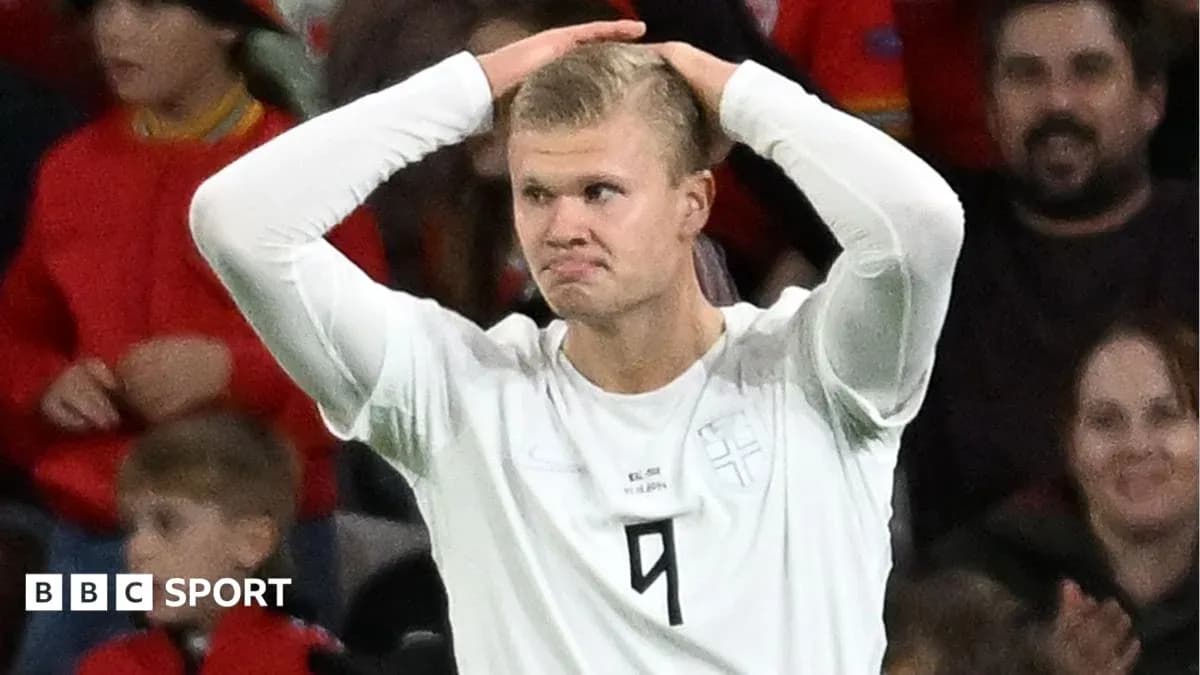
A month ago in Cardiff, Haaland walked off the pitch beaten, irritated and largely neutered in a 2-1 Wales win. On Saturday in Oslo, Craig Bellamy asks his players to do it all over again – this time in the lion’s den, with a Nations League campaign and a wounded Norway in front of them.
Bellamy’s Gamble
Bellamy is under no illusions about the size of the problem.
"You're talking about trying to deal with one of the best players in his position in the world," the Wales head coach says. Haaland, with 65 goals in 59 games for his country and a mountainous haul for Manchester City and beyond, is not just prolific. He is a system on legs.
Most teams respond to that by retreating. They drop off, close the space in behind, and cling to the idea that a low block will starve him of room. Often, it does the opposite. Sit deep and Haaland has time to wrestle centre-backs, time to time his runs, time for Martin Odegaard to pick his passes.
Others try to fight fire with muscle, turning it into a physical scrap. That sounds brave until you remember the “specimen” they are up against: 6ft 5in, powerful, relentless. Few win that duel for 90 minutes.
Bellamy went the other way. He took the risk that keeps most managers awake at night.
"Drive up and don't let him dictate," he says. A high line against Haaland is the tactical equivalent of walking a tightrope in a storm, and Bellamy knows exactly how it sounds. "Trust me you don't want to, but you can't have him dictating the game."
So Wales squeezed the pitch. They pressed the ball. They lived on the front foot and dared Norway to hit perfection with every pass in behind.
Starving the Giant
The plan was simple in concept, brutal in execution: deny Haaland the oxygen of service.
At Cardiff City Stadium, the numbers told the story. Haaland had just 24 touches. That, by itself, is not extraordinary; he often drifts on the fringes before exploding into life in the box. What mattered was what he didn’t do. Two shots all night. Only one on target – a tame header straight at Danny Ward.
The cure was prevention. Wales did not wait to see what Haaland would do. They choked off the supply line at source.
That is no small achievement when the man pulling the strings is Odegaard. Arsenal’s captain, the Premier League’s creative metronome last season, is Norway’s architect-in-chief. Allow him to settle, and Haaland becomes inevitable.
So Bellamy’s defensive scheme started in midfield. Ethan Ampadu and company were not just shielding the back line; they were patrolling the space between Odegaard and his forwards, constantly recalculating distances, angles, and danger.
"You have to consider the distance between Ethan and Haaland," Bellamy explains. Open the middle and Norway thread passes into Haaland’s feet. Get too tight and they spin you with runs in behind. The balance is everything.
Wales’ defenders – charged with handling Haaland, Oscar Bobb and Andreas Schjelderup – relied on that screen. Stay side-on. Read the runs. Block the lanes. And when they won the ball, use it.
"It's also important how we use the ball," Bellamy says. If Wales could develop possession and move up the pitch, Haaland had to work the other way. He had to run back, not just forward. He had to chase.
Possession with a Purpose
Since Bellamy took charge in the summer of 2024, Wales’ relationship with the ball has changed. Their average share of possession has rocketed, a conscious shift towards a more assertive identity.
The Nations League, with Norway, Portugal and Denmark in the group, has tested that ambition. Against this calibre of opposition, Wales have seen less of the ball than Bellamy would like. He knows that has to improve.
He has already made his intentions clear for Oslo: Wales will go “all out” for the win. That is not bravado. It is part of the defensive plan.
If Wales can force Norway to defend, Haaland spends more time facing his own goal, more time tracking runners, less time prowling the penalty area. Possession, for Bellamy, is not just about creativity. It is about control – of the game, of the tempo, and of Norway’s most dangerous weapon.
Distances, Discipline and Dan James
Dan James, scorer of Wales’ opener in that 2-1 win, saw the work from the inside. For him, the key was not just the back four. It was the unit.
"Our distances [between players] were really good," he says. Odegaard, he points out, is “a unique player” who will collect the ball anywhere. Norway want defenders to jump out, to bite, to break the line. When they did, the punishment was immediate – the pass to Oscar Bobb and a clinical finish.
That was the warning. Wales heeded it.
"We showed our resilience and it was about limiting their chances," James says. Odegaard still found moments, still slipped balls in behind, but every time Norway tried to stretch Wales, red shirts snapped back into shape. From the forwards all the way back, they defended as one.
To the last minute, they held.
That is the standard James knows they must hit again. "We've got to be great again on Saturday," he says. Not just good. Great. Because against Haaland and Odegaard, anything less is an invitation.
Changes at the Back, Same Brutal Truth
Wales will not be able to roll out exactly the same cast in Oslo. Ben Cabango, who performed admirably in Cardiff and walked away with Haaland’s shirt as a souvenir, is suspended. One warrior down.
The upside is significant, though: Joe Rodon is back. The first-choice centre-back, absent for the previous game, returned for Leeds United last weekend and is available again.
Bellamy is quick to share the credit when it comes to stopping Haaland.
"Ben Cabango and Ben Davies have both done really well against him," he says. But he circles back to the same point: if the work in front of them is not done, no centre-back in the world looks comfortable.
"Against this type of player, it doesn't matter how good an individual defender is," Bellamy adds. The last four or five years have shown exactly that. One-on-one, Haaland devours reputations.
The only answer is collective resistance. Compress the space. Press the ball. Force him into areas where he is less terrifying. Turn a world-class finisher into an ordinary forward by denying him the situations where he is anything but.
Facing the Monster Again
Wales have done it once. They know the blueprint, they know the risks, and they know that repeating it in Oslo will be harder.
Norway will be angrier. Haaland will be hungrier. Odegaard will demand more of the ball. The home crowd will demand a response.
But Bellamy will not retreat into fear. His plan is not to survive Haaland. It is to confront him – high, aggressive, and together.
Taking him on alone is a fantasy. Taking him on as a pack, as Wales proved in Cardiff, is something else entirely.
The question now is not whether Haaland can be stopped. Wales already answered that. The question is whether they can do it again, on foreign soil, with the stakes and the noise turned all the way up.





