VAR Error in Manchester Derby: Speed Over Accuracy
“Quick, quick, quick, quick! Go, go, go, go, go!”
In the claustrophobic silence of the VAR room, Matt Donohue’s voice cut through the tension like an alarm. It was meant to be urgency. It became the soundtrack to one of the most damaging VAR errors the Premier League has seen.
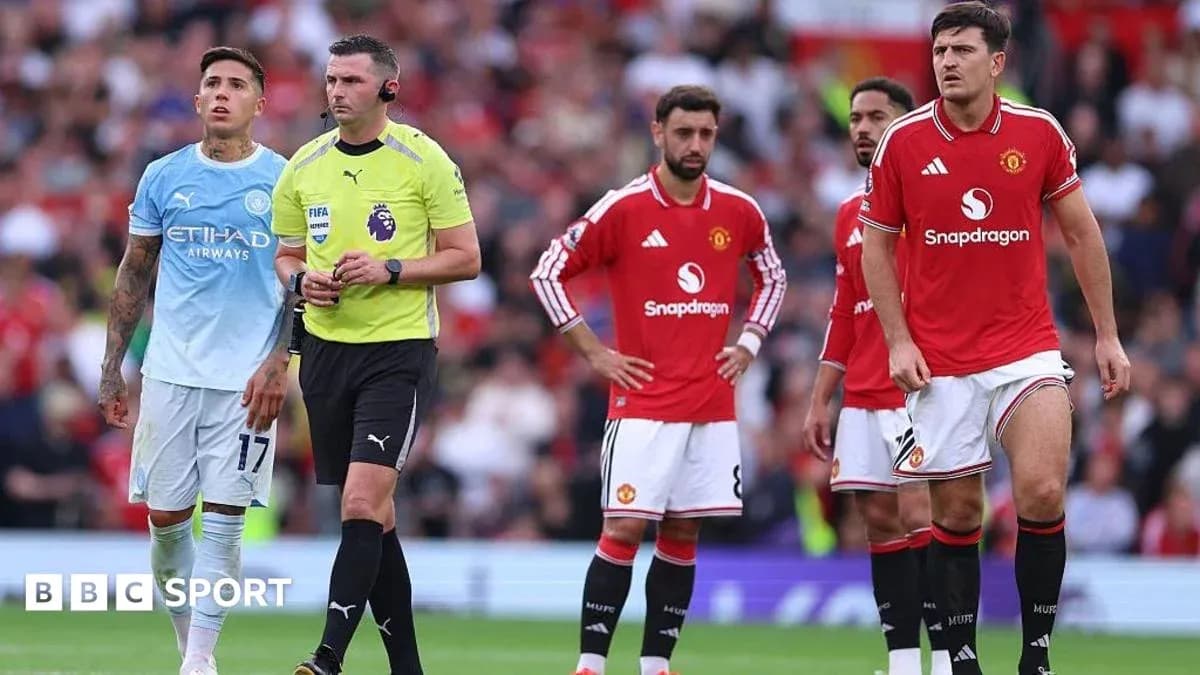
Seconds later, Erling Haaland’s winner in the Manchester derby stood. Manchester City 1, Manchester United 0. And Enzo Fernandez, three yards offside in the build-up, somehow invisible to the technology designed to catch exactly that.
When speed beats sense
Refereeing has always lived in a goldfish bowl, every decision magnified and replayed. VAR was supposed to help. Instead, it has created a new kind of pressure: be right, and be quick.
The Premier League has even codified it. A “more efficient application of VAR to reduce delays” is one of its football principles this season. Stakeholders’ surveys – managers, coaches, supporters – all hammered home the same message: the reviews must be faster.
On Sunday, that obsession bit back.
“Let’s go, let’s go, let’s go, let’s go!” Donohue urged, as he rushed through the check. It did not sound like a team calmly dissecting one of the biggest moments of the season. It sounded panicked. Rushed. Chaotic. Everything a video review is not supposed to be.
The result was brutal. Donohue and his assistant VAR, Blake Antrobus, simply failed to see Fernandez drifting into an offside position before trying to head the ball. The phase was checked, the technology deployed, the lines drawn. The most basic part of the job – seeing the whole picture – was missed.
The goal stood. The fallout will last much longer than the 10 or 20 seconds they were trying to save.
The process that broke
Strip away the noise and one detail is damning.
On the first replay of Josko Gvardiol crossing the ball, Donohue told the replay operator to freeze the frame at the moment of contact. He went straight into the semi-automated offside system from there.
That is not how this is meant to work.
The VAR team should first scan the entire attacking sequence: from Gvardiol’s cross, through the movement in the area, to Haaland’s header. Only then do they drill into specifics, like offside lines and potential touches.
Had they done that, Fernandez’s position would have been obvious. His attempt to play the ball would have been seen, his impact understood. Instead, those events inside the box were only really considered after the attacking phase had already been locked in.
By that stage, Donohue and Antrobus were fixated on one question: did Fernandez touch the ball? If he had, it would have started a new phase and made Haaland offside. When they decided he did not, the goal was cleared. The earlier, simpler problem – Fernandez being offside in the first place – never truly entered the conversation.
Speed played its part. The deeper failure was procedural.
The silent assistant
Most of the criticism has fallen on Donohue, the man with the final say. Yet the role of the assistant VAR is designed precisely for nights like this – to spot what the main official has missed, to apply the brakes when the train is running too fast.
Antrobus barely did that.
His entire contribution to the review boiled down to “no, yeah” on the question of whether Fernandez had made contact. One brief interjection. One second before Donohue declared: “final decision is goal, check complete.”
An AVAR is supposed to be a counterweight, not an echo. On Sunday, that safeguard failed.
The irony is painful. The only truly long VAR delay this season came in Brentford v Sunderland, when Dan Ballard had a goal ruled out for a subjective offside against Kevin Danso. That review dragged on for more than four minutes. The AVAR that day? Blake Antrobus.
The criticism after that game was fierce. Too slow. Too fussy. Too intrusive. Did that linger in his mind when the stakes were even higher in the derby? No-one can say with certainty. The outcome, though, was a complete swing in the opposite direction – and an error that dwarfs the earlier complaints.
Back then, Antrobus helped guide VAR Tim Wood to the correct offside call against Danso. Under fire for taking too long. Now, under fire for not taking long enough.
Layers of protection that never kicked in
There was another line of defence available. A support VAR sits in the operations room next to the main match hub at Stockley Park, empowered to step in on matters of protocol.
They could see what was unfolding. They knew how quickly the review was being driven. No intervention came.
Even after the goal was awarded, the situation was still salvageable. Between the ball hitting the net and the restart from kick-off, there was a window to pull the game back, correct the mistake, and accept the embarrassment in real time rather than in the days that followed.
That window closed. So did United’s chance of salvaging a point.
Pro Ref has poured time, money and training into making VAR both efficient and accurate. On paper, the numbers look good. Average VAR delays, including the referee’s announcement to the crowd, have dropped from 46 seconds per game to 36 season-on-season.
But numbers do not repair a moment like this.
The only other acknowledged VAR error this campaign – the failure to award Arsenal a penalty at Aston Villa – also came from a review cleared too quickly. The pattern is obvious. The lesson, less so.
Specialists under the microscope
The calls for “VAR specialists” will grow louder now. Yet that is precisely what Donohue is, by the Premier League’s own definition.
Three seasons ago, Pro Ref invited referees to apply for a dedicated video role. Those who came forward were put through aptitude tests. Around 15 reached the final training stages. Ten have since operated in the Premier League.
Donohue is one of them. Sunday was his 65th match as the video official. His progress has been such that he is now on the international list and worked on Uefa club competition qualifiers in the summer.
He has made mistakes before. Almost all VARs have. The job is unforgiving, the margin for error tiny. Only Nick Hopton and Neil Davies, both graduates of the same accelerated programme, have a clean record over the past two seasons.
And even the notion of full-time VARs is no silver bullet. Lee Mason and Mike Dean, appointed as the Premier League’s only dedicated video officials after retiring from on-pitch duties, both lost their roles under Howard Webb after a string of high-profile errors.
Look abroad and the picture does not improve. Spain’s La Liga and second division use a full team of officials who work only as VARs, never as on-field referees. The controversies there are just as fierce, just as frequent. At the start of last season, their VAR team completely missed that a goalscorer was offside when the ball was played.
Specialists help. They do not inoculate the game against human failure.
A bigger problem than one screen and one voice
Webb has listened to the demand for faster decisions. The statistics show progress. The derby showed the cost.
Pro Ref will have to explain why one of its most experienced VARs was rushing so frantically through a review in a fixture of this magnitude. Why the AVAR barely challenged him. Why the support VAR stayed silent. Why the system designed to slow the game down at critical moments instead tried to keep pace with it.
Contrast that with West Ham’s stoppage-time equaliser at Arsenal last season. That review took more than four minutes. The delay drew groans and social media fury. But the VAR got it right, and the goal was correctly ruled out.
The lesson from that night should have been clear: the game will forgive time if the decision is right. It will not forgive speed when the decision is wrong.
Yet football keeps pushing in the opposite direction. Faster checks. Shorter delays. Less interruption. The obsession with tempo now threatens to undermine every quiet hour spent at Stockley Park, every training session, every new piece of technology.
What happened in the Manchester derby was not just a VAR failure. It was the inevitable collision between a sport that wants instant answers and a system that, at its best, needs a moment to breathe.