
Understanding the Complexity of GAA Player Evaluations
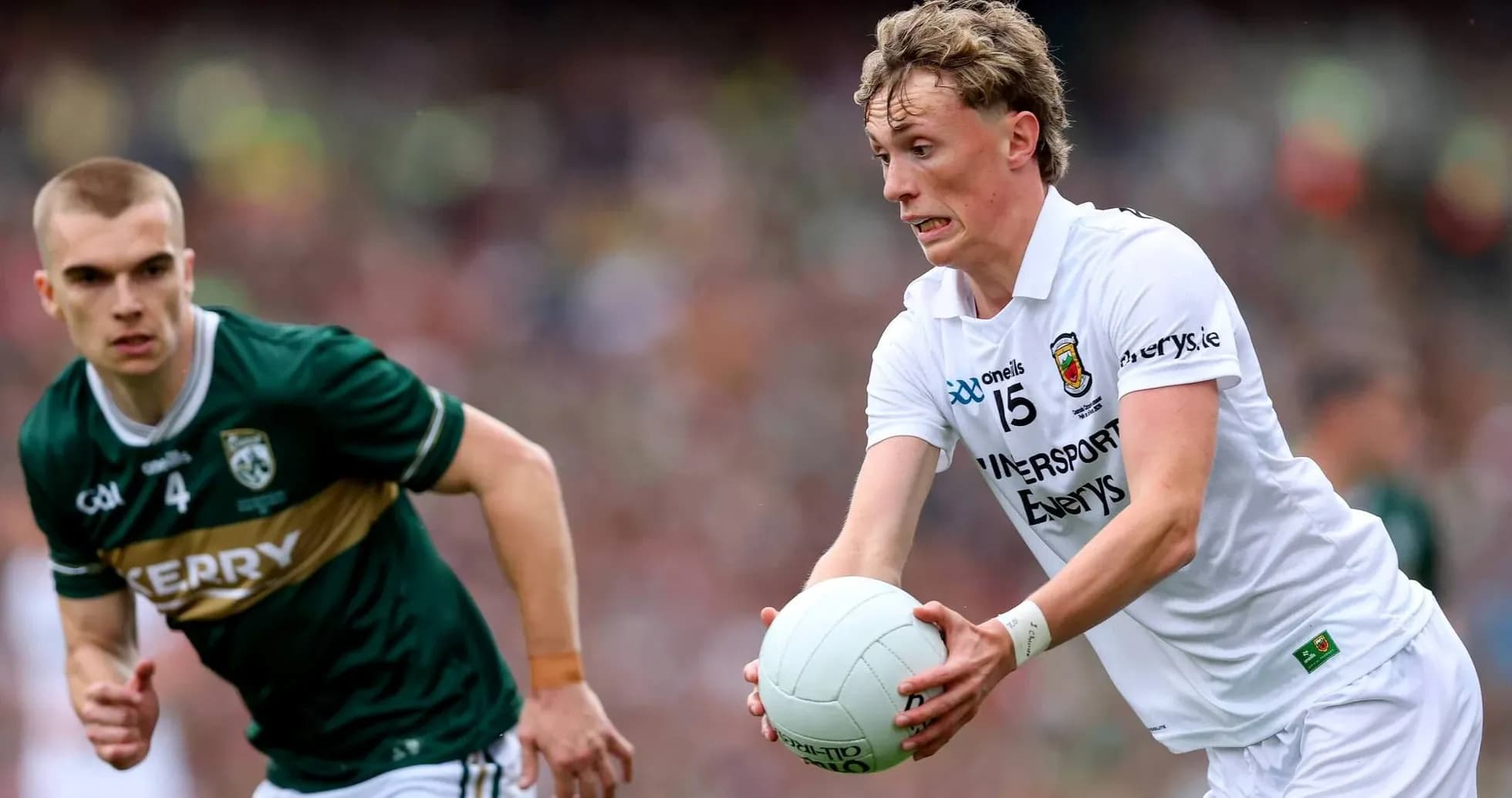
Whose point was that, really? Whose mistake?
Kobe McDonald had tracked Donal O’Sullivan Casey diligently, stride for stride, as he burst from deep. Then he hit the brakes on halfway, like Wile E Coyote at the canyon’s edge, because he couldn’t afford to breach. One step further and he’d abandon the defensive shape Mayo had drilled for months.
Eoin McGreal hovered nearby, but his body was turned away from the ball, locked instead on Paudie Clifford. Jordan Flynn took over the Casey run for a moment, shadowing him until the ball was laid off. Then instinct kicked in. Flynn went hunting the ball. Casey kept going. Clifford found him. Kerry had their opening point.
So whose fault? McDonald for not gambling? McGreal for not peeling off Clifford? Flynn for not staying with the runner he’d picked up? Or is that entire line of questioning missing the point?
These are the margins that turn All-Star debates into a minefield. They’re the reason any final team feels, at best, like an educated compromise. It’s judgement, not algebra.
Every season, the same demands roll in. More input from current players and managers. More numbers. More weight on league form or on those grim, wind-lashed days in early summer when nobody is at full tilt but everything still counts. Everyone wants the magic key, the single metric or insight that will make sense of the chaos.
Players chase the one tweak that nudges them into a starting 15. Managers search for the one adjustment that makes this year different from all the others. Journalists hunt for the one clean explanation that separates winner from loser.
But games don’t bend to neat storylines. Seasons don’t either. Neither do careers. A tidy, single-factor explanation makes for a comfortable narrative; the truth is a mess of overlapping details, roles, moments and decisions, all tugging in different directions.
And the tools we use to judge? They’re skewed.
The modern GAA numbers machine is built around possession. Kickout wins. Shots. Scores. Assists. All the shiny things that happen when a team has the ball. They’re easier to track, easier to understand, and, bluntly, easier to sell.
Those numbers matter. They should influence decisions. But context keeps barging its way back into the room.
Take Mayo’s 2026 championship. Their leading assisters? A three-way tie: Ryan O’Donoghue, Kobe McDonald and Jack Carney. Next on the list: Sam Callinan, who set up 13 points and scored with both of his own shots. From corner-back.
How much weight do you give that? How far does a corner-back’s assist tally move the needle when you sit down to pick an All-Star team? It’s not a trick question; it’s exactly the kind of uncomfortable one that has to be asked.
There are defensive metrics too. Tackles. Turnovers. Some counties track “breaches” – the moments when a defender is beaten by man or ball. Those numbers exist, but they’re laborious to gather, rarely standardised, and seldom pushed into the public domain. They’re also, to be blunt, less glamorous than a highlight reel of booming scores.
Then there are matchups, the lifeblood of any serious defensive analysis. How often did you hear this one this year: Jack Coyne held his direct marker scoreless from play in his last four games?
On the surface, that’s a dream stat for an All-Star campaign. But you scratch it, and it needs a second look.
Coyne started the All-Ireland final on Dylan Geaney. McGreal went to Paudie Clifford. As the game wore on, the picture changed. Midway through the second half, both McGreal and Geaney were gone. Coyne ended up on Clifford.
For Kerry’s last point, Clifford took the ball outside the D and squared Coyne up. One sidestep. Then another. Then the slip past on the left and the score. A classic Clifford moment, but a reminder too: that “scoreless from play” line suddenly doesn’t sit as neatly as it did.
None of this means Coyne didn’t deserve his recognition or that he didn’t have a superb season. It just shows how quickly a headline stat can fray once you tug on the thread.
The game itself has shifted under defenders’ feet. Rules, conditioning, systems – all of it leans towards the attacker. For backs, the job description has changed. You don’t always “win” your duel any more; sometimes you bend, slow, spoil, and hope the dam doesn’t burst. You call switches. You cover space. You track decoy runners so someone else can double the danger man. On paper, it looks like you’ve done nothing. On video, it’s the opposite.
Look at David McBrien. Against Roscommon in the championship, he struggled at midfield. Against Monaghan, Bobby McCaul gave him serious problems. Louth’s Ciaran Downey kicked 0-4 directly off him. On the stat sheet, those are heavy marks against his name.
Yet McBrien’s role is rooted in structure: doubling up, dropping as a sweeper, knitting together a defensive unit that doesn’t always get to show off. In the All-Ireland decider, he was a legitimate Player of the Match contender. How do you square those earlier battles with his influence on the biggest day?
Injury complicates everything again. Matthew Whittaker spent a huge chunk of his season playing through knocks. How much slack do you cut for that? How much extra credit for what he produced despite it?
Jordan Flynn’s case is another tangle. His work-rate in a centrefield that was often under siege doesn’t always translate into neat numbers. You see the graft in real time – the covering runs, the hits, the line-breaking carries – but it can vanish in a spreadsheet.
Paudie Clifford’s year might be the most awkward to box off. Eight championship games. Across the final three in Croke Park, he hit 0-13, with 0-9 from play. Those are outrageous returns at that stage of the season. Yet earlier in the campaign – against Cork, Donegal, Armagh – various impediments blunted his influence. So what matters more: his body of work across the summer, or the fact that when the stage was biggest, he caught fire?
These are not side notes. They are the heart of the argument.
The system can get better. It should. For the Tailteann Cup Team of the Year, players and management already submit their own selections. That layer of insider perspective gives selectors more to chew on. A mid-championship stock-take could stop early-season excellence from being forgotten by the time the lights go up in Croke Park.
Sponsors could go further again, commissioning an independent data report from an analysis outfit like GAA Insights. Put that on the table for the selection meeting. Use it in the public rollout. Let it fuel the rows in living rooms and bars when the final 15 is named.
Because this is what you’re really trying to weigh: individual tallies against collective duties. Injury history against peak form. A player’s defining moments against his unseen, unglamorous labour. Fitness curves, tactical roles, intangibles – leadership, temperament, resilience under pressure.
There is no clean answer. There never will be. Claiming otherwise doesn’t just oversimplify the game; it sells short the players who live inside all that complexity, and the people tasked with judging them.





