
The True Value of Shirt Numbers in Football
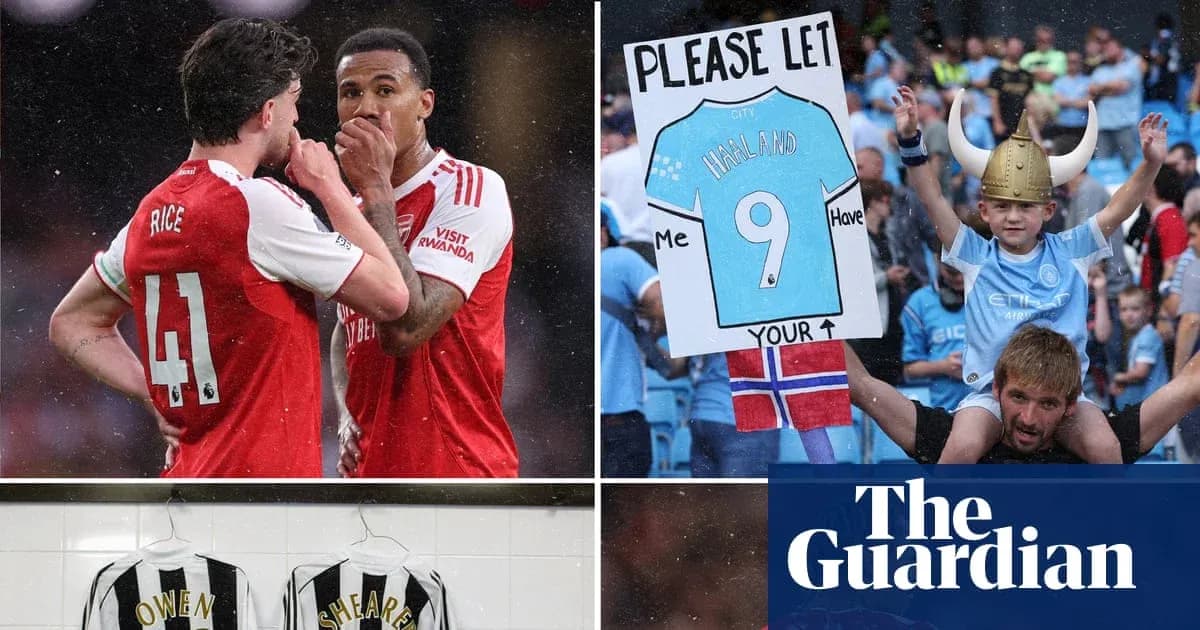
At the club shop, it’s simple enough. Arsenal will charge you £8 to stick two digits on the back of their 2026-27 home shirt. Manchester City want double that — £16 — whether you add just a number or go the whole way with a name. A few taps on a screen, a whirr of a printer, and your chosen number is yours.
On the pitch and in the dressing room, the economy is very different.
In baseball, the market is brazen. When Juan Soto joined the New York Mets last year and wanted his favoured 22, he didn’t haggle over a dinner or a watch. He bought Brett Baty a $92,000 (£69,000) car. One number, one key to his identity, traded for a luxury vehicle. That’s a sport where players can even wear ‘0’. The culture says: if it matters to you, pay for it.
Football has never quite gone that far, yet the landscape is far stranger than a glance at a shirt rail suggests. Nobody has taken ‘0’ in the modern game, but almost everything else has been tried. According to Transfermarkt, every number from 1 to 99 has been worn at some point by at least one of the current Premier League clubs. Only when you climb above 45 do the gaps begin to appear.
Those gaps are not where you might expect them. Brentford and Manchester City, for instance, have never handed out a 46. But Brentford have gone all the way to 99, while City have issued a 98. So the upper reaches of the squad list are not a carefully curated hierarchy. They’re a collage of academy promotions, mid-season signings and the occasional player who simply fancies something odd.
Chelsea, for years accused of buying half of Europe every summer, have never gone above 81. That’s their ceiling. Everton, meanwhile, offer the best riddle on the board: already on to their second No 10 of the 2026-27 season, yet nobody at Goodison is wearing the No 7 or No 9. The classic winger and the classic centre-forward lie vacant, while the playmaker’s shirt passes from one owner to another.
For most of football’s history, this would have been unthinkable. Numbered shirts first appeared in 1911, but for decades the logic was strict. The starting XI wore 1 to 11, with each number tied to a position. No 1 in goal, 9 up front, 10 in the hole, 7 on the right, 11 on the left. The number belonged to the role more than the man.
Even then, some players elevated certain shirts. Kenny Dalglish in Liverpool’s No 7 turned that piece of cloth into something more than a simple identifier. But if Dalglish missed a game, someone else pulled on the same shirt and took the same number. The shirt stayed; the aura moved around.
Now, the power has shifted. In the era of personal brands and global marketing, the number can mean more to the player than the crest on the front. It’s on their boots, their social media handles, their clothing lines. Change clubs, keep the number if you can. It follows them like a logo.
The numbers still carry echoes of tradition. Opta’s data on Premier League goals since squad numbers arrived in 1993 shows the top five scorers are the shirts between 7 and 11. Those are still the glamour numbers, still the most productive. After that, the rankings get murkier.
Thierry Henry did enormous work for No 14, but he didn’t do it alone. There have been almost 1,300 goals scored by players in that shirt. Now try to think of the main contributors to the 1,100-plus goals racked up by numbers 17, 18, 19 and 20. You might find yourself hesitating. The goals are there, but spread across generations of players who never turned their number into a global symbol.
Goals, though, are only one way of measuring value. Transfermarkt’s crowd-sourced market valuations, imperfect but influential, sketch a different picture of worth. They estimate what a player might cost based on age, position, performance and reputation. Not a transfer fee, but a temperature check.
Run those numbers by shirt, and the hierarchy becomes surprisingly fluid. The 13 players rated at €100m or more in the 2026-27 Premier League share 10 different squad numbers between them. The most striking absence from that elite group is No 11 — a number that once felt nailed on for a superstar in the age of Mohamed Salah’s peak years at Liverpool.
The classic centre-forward’s shirt still has its standard-bearer. Erling Haaland, in City’s No 9, is the most valuable player in the division. Yet he is the only No 9 in the top eight by individual valuation. João Pedro also sits in the €100m bracket, but when you look at the total market value of all players wearing each number, the crown does not belong to the 9.
Across the league, No 10 comes out on top with a combined value of €766m, just ahead of No 9 on €752m and No 7 on €683.5m. Those three shirts remain the heavyweights in terms of total investment. But none of them boast the highest average value per player.
That honour belongs to a number that, for most fans, barely registers.
Ask yourself: who wears No 41 for Chelsea? For Manchester United? For Newcastle? Unless you follow those clubs closely, you may draw a blank. Even some season-ticket holders might need a moment. Yet when you add Arsenal’s Declan Rice to that group, alongside Estêvão, Harry Amass and Jacob Ramsey, the picture changes instantly.
Rice alone drags No 41 into rare air. On average, across the Premier League, that unfashionable, awkward-looking number is now the most valuable shirt. It beats the 7, the 9, the 10 — the numbers that built football mythology.
In another era, the table would look very different. Go back to 2018 or 2019 and you’d find more of the traditional 1 to 11 near the top of the value charts. N’Golo Kanté and Raheem Sterling both hit the €100m mark in No 7. Eden Hazard, Harry Kane and Sadio Mané did the same in No 10. Back then, the most precious shirts aligned more neatly with the old positions.
Today, the game has scattered its riches. Talent sits in 41 as comfortably as it does in 7 or 10. The shirt number is no longer a simple shorthand for status. It’s a personal statement, a quirk, a brand — and occasionally, thanks to a player like Rice, a statistical outlier that turns a once-forgettable number into the most valuable on the board.
The next superstar might not want 7, 9 or 10 at all. He might look at 41, see what it represents now, and decide that’s the number he wants to make his own.





