Top Center Risers and Sleepers for Fantasy Drafts
In most fantasy drafts this fall, the center conversation starts and ends with Nikola Jokić and Victor Wembanyama. Then reality hits. You’re sitting at pick 8, or 14, or 27, and those two unicorns are long gone. That’s where this season really gets interesting.
In Yahoo’s High Score format — where only your best game of the week counts — the middle and late rounds at center become a hunting ground. Volatile bigs with massive ceilings suddenly turn from headaches into weapons. These six risers and sleepers won’t cost you a premium pick, but they can swing a matchup with one monster night.
Center Risers
Kel’el Ware, Milwaukee Bucks
Kel’el Ware is the kind of big who can win you a week in a single outing.
The shooting came first. After a shaky 31.5% from three as a rookie, he jumped to 39.5% last season. The rest of the stat line followed. In only 22 minutes a night with Miami, he delivered 11.1 points, 9 rebounds, 0.8 steals, 1.1 blocks and 1.2 threes. Those are starter numbers hiding in a bench role.
Give him real minutes and he explodes. In the 10 games where he cleared 30 minutes, Ware averaged 18.1 points, 14 boards, 1.1 steals, 3.3 blocks and 1.8 threes. That’s not a tease — that’s a blueprint.
The trade that sent Giannis Antetokounmpo to the Heat pulled Ware the other way, dropping him into Milwaukee as a long-term piece in the frontcourt. Myles Turner starts the year ahead of him, but the Bucks are clearly pivoting into a new era. That usually means younger legs get more runway as the season wears on.
Early on, pencil him in for around 25 minutes with room to climb. In High Score leagues, those 30-minute spikes are the whole selling point. A game with 14 rebounds and 3 blocks is worth about 23 fantasy points before you even touch his scoring. When Ware hits his ceiling, he’s as explosive as anyone in his draft range — and because only his best night counts, the inconsistency that scares managers in standard formats barely matters here.
Mitchell Robinson, Boston Celtics
Mitchell Robinson quietly reminded everyone what he can do last season.
Behind Karl-Anthony Towns in New York’s title run, he carved out 60 appearances — his most since 2021-22 — and gave the Knicks 19.6 minutes of pure rim-running and paint protection. The line was familiar: 5.7 points, 8.8 rebounds, 1.2 blocks, a ridiculous 72.3% from the field. Low usage, high impact.
Boston saw enough to move. They handed him a three-year deal after a year in which Neemias Queta overachieved, Nikola Vučević arrived, and the rotation never truly clicked. Robinson steps into a frontcourt that still needs a defensive anchor and a vertical threat.
His health history makes 30 minutes a night a fantasy, not a projection. Something closer to 25 is realistic, and that’s all you need.
High Score formats strip away his biggest flaw: free-throw percentage doesn’t matter. That turns Robinson into a specialist built for this scoring system. A 16-rebound, 3-block outing — fully within his normal range — lands at roughly 25 fantasy points without him scoring a single basket. If he adds a few put-backs on top, you’re staring at a week-winning line.
Nic Claxton, Chicago Bulls
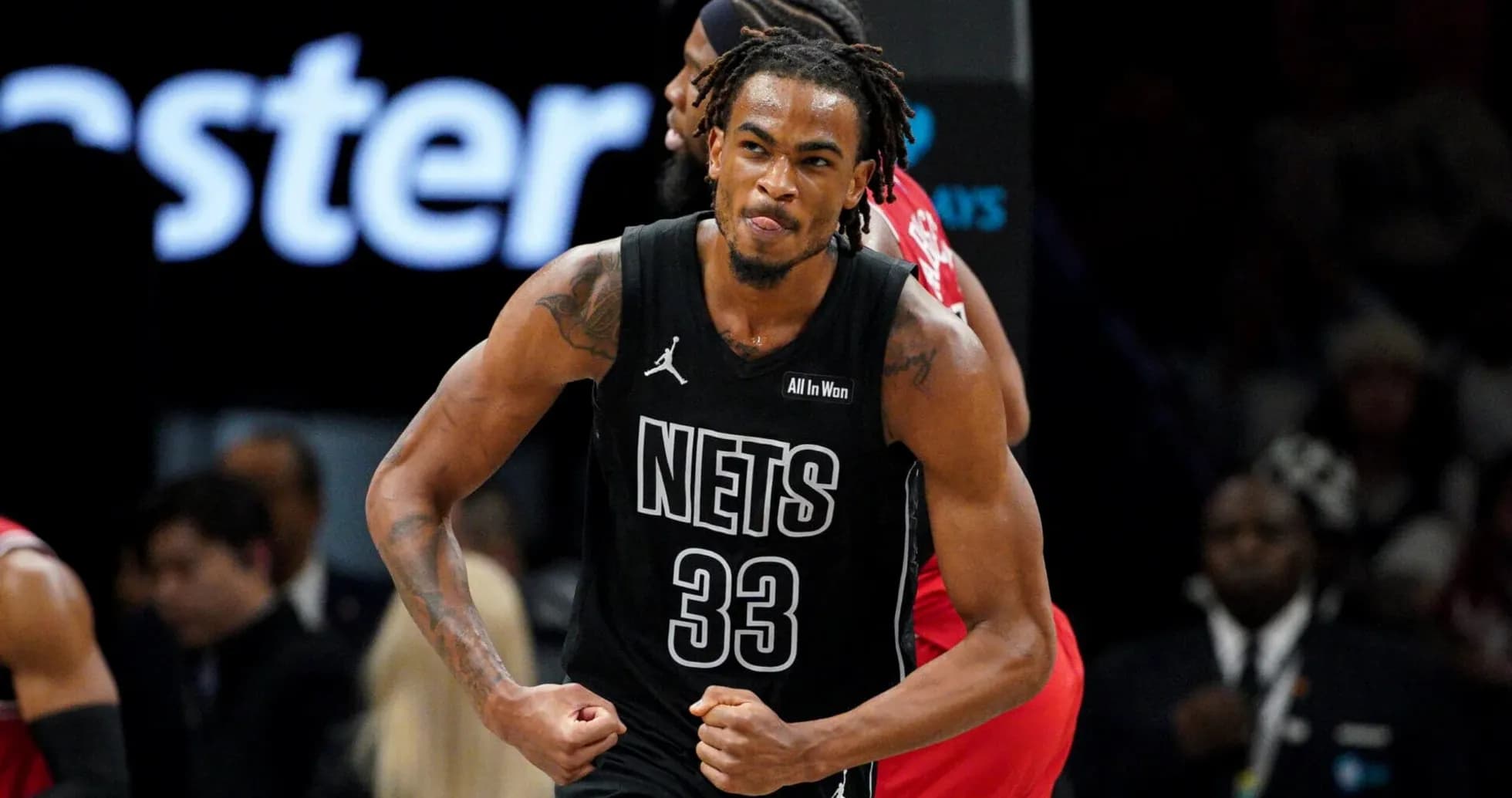
Nic Claxton arrives in Chicago as the centerpiece of a changing frontcourt.
The Bulls moved on from Vučević at last year’s deadline, ending a long run of steady double-doubles in the middle. They responded this offseason by prying Claxton out of Brooklyn, betting on a more modern, switchable big who can do a bit of everything.
His raw numbers dipped on a young Nets team last year — 11.7 points, 6.9 rebounds, 3.7 assists, 1.1 blocks — but one line jumps off the page: the assists. Claxton has already shown he can post back-to-back seasons of at least 11.8 points, 9.2 rebounds and 2.1 blocks. Add the playmaking growth and you get a center with a wider fantasy profile than people realize.
Chicago’s context helps. This isn’t a bare rebuild. Caleb Wilson, Matas Buzelis and Josh Giddey form a promising young core, and Giddey is one of the league’s sharpest passers. The lob game between Giddey and Claxton should be a staple of the Bulls’ offense.
Under High Score rules, Claxton stands out as the most complete scorer in this group. He can give you points, boards, blocks and assists in the same night. A 10/10/3 line with two blocks translates to roughly 32 fantasy points. That’s a star-level weekly spike from a player you don’t have to pay star prices for.
Center Sleepers
Hannes Steinbach, Charlotte Hornets
Charlotte’s frontcourt is crowded, but it’s not settled.
Moussa Diabaté seized the starting center job in December on energy and effort. He rebounded, defended, did the dirty work. He also barely shot. Even at 63.1% from the field, he averaged just 7.9 points on an 11.2% usage rate. The Hornets clearly wanted more scoring punch up front.
They moved for Naz Reid from Minnesota, a proven bucket-getter who should split time between power forward and center, especially with Miles Bridges gone. Then they added Hannes Steinbach in the draft, and that’s where the long-term intrigue kicks in.
Steinbach arrives from Washington with a polished offensive résumé: 18.5 points, 11.8 rebounds and 1.2 blocks per game in college last season. The rebounding translates, the touch around the rim is there, and his frame fits the modern five.
In High Score leagues with only 10 roster spots, stashing a rookie is a real cost. For now, Steinbach is more “watchlist” than “draft-and-hold.” But if minutes open up — through injury, trades or a coaching shake-up — his rebounding alone can make him relevant immediately. One breakout week is all it takes to justify the add.
Day’Ron Sharpe, Brooklyn Nets
Someone has to take the minutes Nic Claxton left behind in Brooklyn. Day’Ron Sharpe has the inside track.
The Nets added Julius Randle and drafted Mikel Brown Jr., with Moritz Wagner also in the frontcourt mix. Randle will soak up usage and can play small-ball five in stretches, but he doesn’t solve the traditional center role. Sharpe does.
We’ve already seen a glimpse of what he looks like as a starter. He opened seven games last season, averaging 28 minutes in those starts compared to 18 off the bench. In that role, he produced 11.1 points, 7.9 rebounds, 3.6 assists and 1 block per game. That’s a versatile line for a big, and it fits neatly into Brooklyn’s youth-driven approach.
Translate that starter profile to High Score and you get a player who can crack 30 fantasy points in any given week. That’s top-30 value at the position, available in the late rounds. Sharpe doesn’t need to hold that level every night — he just needs to reach it once a week.
Khaman Maluach, Phoenix Suns
Khaman Maluach is the kind of name you circle now and wait on.
Phoenix took him 10th overall in the 2025 Draft out of Duke, fully aware he was more project than finished product. His rookie year reflected that: 46 games, 8.9 minutes per night, flashes more than stretches.
The depth chart in front of him looks straightforward. Mark Williams returns as the starter on a new three-year deal. Oso Ighodaro is in the mix after filling in last season. On paper, Maluach is the third center.
But the door is already cracked open. Williams has battled injuries throughout his career and underwent surgery to repair a torn labrum in his left shoulder, a procedure that could sideline him for an extended spell. If those minutes become available, someone has to claim them. Maluach carries the higher long-term upside of the two backups.
For now, fantasy managers are right to let him go undrafted in most leagues, especially with 10-man rosters in High Score. He doesn’t belong on your bench yet. He belongs on your waiver radar. If Phoenix’s rotation loosens as expected while Williams recovers, Maluach is the first pickup you make at center — and maybe the one that changes your season.