The Spurs' Winning Streak: Wembanyama's Impact
The Spurs have their edge back. Ten straight wins say so. The way they’re doing it says even more.
A week into the season, San Antonio looked wobbly, still rubbing its eyes after a deep playoff run. Since then, they’ve ripped through the schedule and rebuilt something more dangerous than momentum: a clear identity wrapped around Victor Wembanyama.
This isn’t just “give Wemby the ball and see what happens” anymore. It’s a system.
The Wemby system, finally organized
Last year, possessions often started with 14 eyes staring at Wembanyama, waiting to see what he felt like doing. Teammates reacted. Offenses stalled. In the postseason, that hesitation showed up in every half-court grind.
That version of the Spurs is gone.
Now, the offense runs through Wembanyama with intention. The timing around him is sharper. The guards aren’t just watching; they’re arriving. Cuts are synced to his reads. Lobs come from better angles. He’s planting off two feet, powering through contact instead of drifting away from it.
The result: the ball moves with him, not after him.
San Antonio still isn’t shooting the lights out. They don’t have to yet. What’s changed is the structure. They look like a team that knows exactly where its star wants the ball, where he wants his cutters, where he wants his release valves. It’s the closest thing they’ve had to a fully formed Wembanyama offense.
The shots will eventually have to fall. But the bones of something serious are already in place.
Three guards, one identity
The boldest choice Mitch Johnson has made is also his cleanest success: the three-guard starting lineup.
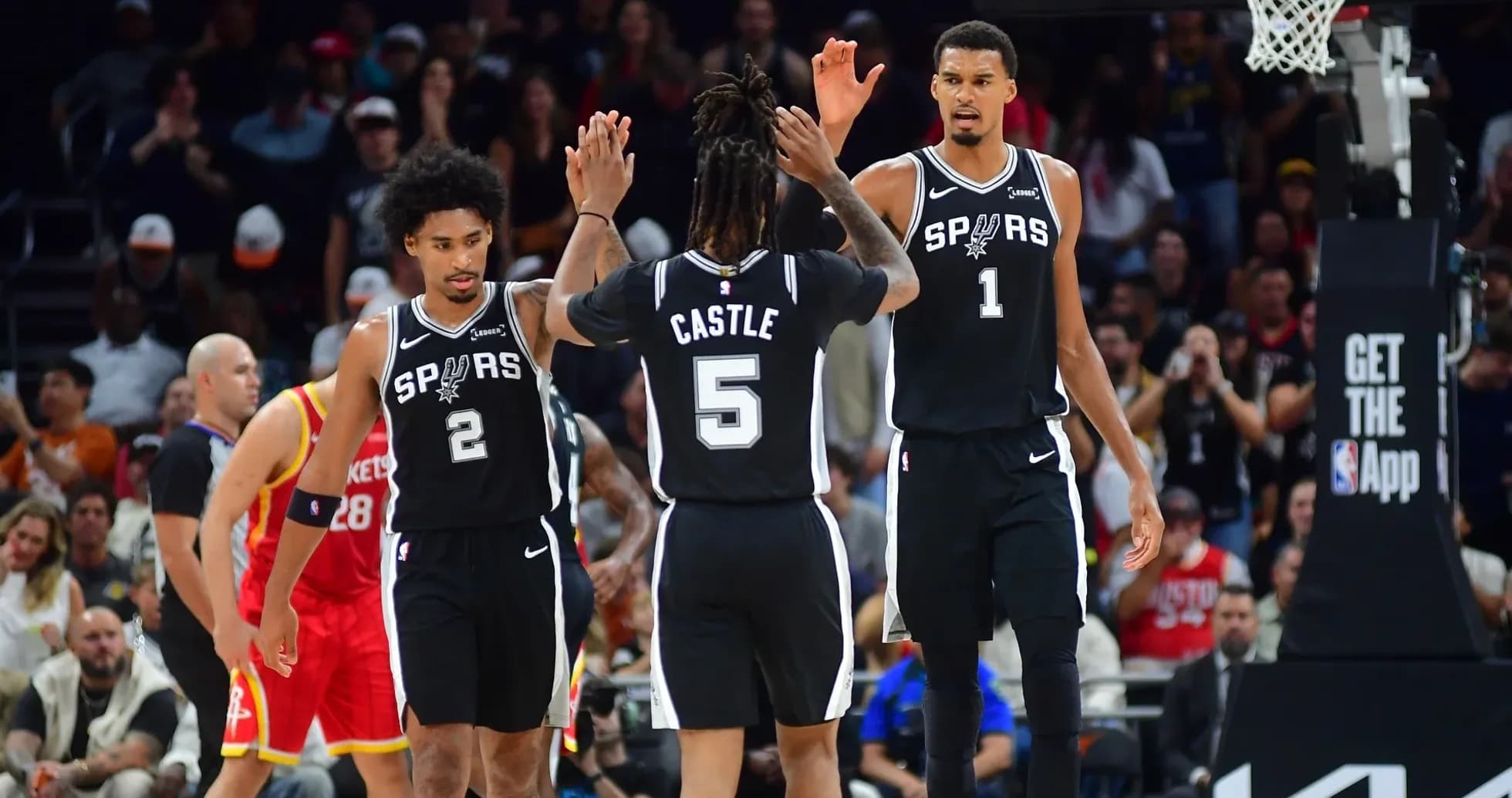
De’Aaron Fox, Stephon Castle and Dylan Harper, flanking Wembanyama, have turned into a battering ram of a unit. A plus-30.3 net rating over 10 games isn’t a blip; it’s a warning. Their raw plus-minus of plus-68 leaves even the best lineups, including the Los Angeles Lakers’ top group, chasing.
You can see it as soon as they check in together. They choke off the paint. They chase shooters. They funnel everything toward Wembanyama, who closes off the rim like a vault door.
Opponents are shooting just 32.4 percent on 2-pointers against that group. That number is absurd. It also matches the eye test: ball-handlers turn the corner, see length everywhere and either pull up for contested jumpers or drive straight into trouble.
Offensively, it’s not pretty yet. The spacing is imperfect. Defenses are happy to sag off Castle and live with his open 3s. He’s been solid enough to keep them honest, not yet punishing enough to flip the geometry of the floor.
But the lineup doesn’t bleed points inside the arc. It survives ugly stretches because it strangles you defensively. That’s playoff DNA, even if the sample size still needs postseason proof.
As Castle settles into which shots are his and which aren’t, the ceiling rises. The floor, thanks to that defense, already looks high.
Mitch Johnson’s minute math
Johnson admitted in Chicago that the early-season rotation chaos wasn’t about matchups. It was about discovery. He had to rewire his substitution patterns the moment Dylan Harper moved into the starting lineup.
Harper used to be the spark plug, the mid-quarter scoring jolt that kept the offense from going flat. Once he joined the opening five, that security blanket disappeared. San Antonio suddenly needed to find a way to keep at least two point guards on the floor without burning them out.
The answer has been a more surgical use of Fox.
Fox now checks out early in the first quarter, grabs a quick breather, then returns to run the second unit around the four-minute mark. He stays on into the second and fourth quarters while Castle takes longer, more demanding shifts. It’s a rhythm play: Fox gets shorter, frequent breaks; Castle gets longer stints at full throttle.
The bench is starting to crystallize around Fox, Julian Champagnie, Keldon Johnson, Luke Kornet and one of Harper or Castle. Carter Bryant and Harrison Barnes slip in during those early second- and fourth-quarter minutes when Wembanyama returns, giving the Spurs a Fox–Wembanyama short-roll engine to lean on while the young guards rest.
That’s the spine of a real rotation, not a preseason experiment. And it’s working.
It should only stabilize further when Tobias Harris comes back.
Where Tobias Harris fits
If anyone wondered why San Antonio went and got Harris in the summer, the opening weeks of the season answered it bluntly.
This team needs another scorer who can bend a defense without a screen, someone who doesn’t require a runway or a high pick-and-roll to get to his spots. Someone who can catch at the elbow, read the floor and tilt it.
Right now, most of their post work belongs to Wembanyama, with the occasional Castle possession sprinkled in. Fox and Harper can back down smaller guards, but that’s more stalling than sculpting — a way to hold up the ball while they reroute their attack.
Harris changes that calculus.
Put him at the high post, and the gravity shifts. He can face up, shoot over the top, drive either way or hit cutters slicing behind overplays. Unlike San Antonio’s straight-line drivers, Harris plays with a natural rhythm, a looseness that makes his decisions hard to predict.
For a second unit that can bog down into “Fox or bust” stretches, that kind of secondary hub matters. It gives the Spurs a different flavor of offense without asking Wembanyama to do everything, every trip.
When he returns, the rotation doesn’t just get deeper. It gets more versatile.
No finals hangover, just continuity
The most impressive part of this 10-game surge isn’t in the numbers. It’s in the room.
Teams that ride chemistry to the NBA Finals often come back warped. Roles shift. Egos swell. The light gets brighter, and so do the shadows.
San Antonio hasn’t cracked.
The same easy humor still bounces around the locker room. The same inside jokes land. Mitch Johnson’s voice still booms, still draws laughter instead of eye-rolls. After the win in Chicago, it was Harris pushing a team burger run, hurrying everyone to get dressed so they could enjoy the streak together — and catching plenty of friendly fire for it.
The leadership structure hasn’t twisted. The way teammates talk about Wembanyama hasn’t changed. Barnes remains the veteran compass. Younger players still orbit around the same voices. A deep playoff run didn’t fracture anything; if anything, it reinforced the hierarchy.
Wembanyama was asked about a finals hangover and brushed it off.
“I would’ve expected it,” he said. “But I didn’t feel it.”
It didn’t look that way in the preseason, or in the opener against Oklahoma City, when the Spurs stumbled out of the gate. But the last 10 games have told a different story.
They now have a coherent identity. Only a handful of players are truly in rhythm. The shooting can climb. The rotations can tighten. Harris hasn’t even rejoined the mix.
The framework is already standing. What happens when this team starts hitting its ceiling instead of just its stride?