
Ronald Koeman Defends Frenkie de Jong Amid Barcelona Scrutiny
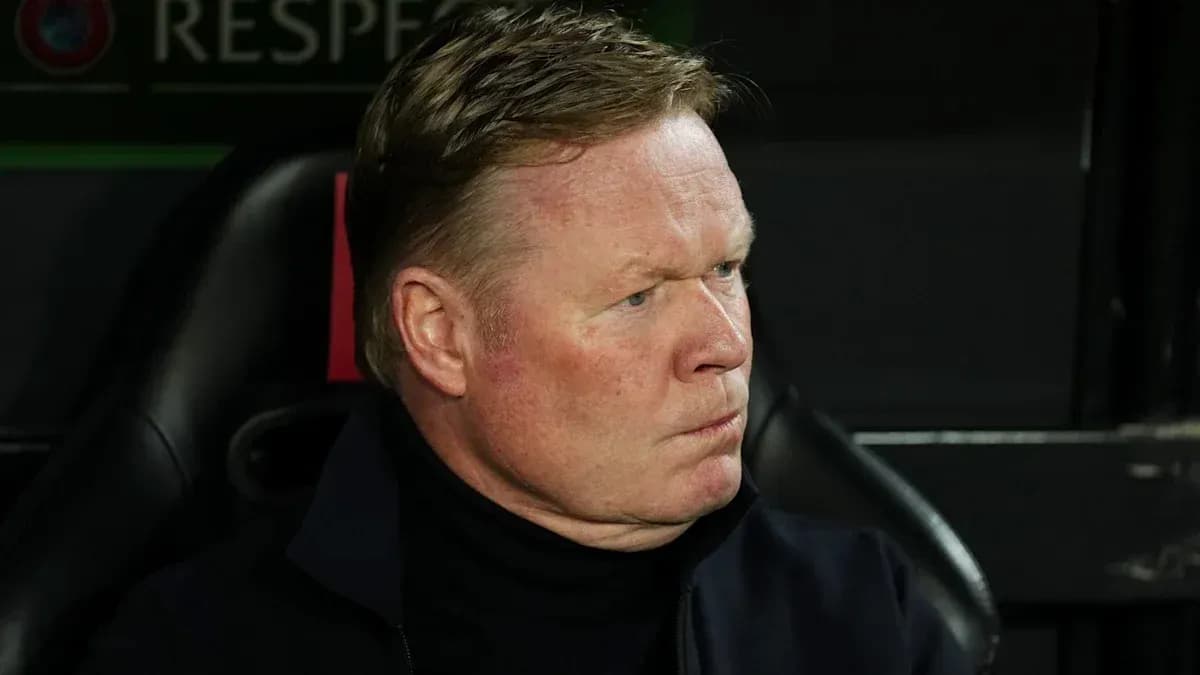
Ronald Koeman has never been one to follow the noise. While the debate around Frenkie de Jong grows louder with every Barcelona stumble, the former Barça and Netherlands coach cut straight through it: this is not a player in decline, he argued, but one fighting his way back from two bruising years with his body.
The criticism has been relentless. The patience, less so. De Jong, once the symbol of Barcelona’s future, now finds every misplaced pass and every subdued performance dissected as if it were a referendum on his entire career. Koeman, who knows both the club and the player as well as anyone, pushed back.
“He’s a great player,” he said, reminding everyone of the obvious before pointing to what many conveniently forget: “He’s had injuries the last two years and it’s always hard to come back. It happened to him in the European Championship, and also in the World Cup.”
Those tournaments were supposed to be De Jong’s grand stages. Instead, they became markers of frustration, his rhythm broken, his continuity shattered. For a midfielder whose game depends on timing, confidence and sharpness, that matters. A lot.
De Jong the defender? Koeman shrugs
Hansi Flick’s recent decision to use De Jong at right-back against Atletico Madrid stirred another round of commentary. Was this a misuse of his talent? A sign he no longer commands the midfield? Koeman, again, refused the drama.
He’d seen it before. In fact, he’d done it himself.
“He can play at full-back, and also at centre-back; he did it with me. He can play in different positions,” Koeman noted, treating the switch as a tactical tool, not a demotion.
For Koeman, De Jong’s versatility is an asset in a squad stacked with technical midfielders. Barcelona’s dressing room is crowded with quality; there are, as he put it, “very good players at Barça.” In that kind of environment, adaptability keeps you on the pitch.
And yet the scrutiny never really leaves. Every touch at Camp Nou — or Montjuïc for now — carries weight. Koeman, who has lived that pressure from the dugout and the pitch, believes De Jong is built to handle it.
“He knows the pressure at Barça. I don’t see any problems. He’s always said he wants to play for Barça, and that’s what he’s doing,” he said. No alarm. No crisis. Just a reminder that this is a player who chose the club, resisted lucrative exits, and continues to absorb the demands that come with the shirt.
La Liga belief, Champions League caution
Koeman didn’t stop at De Jong. His assessment of Barcelona under Flick carried a familiar mix: optimism about the league, caution about Europe.
Domestically, he sees a team capable of going the distance. The football, in his eyes, is at a level that can deliver another La Liga title. The structure is clearer, the squad deep, the performances strong enough to sustain a campaign across 38 games.
Europe is another story.
“The Champions League is a different matter,” he warned. Barcelona, he believes, belong among the favourites, but history has taught him that the competition’s sharp edges only reveal themselves when the knockout rounds arrive.
“They are one of the favourites, but there are other strong teams too, and when the knockout stages come around, there are always tricky moments.”
Those “tricky moments” have defined Barcelona’s recent Champions League history: collapses, missed chances, brutal exits. Koeman knows that narrative all too well. His words carried the weight of experience rather than fear — a recognition that talent alone never guarantees anything under the bright lights of Europe.
A nod to Xavi and the Dutch connection
There was also space for a quieter compliment. Koeman reserved praise for new Netherlands manager Xavi Hernandez, a man who, like him, carries the dual identity of Barça icon and national figurehead.
“He’s doing a great job,” Koeman said, a brief but pointed acknowledgment from one former Barcelona midfielder-turned-coach to another now leading their country.
In the middle of all this, De Jong sits at the crossroads of club and country, expectation and reality. For some, he has not yet become the dominant force they imagined when he arrived from Ajax. For Koeman, the picture is simpler: a top-level footballer, battered by injuries, still trusted to play across the back line and midfield, still committed to the club, still under the harshest spotlight in Europe.
The debate around him will not fade quickly. But if De Jong’s body finally gives him a clear run, the question may soon shift from whether he can cope with Barcelona — to whether Barcelona can afford not to build around him.





