Power Shifts in the Southeast Division: Giannis, Young, and Ambitious Teams
The Southeast has lived in the shadow of heavier hitters for years. Not this time. A generational force has walked through Miami’s door, Trae Young has changed uniforms but not conferences, and a handful of ambitious front offices have decided “good enough” isn’t nearly good enough.
This division is no longer a holding pattern. It’s a collision course.
Atlanta Hawks: Deeper, Meaner, and Still Jalen’s Team
Atlanta traded away the face of the franchise and somehow came out looking sharper. No Trae Young. No so-called superstar arrival. Yet the Hawks went 46-36, rode a breakout year from Jalen Johnson and punched into the first round of the postseason.
Now they arrive with something most teams spend years trying to build: a rotation that runs heavy and hard.
The additions don’t scream marquee, but they fit. Luguentz Dort and Aaron Wiggins arrive with championship habits from Oklahoma City, bringing a defensive and cultural edge that should travel. Dort, especially, changes Atlanta’s identity on the perimeter. Paired with Dyson Daniels, he gives the Hawks a snarling 1-2 defensive tandem that can hound elite guards and wings for 48 minutes.
Atlanta doubled down on shooting and composure by re-signing CJ McCollum. Slide him next to Nickeil Alexander-Walker and suddenly the backcourt offers plenty of scoring, spacing and late-game shot-making without having to dominate the ball the way Young once did.
The risk is obvious. The frontcourt is thin on proven, high-end big men. Henri Veesaar is a project, not a plug-and-play anchor. If the Hawks get pushed around inside over an 82-game grind, all that perimeter depth might feel like a luxury instead of a weapon.
On paper, this looks like a 50-win team with a puncher’s chance of climbing the ladder in the East. In reality, Atlanta might just as easily find itself fighting through the SoFi Play-In Tournament. The margin between those outcomes will be decided in the paint.
Charlotte Hornets: Betting Big on Change, Not Comfort
Most teams that finally crawl to respectability cling to what got them there. Charlotte did the opposite.
The Hornets went 44-38 with a young core and earned a place in the Play-In. Then they ripped out two pillars of that progress. LaMelo Ball and Miles Bridges are gone, both traded just as they were entering their prime years.
You don’t make those moves unless the offers are too strong to ignore and you trust the replacements.
The keys at point guard now sit with Coby White, who already showed promise after arriving from Chicago. He doesn’t have Ball’s flair, but he brings steadier decision-making and a more conventional scoring profile. Around him, Brandon Miller is poised to make the leap from “intriguing” to “inevitable.” A top-15 scorer in the league? Charlotte clearly believes that’s within reach, which is why Bridges’ scoring void doesn’t spook them.
The Hornets didn’t stop at star reshuffling. They stacked the rotation with proven role players. Grayson Allen’s shooting and edge, Dorian Finney-Smith and Royce O’Neale’s switchable defense, Naz Reid’s scoring punch at center, Dennis Schröder’s veteran handling of second units, Hannes Steinbach as another frontcourt option — this is a roster built to function, not just flash.
There’s danger in assuming chemistry will arrive on schedule. Strip out your two best players and you risk losing your identity. But if the pieces click quickly, this isn’t a step back. It’s a sharp turn toward a different kind of playoff chase.
Miami Heat: Giannis Arrives, and the Clock Starts Ticking
The Heat spent last season grinding. Tyler Herro played only 33 games, the offense sputtered, and yet Miami still clawed its way to 43-39 and into the Play-In. It felt like a holding pattern.
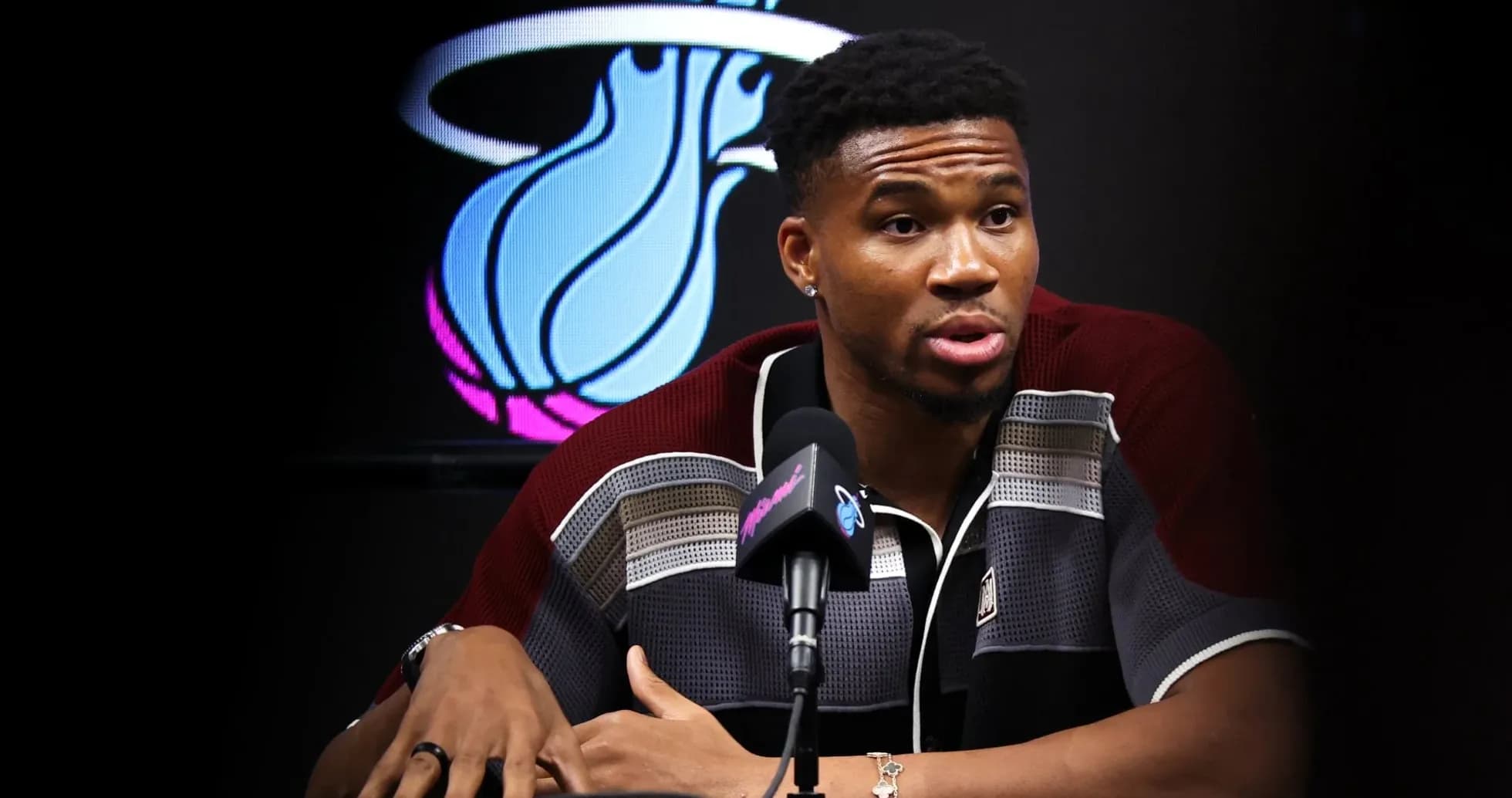
That’s over. Giannis Antetokounmpo is here.
Pat Riley has done this before — identify the generational piece, pay the price, reset the franchise’s ceiling. Giannis, a two-time Kia MVP and still one of the most terrifying two-way forces in the sport, instantly drags Miami back into the conversation no one wants to leave: who can actually win the East?
But there’s a timer on this version of the Heat. Giannis is 31, with an injury history and a game built heavily on explosive athleticism. For Miami’s gamble to pay off, he has to stay on the floor and stay himself.
He won’t have to do it alone. Bam Adebayo remains the perfect co-star, an All-Star-level big who covers ground, orchestrates from the elbows and takes on the toughest defensive assignments. Together, Giannis and Bam form what might be the league’s most intimidating defensive front line — reputation backed by results.
The cost of landing a player like Giannis is always depth. Miami shipped out Herro, Jaime Jaquez Jr., Norman Powell, Kel’el Ware and others. The rotation has been stripped of some of its easy scoring and shot creation.
So the Heat turn to what’s left — and what’s been added. Bobby Portis brings toughness, rebounding and a reliable jumper. Tim Hardaway Jr. offers instant offense. Klay Thompson, if he can squeeze out one more credible year of shooting, stretches the floor for Giannis’ relentless drives. Nick Richards adds size in the middle. Andrew Wiggins, already on hand, remains a swing piece on both ends.
Miami has its superstar. It has its defensive backbone. What it doesn’t have is time to waste. This isn’t a slow build. It’s a run, right now, as far into May and June as Giannis’ body will allow.
Orlando Magic: Stability, Health, and a Coach with a Mandate
Orlando’s 45-37 record last season came with an asterisk that nobody inside the locker room enjoyed. Franz Wagner played only 34 games. Jalen Suggs missed a chunk of the year, appearing in just 57. The Magic still made the first round, but they never really saw what this group could be.
So they changed the voice, not the roster.
Sean Sweeney takes over on the sideline, tasked with squeezing more out of a team that believes its internal growth curve is far from finished. Beyond that, Orlando stayed deliberately quiet.
The headline addition is actually a familiar face: Nikola Vučević returns to the Magic frontcourt. He and Izaiyah Nelson give Sweeney more options up front, but this wasn’t a splashy overhaul. It was a targeted reinforcement.
The real work came in-house. Orlando re-signed Vučević, Jonathan Isaac and Jevon Carter on team-friendly terms, keeping three rotation-level pieces without stressing the payroll. Isaac remains a defensive wild card when healthy. Carter adds toughness and ball pressure in the backcourt.
What the Magic want, more than anything, is a clean run. A full season of Wagner and Paolo Banchero together. A healthy Suggs in the guard rotation. A fair look at what this core actually is before the front office decides whether to double down or detonate.
If Sweeney’s system unlocks another level from Wagner and Banchero, Orlando’s patience will look like wisdom. If it doesn’t, the trade deadline — or next summer — could bring a very different kind of conversation.
Washington Wizards: A Starved Franchise Reaches for a Game-Changer
The numbers are brutal. One playoff appearance in eight years. No first-round series win since 2017. A 17-65 record last season, buried at the bottom of the Southeast while injuries and youth development swallowed any real momentum.
Washington had to change something. So it went big.
AJ Dybantsa is the new face of hope, a fresh jolt of energy for a fan base that has been waiting for a player who can tilt the floor on his own. He checks the boxes modern franchises crave: size, skill, star potential. More importantly for the Wizards, he arrives at a time when the organization is desperate for a player who can grow into “the guy,” not just another piece.
He won’t have to do all the heavy lifting from day one. The Wizards extended Trae Young, handing the offense to one of the league’s premier passers. His job is clear: make life easier for Dybantsa, for Alex Sarr, and for the wave of young talent trying to find its place.
The front office didn’t stop there. Deandre Ayton joins to stabilize the center spot. Khris Middleton adds experience, scoring and structure on the wing. Tre Mann and Felix Okpara deepen the rotation. The roster finally looks like it has a roadmap instead of a collection of experiments.
Hovering over all of it is Anthony Davis. His health, his availability, his long-term intentions — they hang over the season like a question the franchise can’t yet answer. When he’s right, Davis remains a high-impact two-way force, the kind of player who can anchor a defense and tilt a series. The problem is simple: nobody knows how long “right” will last, or whether Washington is his destination or just a stop along the way.
The Wizards have lived too long in the land of maybes. Dybantsa’s arrival, Young’s extension, the influx of veterans — all of it points to a franchise finally trying to step out of the shadows.
In a Southeast Division suddenly stacked with ambition and star power, the question isn’t whether change has come. It’s which of these teams will actually turn all this movement into something that matters in late April and beyond.