NBA's Middle Tier: A Crossroads of Careers and Expectations
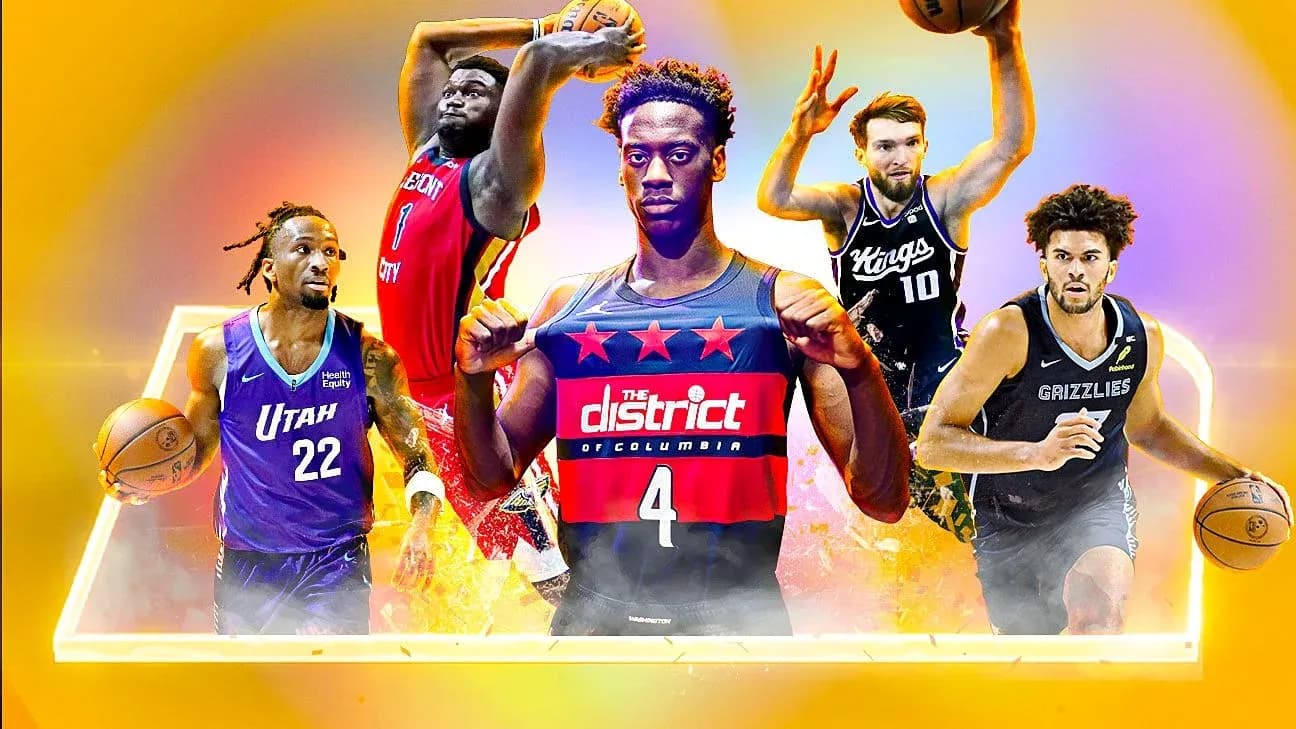
The middle tier of the NBA’s top 100 has always been where chaos lives. It’s where rising stars crash the party, former All-Stars fight for relevance and franchises quietly bet their futures on players who still haven’t hit their ceiling.
This year’s stretch from 78 to 51 is exactly that: a crossroads of careers, contracts and expectations.
A new No. 1, a familiar burden in D.C.
The Washington Wizards haven’t owned the draft for a long time. Not since John Wall in 2010. AJ Dybantsa changes that.
At 19, fresh off leading the nation in scoring at BYU with 25.5 points per game, the rookie forward arrives as the franchise’s first No. 1 pick in 15 years and the first college scoring leader to go No. 1 since Glenn Robinson in 1994. He doesn’t walk into a blank slate, either. Washington has a locker room that already mixes recent first-rounders with heavyweight veterans Anthony Davis and Trae Young.
Where he lands in that hierarchy will say a lot about two things: his Rookie of the Year case and whether the Wizards can finally escape a five-year stay in the lottery. The talent is obvious. The pecking order is not.
Projected: 20.1 points, 4.9 rebounds, 2.8 assists.
Morant, Lillard and the strangest backcourt in basketball
Ja Morant’s name at 77 feels jarring until you look at the numbers that don’t show up in a box score: games played. Just 79 over the past three seasons.
Portland is his new home now, and it’s crowded. Micah Nori has Morant, Damian Lillard, Jrue Holiday, Scoot Henderson and, eventually, Shaedon Sharpe to juggle. That’s not a rotation, it’s a traffic jam.
Morant remains one of only nine players since 2019-20 to average at least 20 points and seven assists. The production is there when he’s on the floor. The question is how often that will be, and how the Blazers carve out a lane for him in a backcourt already overflowing with ballhandlers.
Fantasy projection: 21.0 points, 7.2 assists, 3.8 rebounds.
Lillard, at 69, returns to Portland after missing all of last season with an Achilles injury. The last time he played, he was still a 25-point scorer shooting 38% from deep. He is the franchise’s all-time leading scorer and second in assists. Now he comes back to a different team, a different role, and a different stage of his career. Heartwarming? Yes. Simple? Hardly.
Projected: 21.7 points, 6.2 assists, 4.0 rebounds.
Culture changers, iron men and defensive terrors
Dillon Brooks has worn plenty of labels. “Dillon the Villain” was the loudest. Houston and Phoenix have a different one now: culture changer.
At 76, he lands in this range after averaging a career-best 20.2 points last season on a Suns team that unexpectedly surged in the West. Phoenix rewarded him with a three-year extension, just as Houston once did after jumping from 22 to 41 wins in his first season there. His shot profile isn’t pretty, but his impact keeps showing up in win columns.
Signature: top 10 in made two-point jumpers last season.
Mikal Bridges, at 61, is the league’s iron man. His 638 consecutive games played place him eighth all time, and he’s closing in on names like Harry Gallatin, Bill Laimbeer and Dolph Schayes. His scoring dipped last regular season, but when the playoffs hit, he shot 56% and hit big shots in New York’s run. He doesn’t miss games. He doesn’t shy from moments.
Fantasy projection: 15.2 points, 3.7 assists, 1.2 steals.
Ausar Thompson sits at 59 as the kind of defender coaches build schemes around. The shooting questions are real. His defensive impact is louder. He led the league in steals per game and finished second in total deflections, then nearly averaged four combined steals and blocks per game in the playoffs. Detroit has already locked him into a contract that could look like a bargain if his offense nudges forward. Without Victor Wembanyama, the Defensive Player of the Year conversation would sound very different.
Projected: 10.4 points, 6.0 rebounds, 2.0 steals.
Jaden McDaniels, at 56, is another perimeter stopper who’s starting to stretch his game. Known first for his defense, he climbed 19 spots after a career year: 14.8 points, 2.7 assists, 41% from three. His 32-point eruption in Game 6 to knock out Denver showed the offensive ceiling. With Julius Randle and Naz Reid gone and Donte DiVincenzo out long term, Minnesota will need more of that, even after adding LaMelo Ball.
He defended 2026 All-Stars for 1,163 matchups last season, fourth most in the league.
Big men with big stakes
Oklahoma City leans heavily on its frontcourt pairing at 74 and 75.
Isaiah Hartenstein, 28, has played only 94 games over the past two seasons, but when he’s available, he gives the Thunder a rugged interior backbone. He’s averaged a double-double while ranking fifth in total defensive net points, crashing the offensive glass and providing the physical edge that complements Chet Holmgren’s length and skill. Together, they form one of the most intriguing big-man duos in the league.
Projected: 9.5 points, 9.6 rebounds, 3.5 assists.
Cason Wallace joins the top 100 for the first time at 75 on the strength of his defense. He led the NBA in total steals and deflections and held opponents to 41.6% shooting as the closest defender, fifth-best in the league. In the playoffs, he hounded Austin Reaves, Devin Booker, Stephon Castle and Jalen Green into a combined 25% from three. He’s played at least 68 games in each of his first three seasons, including a full 82 as a rookie, and is now up for a rookie extension before the Oct. 19 deadline.
Projected: 8.4 points, 3.1 rebounds, 1.9 steals.
Jarrett Allen, at 63, gives Cleveland its interior engine. Pairing him with James Harden in pick-and-roll changed the Cavaliers’ offense on the fly. From Feb. 7 to the end of the regular season, Allen set 13.7 on-ball screens per game with Harden as the handler, a top-five mark among duos with at least 100 pick actions. His scoring jumped to 18.4 points on 70.5% shooting in those 13 regular-season games together. With a full season, that partnership becomes the core of Cleveland’s half-court identity.
He shot 64% from the field last season, fifth among qualified players.
Indiana’s Ivica Zubac, at 66, enters as the Pacers’ interior anchor after a breakout year in which he finished fourth in rebounding at 12.6 per game and made second-team All-Defense. Injuries cut short his follow-up and helped trigger a trade from the Clippers, but his role in Indiana is clear: protect the rim, control the glass, stabilize a team that wants to climb back into the East’s upper tier. Opponents shot just 49% at the rim against him, fourth-best among high-volume rim defenders.
Projected: 14.3 points, 10.9 rebounds, 1.1 blocks.
Domantas Sabonis, at 58, comes off the most frustrating season of his career. A knee injury limited him to 19 games, ending his three-year run atop the league in rebounds per game. Even so, over the past five seasons he ranks second in total double-doubles and remains one of the NBA’s most productive offensive hubs: 18.9 points, 13.6 rebounds, 6.8 assists projected. The Kings still have to solve the same riddle, though. His lack of three-point range and limited rim protection complicate roster building around him.
Walker Kessler, ranked 73, is a different kind of bet. The Lakers traded unprotected first-rounders in 2031 and 2033 plus swaps in 2028 and 2030, then handed him a four-year, $130 million deal, despite him playing only five games last season after shoulder surgery. The appeal is obvious: a 7-foot-2 rim protector averaging 2.4 blocks per game across his career, second only to Victor Wembanyama since 2022-23, and an ideal lob partner for Luka Doncic. If he stays healthy, he becomes the defensive pillar Los Angeles has been chasing.
Projected: 11.5 points, 12.4 rebounds, 2.6 blocks.
Wings on the move, and the cost of inconsistency
Brandon Ingram, at 65, has been remarkably consistent on paper. Since winning Most Improved Player in 2019-20, he has averaged between 20 and 25 points every season with high usage and roughly league-average efficiency. Yet he’s now on his third team in three years, landing with the Clippers because his overall impact hasn’t matched his scoring totals. He’ll get buckets in L.A. The bigger question is what else he brings.
He finished third in the NBA in midrange makes last season with 197, trailing only DeMar DeRozan and Kevin Durant.
Michael Porter Jr., ranked 60, used Brooklyn as a springboard. Traded from Denver with a 2032 unprotected first-rounder, he responded by averaging a career-high 24.2 points and hitting 36.3% from three, his fourth straight season above 36% from deep. He had 14 games of 30-plus points, more than double any other season of his career, before a strained left hamstring slowed him late. Now he’s on an expiring $40.8 million deal and eligible for a four-year extension worth up to $234 million. Brooklyn has a decision to make.
Julius Randle, at 54, slid 12 spots despite topping 20 points per game for the fifth time in six seasons. The problem came when it mattered most. His playoff production collapsed: five fewer points per game, 39% from the field, 24.4% from three. Minnesota moved him to Brooklyn in the offseason, and the Nets will lean on his playmaking as much as his scoring. On lineups without a point guard in Minnesota, he averaged 5.0 assists. On a team that finished 30th in offensive rating, that matters.
He was one of only four players to post at least 1,500 points, 500 rebounds and 300 assists last season.
Paul George, at 67, slides into Boston as part of the stunning Jaylen Brown trade. It’s his fourth team after starting in Indiana, then starring in Oklahoma City and Philadelphia. At 36, he remains a high-level two-way wing. His last postseason showing came in a seven-game first-round win over these same Celtics, where he averaged 17.4 points on 55% from three, with 4.0 rebounds, 3.0 assists and 1.4 steals. Boston expects him to help drive another deep playoff run and chase his third conference finals in year 17.
He needs just two made threes to pass Kyle Korver for eighth on the all-time list.
Trey Murphy III, at 57, represents one of the league’s most valuable archetypes: a true 3-and-D wing with room to grow. He hit 38% from three for his career and ranked sixth in three-pointers made per game last season. He’s also quietly expanded his playmaking, increasing his assist average every year. His statistical profile screams trade target for contenders: last season he became just the second player in history with at least 200 threes and 100 dunks, joining Lauri Markkanen.
Projected: 19.5 points, 5.2 rebounds, 3.4 assists.
Aaron Gordon, at 64, is the glue that holds Denver’s stars together. The Nuggets played at a 62-win pace with him in the lineup and a 48-win pace without him last season. When a calf injury hampered him in the first round, Denver crumbled. His availability has become a concern — he’s averaged just 53 games played over the three years since their 2023 title — but his fit next to Nikola Jokic and Jamal Murray is still perfect. He’s also quietly reshaped his jumper, shooting 41% from three over the past two seasons after sitting at 32% across his first 10.
Guards fighting for status and control
Tyler Herro, at 71, took a hit in the standings and in the headlines this summer. Miami traded him to Milwaukee, and weeks later he was on the wrong end of a physical altercation with former teammate Bam Adebayo in Las Vegas. Now he returns home to Milwaukee as a 2025 All-Star who grew from sixth man to primary initiator in Miami. On a Bucks team rebuilding its identity after moving on from Giannis Antetokounmpo, Herro will have a green light and the ball in his hands.
GeniusIQ had him second in points per direct isolation last season among players with at least 100 isolations, behind only Shai Gilgeous-Alexander. Projected: 22.5 points, 5.1 rebounds, 4.7 assists.
Payton Pritchard, at 70, turned an opportunity into a new role. He became a consistent starter for Boston before sliding back to the bench in February, but not before posting career highs across the board: 17.0 points, 3.9 rebounds, 5.2 assists. His touches per game leaped from 51.8 to 68.9 year over year, the second-biggest increase among players with at least 4,000 touches in each season, trailing only Deni Avdija. He started 50 games last year after starting just 17 in his first five seasons.
Keyonte George, ranked 68, would have been a front-runner for Most Improved Player if not for the 65-game rule. He became one of only 11 players to average at least 23 points and six assists last season and was one of 18 to boost his scoring by at least 6.8 points. Utah’s aggressive summer — adding Jaren Jackson Jr. and No. 2 pick Darryn Peterson — signals playoff intent. George, already the second Jazz player ever with 3,000 points and 1,000 assists in his first three seasons (joining Deron Williams), is at the center of that push and eligible for a rookie extension until Oct. 19.
Projected: 22.3 points, 6.1 assists, 3.7 rebounds.
Darius Garland, at 62, fell from 38 after injuries limited him to 45 games and Cleveland sent him to the Clippers. The early returns in Los Angeles were strong: the Clippers went 13-6 in his 19 games. He’s one of 71 active players with at least 1,000 made threes and will be vital spacing the floor in Ty Lue’s matchup-heavy system.
Projected: 21.6 points, 7.4 assists, 1.3 steals.
Desmond Bane, at 52, gave Orlando exactly what it lacked: reliable perimeter shooting and durability. He played all 82 games — one of just four players to start every night, alongside Toumani Camara, Mikal Bridges and Donte DiVincenzo — and has averaged over 20 points in three of the past four seasons. His five straight years with at least two made threes per game on strong percentages make him the offensive stabilizer for a Magic team that’s been battered by injuries elsewhere.
Projected: 20.7 points, 4.8 rebounds, 4.8 assists.
Nickeil Alexander-Walker, ranked 55, is the reigning Most Improved Player and one of the biggest individual risers. In his first season with Atlanta, he jumped to 20.8 points per game while setting career highs in efficiency, locking down the starting shooting guard spot on a Hawks team that surged late. He can score off the dribble, space as a spot-up threat and disrupt defensively. His 11.4-point scoring increase from 2024-25 to 2025-26 was the largest in the league. The All-Star conversation is no longer hypothetical.
Projected: 19.2 points, 3.5 assists, 1.2 steals.
VJ Edgecombe, at 72, arrived as the No. 3 pick and finished third in Rookie of the Year voting, but that undersells how ready he was. He started from Day 1 for a Philadelphia team that reached the second round, averaging 16.0 points, 5.6 rebounds and 4.2 assists while hitting 35% from three. He also ranked 11th in the league in minutes, logging 2,623 — the most by a rookie since Ben Simmons and Donovan Mitchell in 2017-18. That’s workload and trust you don’t often see from a first-year guard.
Stars with something to prove
Jaren Jackson Jr., at 53, quietly became one of Utah’s most important additions. Acquired in February, he played only three games for the Jazz after the trade, but his career averages — 18.6 points, 5.6 rebounds, 1.9 blocks — tell the story. He’ll slot next to Lauri Markkanen, George, Ace Bailey and Peterson on a roster built to end Utah’s playoff drought dating back to 2022. Defensively, he remains elite: he ranked in the top 10 in effective field goal percentage allowed as the contesting defender among players who challenged at least 800 shots.
Projected: 21.9 points, 5.7 rebounds, 1.6 blocks.
Domantas Sabonis, Zion Williamson and others in this range carry different kinds of pressure. Sabonis has to prove his body will hold up and that Sacramento can build a winner around his unique offensive skill set. Williamson, at 51, faces something more complicated: redefining who he is.
He played 62 games last season, the second-highest total of his career, and yet his impact dipped. His usage rate and scoring average — 21.0 points — were both career lows. Early in his career, he was a paradox: rarely healthy, but almost unstoppable when he was. Now, in his mid-20s, he’s settled into something more ordinary. He still led the league in paint points at 15.4 per game among players who appeared in at least 40 games, but his lack of shooting range and defensive issues make him a puzzle piece that doesn’t quite fit everywhere. He hasn’t made an All-Star team since 2023.
The talent hasn’t gone anywhere. The league, and the Pelicans, are still waiting for the version of Zion that once felt inevitable.
Some of the names in this band will climb into the top 30 next year. Some will fall out of the 100 entirely. A few might change teams again before the season ends. This is the tier where reputations harden and narratives flip — where a rookie like Dybantsa can rewrite a franchise’s future, and a former star like Williamson has to decide what comes next.