Morocco’s World Cup Bid Sparks Political Tensions
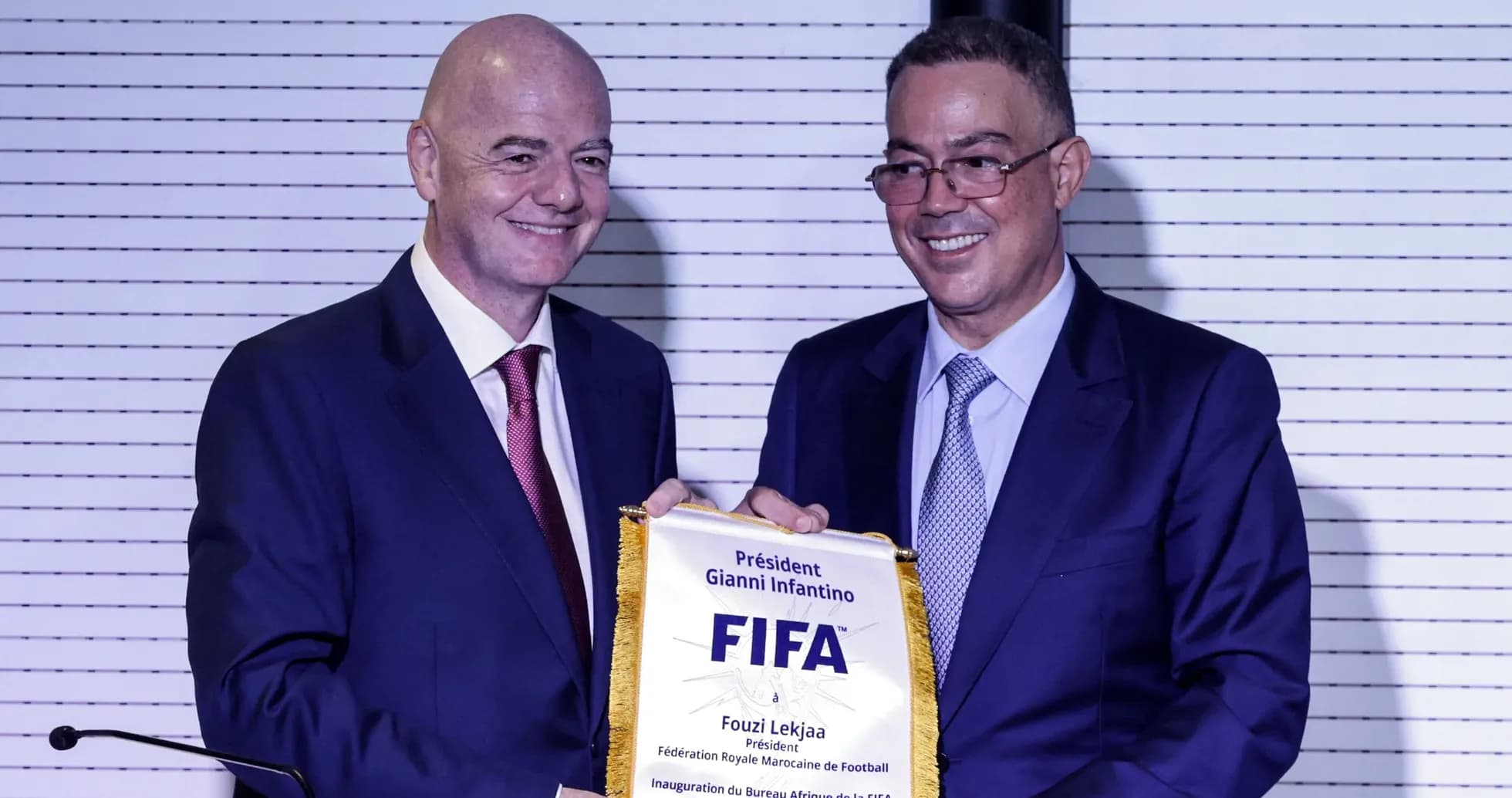
The race to stage the 2030 World Cup final has burst out of the boardroom and straight into Morocco’s domestic politics.
Prime Minister Aziz Akhannouch has publicly rebuked Fouzi Lekjaa, the powerful president of the Royal Moroccan Football Federation (RMFF), ordering him to stop making bold promises about Casablanca hosting the showpiece match before anything has been agreed with their European partners.
The warning was sharp. And deliberate.
Political Stage, Football Spotlight
Lekjaa, a central figure in Morocco’s successful joint bid with Spain and Portugal, told a political party gathering that the new mega-stadium planned for Casablanca would have the “honour” of staging the World Cup final.
That single word lit the fuse.
With FIFA yet to designate a host city for the decider of the centenary tournament, Akhannouch stepped in, clearly worried that Lekjaa’s confidence risked embarrassing Rabat in front of Madrid and Lisbon.
Speaking at a rally, the Prime Minister did not bother to soften the message. He urged Lekjaa to stop making public guarantees on a decision that has not been thrashed out with their co-hosts, warning against using World Cup prestige as a domestic electoral tool.
“Do not offer to host the big final game in Morocco while we still have not discussed the matter with our allies, Spain and Portugal. There should be some respect, brothers. Stop using electoral promises to pull the rug out from under us. These are huge matters. Deciding where the final will be held is a major issue.”
In one intervention, Akhannouch turned a football question into a test of regional diplomacy and internal discipline.
FIFA Holds the Cards
For now, FIFA is keeping everyone at arm’s length. The governing body has simply stated that “a decision will be made in due course,” leaving Morocco, Spain, and Portugal to posture and lobby in the background.
The 2030 edition, marking 100 years since the first World Cup, will be a sprawling, symbolic tournament: primarily hosted by Morocco, Spain, and Portugal, with opening fixtures in South America to honour the competition’s origins. That symbolism has only heightened the stakes around who gets the final.
Morocco wants history. Africa has not staged a World Cup final since Johannesburg in 2010. Bringing the decisive game to Casablanca would be a landmark moment for the continent and a crowning achievement for a country that has invested heavily in football infrastructure and soft power.
Spain’s Case: Champions, Stadiums, Momentum
Rafael Louzan, president of the Spanish federation (RFEF), has been unapologetically bullish. In an interview with Cadena SER, he insisted Spain is the “natural” destination for the final, leaning on both sporting success and infrastructure.
“Even though no decision has been taken, I believe Spain is the place because it cannot be any other way,” he said. “As you know, we are currently world champions. I believe Spain's organisational capacity for major events is beyond question and that is why reality dictates that the grand final cannot and must not be held anywhere other than in Spain.”
Spain’s argument is clear: they are the reigning world champions after beating Argentina to claim a second World Cup title this past summer, and they already have the stadiums and logistics ready to go.
The revamped Santiago Bernabeu in Madrid stands as a gleaming flagship, now transformed into a multi-purpose arena built to host global events. Barcelona’s Spotify Camp Nou is undergoing a major expansion of its own, strengthening Spain’s claim that it can deliver a final without needing to build from scratch.
From the RFEF’s point of view, the country’s track record and existing infrastructure give them a decisive edge.
Morocco’s Giant Bet in Casablanca
Morocco is answering with ambition and concrete.
The country is building a colossal 115,000-seat stadium, a project designed to put Casablanca on the same level as the game’s most iconic arenas and, in sheer capacity, above them. If completed as planned, it would become the largest football-specific stadium in the world.
This is not just a construction project; it is a statement of intent. A signal to FIFA that Morocco is ready not only to co-host but to carry the weight of the final itself.
Yet Akhannouch’s intervention shows that, inside Morocco, there is a clear desire to keep the political temperature down while the concrete goes up. The government wants the final. It just does not want a diplomatic row with Spain and Portugal along the way.
Long Game, Late Decision
The timeline offers some breathing space. The 2026 World Cup final venue was only confirmed in early 2024, when New Jersey’s MetLife Stadium finally got the nod. The 2030 decision can follow a similar late path.
That delay suits FIFA, which can watch the three hosts push their cases on and off the pitch, weigh the politics, and gauge which stadium and city offer the best global showcase for the centenary final.
For Morocco, the message from the top is now clear: build big, dream big, but talk carefully. For Spain, the stance is just as firm: as world champions with two super-stadiums and a deep history in the game, they believe the final already belongs on their soil.
Somewhere in Zurich, the file marked “2030 Final Venue” remains closed.
When it finally opens, will Casablanca’s new colossus or Spain’s refurbished temples of football get the nod for the World Cup’s 100th-year climax?