
Mohammed bin Salman: The Power Behind Saudi Football
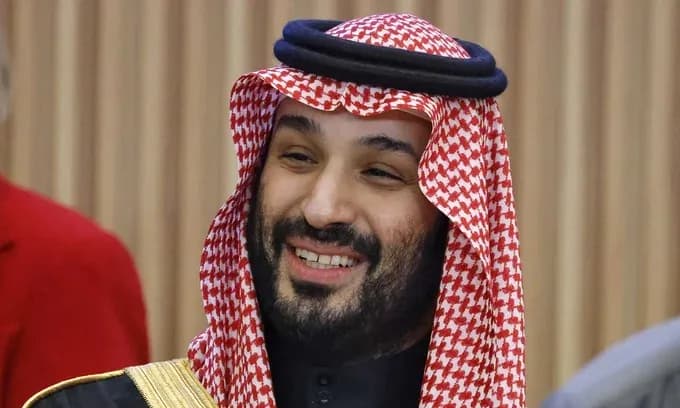
The most powerful man in Saudi football does his thinking in bomb-proof palaces and his relaxing on a €429 million superyacht.
Mohammed bin Salman, the 41-year-old Crown Prince of Saudi Arabia, has turned extreme wealth into a geopolitical tool — and football is one of his sharpest instruments.
A yacht, a château, a da Vinci
In 2015, he stepped aboard the 134-metre superyacht Serene, liked what he saw and, within half a day, reportedly closed a deal worth €429 million (US$550.7 million) with a Russian billionaire. No long courtship, no drawn-out negotiations. Just a staggering fee and a new toy.
Serene is less a boat than a floating kingdom: two helipads, an underwater viewing room, cinema, multiple swimming pools and its own private nightclub. It’s the sort of vessel where deals can be done out of sight, where power can entertain power.
That same year, the Crown Prince turned his attention to France. Near Versailles, he bought Château Louis XIV for over $300 million, a property widely described as the world’s most expensive private residence. The estate borrows its look from the 17th century but hides 21st-century muscle: climate control, lighting and ornate fountains all run through an iPhone, and an underwater aquarium sits beneath the moat like something from a film set.
Two years later came another headline purchase. At auction in 2017, Leonardo da Vinci’s Salvator Mundi sold for a record $450.3 million. The Crown Prince is widely believed to be the anonymous buyer behind that deal, another symbol of how art, prestige and politics now blend in his orbit.
From palaces to pitches
House of Saud estimates his personal wealth at around $25 billion. With that comes reach, and nowhere is that more visible than in football.
As chairman of Saudi Arabia’s Public Investment Fund (PIF), MBS has put the game at the heart of the kingdom’s Vision 2030 project — a sweeping attempt to diversify an oil-heavy economy through sport and entertainment.
The strategy is simple: buy influence, buy relevance, buy time.
In 2023, the PIF took majority control of four of the Saudi Pro League’s founding clubs: Al Nassr, Al Hilal, Al Ittihad and Al Ahli. Those stakes didn’t just change balance sheets; they rewired the global transfer market.
With PIF money behind them, Al Nassr landed Cristiano Ronaldo, the signing that detonated the dam. Once Ronaldo arrived, the Saudi Pro League stopped being a curiosity and became a destination. A wave of global stars followed, drawn by salaries Europe’s elite clubs could not or would not match.
The reach stretches into England as well. In 2021, PIF completed the acquisition of Newcastle United, planting the Saudi flag firmly in the Premier League. St James’ Park suddenly became a front line in the debate over state-backed ownership, sportswashing and the future shape of elite football.
This is not just about trophies. It’s about soft power, reputation, leverage.
Friends in high places
The Crown Prince’s contact book reads like a guest list for a summit of modern power. His network spans U.S. politics, Silicon Valley and Hollywood.
He has been linked with U.S. President Donald Trump, has courted tech billionaires such as Mark Zuckerberg and Elon Musk, and entertained Hollywood names including Johnny Depp, Morgan Freeman and Lindsay Lohan. The message is clear: Saudi Arabia, under his watch, wants a seat at every important table.
In a previous interview with CBS, asked about his lavish lifestyle, MBS did not pretend to be something he is not.
“As far as my private expenses, I'm a rich person and not a poor person. I'm not Gandhi or Mandela. I'm a member of the ruling family that existed for hundreds of years before the founding of Saudi Arabia,” he said.
It was a rare, blunt admission in a world where most leaders wrap excess in euphemism.
Luxury under threat
Yet even this carefully curated life of superyachts and châteaux now moves under a shadow.
According to The Wall Street Journal, recent drone and missile attacks by Houthi forces have targeted airports and oil infrastructure in Riyadh, while commercial maritime routes in the Red Sea have come under threat. For a ruler building a global brand on stability, spectacle and investment, those images cut against the script.
The response has been swift and discreet. The Crown Prince has reportedly shifted his daily operations into heavily fortified palaces equipped with secure underground bomb shelters — a stark contrast to the open-deck glamour of Serene or the manicured calm of Château Louis XIV.
This is the paradox at the heart of MBS’s football project. On one side, the flood of money, the superstar signings, the acquisition of historic clubs and the pursuit of global prestige. On the other, the hard reality of regional conflict, security risks and the constant need to protect the man at the centre of it all.
As the Saudi Pro League keeps spending and Newcastle United keeps climbing, the question lingers: how far can a football empire stretch when its architect is forced to work from behind blast doors?





