
Michael Carrick Reflects on Sir Alex Ferguson's Legacy at Manchester United
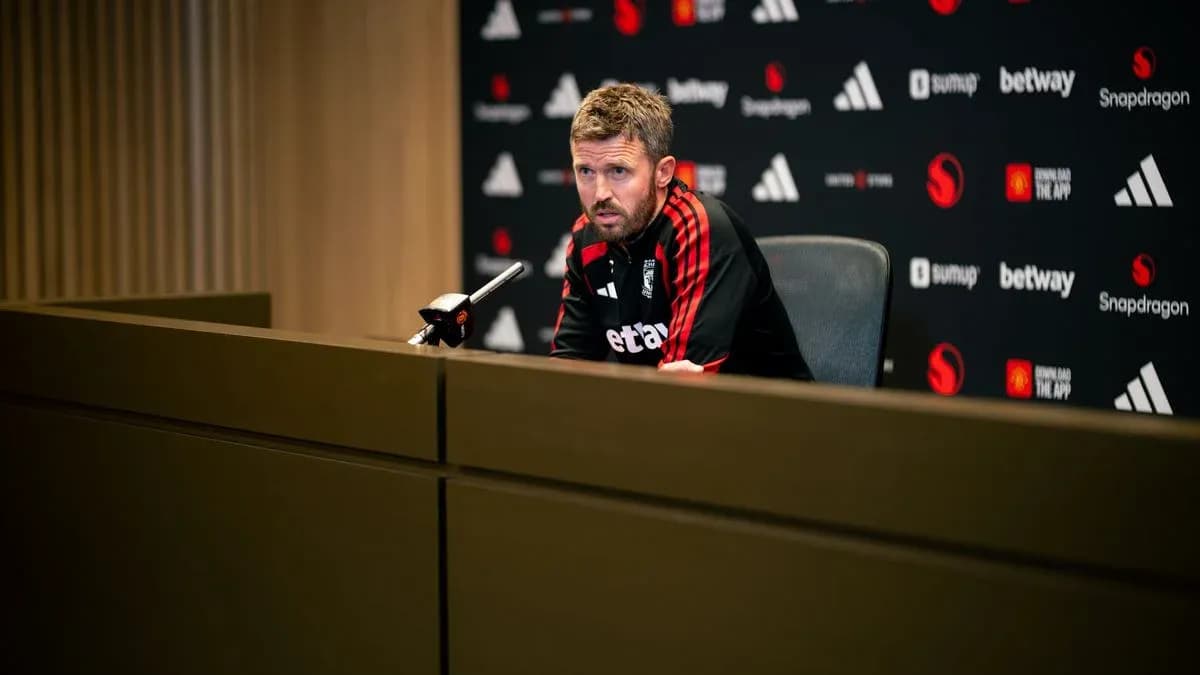
On the 40th anniversary of Sir Alex Ferguson walking into Old Trafford and changing Manchester United forever, Michael Carrick sat in front of the cameras and laughed off the most inevitable question of all.
Could he ever hope to match Ferguson?
He smiled. He joked. But he didn’t back away from the scale of the ambition.
Carrick knows the numbers as well as anyone: 38 trophies in 26 years, 13 Premier League titles, two Champions Leagues, an empire built from a club that, in 1986, hovered just above the relegation zone on goal difference. The symmetry is uncomfortable now. United sit in precisely the same position, again glancing nervously at the table, again clinging to goal difference.
This is the backdrop to Carrick’s tenure: a club still living in the shadow of a giant, on a day when that shadow feels longer than ever.
Ferguson’s ghost and Carrick’s reality
Carrick spoke warmly, and with clear affection, about the man whose statue looms over Old Trafford.
"What's not been said already?" he said, acknowledging the endless tributes. "It's something worth celebrating: 40 years this week since he came here. The impact and everything he drove at the football club during the time he was here are incredible. I'm probably closer to him now than I was when I was playing."
That last line landed with weight. Carrick is no longer just a former midfielder recalling old team talks. He is a manager, leaning on Ferguson the mentor, not Ferguson the boss.
He also understands the scale of the task. United have not come close to a Premier League title or Champions League triumph since Ferguson walked away in 2013. Thirteen years of drift, missteps, and short-term fixes have turned the Fergie era into something that can feel mythical, unreachable.
Carrick refuses to accept that.
"You've got to build, be realistic and put things in perspective," he said. "It's not going to happen in the blink of an eye."
The line was measured, but the message was clear: he still believes that level of success can return. Not as nostalgia, but as a target.
A crisis dressed as a comeback
The mood around United has been temporarily lifted by the wild, comeback win over Roma. Old Trafford roared, the players celebrated, and for one night the place felt like itself again.
Carrick enjoyed it. He also moved on quickly.
"It's up to us to take it forward; it was a fantastic night as a one-off night," he said. "It was a good night for us all, but nothing has been achieved yet, and it's one moment we need to use to move forward."
He had already watched the game back. The first-half chaos bothered him.
"When you watch the game (Roma) back, the first half wasn't so bad. There were moments when we left ourselves short, and we need to fix them. The first half against Chelsea was very good. We're showing signs of improvement, no doubt, and we need to take that forward."
The pattern is familiar: flashes of quality, undermined by structural flaws. An opinion piece circling among supporters this week has zeroed in on one of them. Roma’s opener came after Kobbie Mainoo was dispossessed, Diogo Dalot was stranded high on the left, and a simple ball over Ayden Heaven left Matias Soule with a clear sight of goal. The kind of tactical gamble that looks bold when it works and naive when it doesn’t.
Carrick knows he cannot keep getting punished like that.
Baleba blow and Dorgu patience
If the Roma win gave United a jolt of adrenaline, the injury update that followed dragged them back to earth.
Carlos Baleba, who had finally begun to show why the club spent £70 million to bring him in from Brighton, is out for several weeks with a hamstring injury. He limped off just after half-time against Roma, clutching the back of his leg after a driving run into the box.
It is another cruel interruption. Baleba already missed the start of the season with an ankle problem picked up in pre-season. Just as he was beginning to influence games, he is gone again.
"Carlos, we don't know, but it will be a number of weeks," Carrick admitted.
Pat Dorgu, another player the staff are eager to see more of, is also being handled carefully.
"Pat has done a little bit of training, very small, we have to be patient with Pat."
Patience. A word United fans have heard often in the last decade, not always with much reward. This time, Carrick is banking on it paying off with players he believes can shape his team.
Spirit in the dressing room
For all the noise outside, Carrick insists the dressing room has not fractured.
"It's a positive reaction, it's not like all of a sudden we're getting carried away," he said of the response to the Roma win. "I know what the players are capable of. We just haven't proved it enough lately. The boys have trained really well, I'm not just saying that for the sake of saying it."
The line about training wasn’t throwaway. Managers at crisis clubs often lean on clichés about “great sessions” and “good attitudes”. Carrick sounded keen to distance himself from that kind of empty reassurance. He knows supporters are tired of slogans. They want patterns, performances, points.
He also knows the context has changed since Ferguson’s day. When asked about the time Ferguson was given to rebuild, Carrick didn’t bite on the comparison.
"The game has changed. It evolves and that's how it is. We have to deal with what is front of us."
Translation: no one gets years of grace anymore. Not at this level, not at this club.
Solskjaer, old bonds and modern pressure
Carrick was also asked about another former United manager, and another man who knows what it is to follow Ferguson and feel the weight of the job: Ole Gunnar Solskjaer.
Solskjaer has given a recent interview, but Carrick admitted he hadn’t seen it.
"I've not seen it (Solskjaer interview), so it's difficult to respond. I don't think there are too many people who actually know me, really. Ole is one of them."
The bond between the two remains strong.
"We're friends and we're still in contact now. I saw him not long ago in pre-season."
In a club that has cycled through identities and ideologies since 2013, those personal relationships matter. Carrick is part of the lineage of Ferguson’s dressing room, Solskjaer’s staff, and now his own project. He is trying to draw on the past without becoming trapped by it.
Mainoo, Rashford and the England door
Outside Old Trafford, another story rumbled on. The latest England squad dropped, and two United names were missing: Kobbie Mainoo and Marcus Rashford.
National team boss Thomas Tuchel explained Mainoo’s omission in blunt, football terms.
"I think Kobbie had a difficult spell now with his team & missed a lot of matches. In the meantime, it was Jobe who impressed. The door is always open. The door is always open for younger ones to overtake or to make their mark, so that's just a sign of the competition in central midfield."
Mainoo missed four matches with a minor injury before returning against Chelsea, then starting against Roma on Tuesday. His absence from the England squad is logical, given the disruption to his rhythm and the competition in his position.
Rashford’s situation is different but just as stark. He is still recovering from hip and thigh issues and has not been in an England squad since the trip to Leeds at Elland Road. For a player once seen as a locked-in international, that gap tells its own story.
Rashford’s relationship with the supporters came into focus again this week when leaked audio emerged from a rare Q&A session he held with fans in the Ambassadors' Lounge before the Roma game. Those in attendance had paid around £2,500 for a hospitality package that included seats directly behind the United dugout, a five-course meal, behind-the-scenes access and a live Q&A with the forward.
It was a reminder of the strange, modern reality at United: a club fighting to stay away from the relegation zone, while still selling a “luxury” matchday experience.
Villa next, and the long road back
The press conference itself carried no embargo, no attempt to control the narrative. Carrick was due in at 1.30pm, walked in on time, and spoke with the calm of a man who has lived this club from the inside for nearly two decades.
He knows the Roma win will mean little if United do not back it up against Aston Villa this weekend. He knows the Ferguson anniversary will draw every possible comparison, fair or not. He knows the league table does not lie.
The game has changed, as he said. The pressure is harsher, the patience thinner, the scrutiny constant.
What has not changed is the expectation that Manchester United should compete for the biggest prizes, not just survive the next crisis.
Carrick insists that kind of success is still a realistic ambition. The question now is simple: can he turn one wild European night into the start of something that, one day, no longer needs to be measured against Ferguson at all?





