Matt Hauser: Australia’s New Triathlon Champion
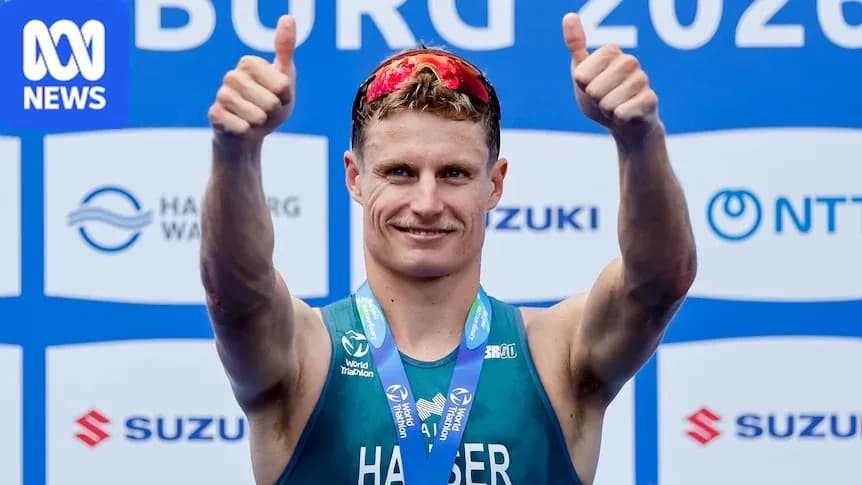
Matt Hauser stood on the Wollongong finish line with Australia back on top of world triathlon and 15 years of frustration finally snapped.
The wait had been long. The message he took from it was short.
This is only the beginning.
Australia’s new standard-bearer
Hauser’s home-soil victory in Wollongong didn’t just end a title drought; it confirmed what the rest of the circuit has been forced to accept over the past few months — the 26-year-old from the Gold Coast is now the man everyone has to beat.
- Three World Triathlon Championship Series starts in 2024.
- Three wins: Yokohama. Hamburg. London.
He heads into the next stop in Weihai on August 29 sitting third in the overall standings, behind Brazil’s Miguel Hidalgo and Portugal’s Vasco Vilaça, both of whom have raced one more event than he has. Hauser’s perfect record makes him the series’ sharpest weapon, even if the points table has not quite caught up.
With that dominance comes a new reality. He is the hunted now.
"It's a bit of a pinch me moment, honestly," he told ABC Sport at the AusTriathlon Performance Hub in Miami on Queensland’s Gold Coast. "It just feels quite surreal to now be at the top of my game … I really need to take a step back and realise that I'm one of the best, if not the best in the world at the moment in my sport."
He knows how quickly that can change. He also knows he is in a window he has to squeeze every last result out of.
A decade in the making
Hauser’s rise looks sudden on paper. It feels anything but to the people who have watched him grind through the years.
"It doesn't feel like a big sudden jump," he said. "It feels like a lot of smaller goals and processes have added up to accumulate to this world champion persona, I guess."
Those “smaller goals” have been stitched together over 10 years under coach Dan Atkins. Day after day on the Gold Coast, they have built what Hauser calls a “daily performance environment” — the kind of system that quietly forges a world leader long before the rest of the world notices.
"For me to be in this position now is just a credit to the support I've had around me, to Dan Atkins, who I've been coached under for 10 years now."
The timing of his surge is not accidental either.
In the immediate afterglow of the Paris Olympics, while others stepped away or experimented, Hauser doubled down on the World Triathlon Championship Series.
Alex Yee, the Olympic champion, has been chasing history on the roads, clocking 2:06:38 to become the second-fastest British marathoner behind Mo Farah. Silver medallist Hayden Wilde has tested himself over longer-distance formats in the T100 series. On the women’s side, Olympic champion Cassandre Beaugrand has been rewriting French records on the track and road and lining up in the Diamond League.
Hauser has watched all that from inside the series, sharpening his own craft.
"It's very inspiring to see those guys go off and do what they do outside of the sport," he said. "Ultimately, it props the sport up to a new level as well, getting that recognition that we are world-class athletes in most of the three disciplines.
"For me, I guess it's just about making sure that I'm perfecting my skills in triathlon."
Changing the way races are won
Perfecting triathlon means juggling three sports that constantly threaten to trip each other up.
Push too hard in the pool, build too much upper-body mass, and you pay for it on the bike and run. Load the legs for the run, and you can watch your swim speed drain away. Every triathlete grows up with the same warning: you can’t win the race in the swim, but you can definitely lose it there.
Finding that balance has been central to Hauser’s evolution. It has also helped him reshape the way the men’s races are being fought.
For a stretch, World Series events often turned into running contests. Packs would roll through the swim and bike together, then hand the race over to the pure runners to rip apart on the final leg.
Hauser has been busy rewriting that script.
He has attacked from the gun, driving the pace in the water, forcing splits on the bike, and stripping away the late-race advantage of the back-end runners. It is a style that echoes the peak years of Alistair and Jonathan Brownlee, who built their Olympic legend on savage swim-bike breakaways and ruthless runs off the front.
"The dynamics change from year to year," Hauser explained. "The Brownlees coined their swim-bike breakaways and were able to produce amazing runs off the back of that and split the race apart from the start.
"Then you had the likes of Mario Mola and Jake Burtwistle and those stronger runners coming from behind and those packs really being quite large and condensed.
"Now we're kind of seeing the front pack and the breakaways kind of come to fruition again."
Hauser is not just adapting to that shift. He is driving it.
"The way the races have kind of panned out the last couple of years … for me to drive at the front pack and maybe limit the strengths of those stronger runners and the pack behind has been really crucial to me succeeding.
"There's a lot of momentum now and there's a lot of belief that you don't have to be like one of the best runners to win a race now."
Inspiring the next wave
When Hauser powers away at the front, he is not only changing tactics at the elite level. He is changing what young Australian triathletes think is possible.
Australia’s history in the sport is deep, especially on the women’s side. Olympic champions. World champions. A generation that defined the early years of triathlon on the global stage.
Now, a new wave is watching Hauser and taking notes.
"Looking back at Australia's history in triathlon, it's so rich, and now we're definitely stepping up our game," 19-year-old rising star Aspen Anderson told ABC Sport.
"Matt's definitely led the way in that aspect. And I think it's really cool to see him paving the way for some of us.
"It's really exciting. You can kind of look at them and say, well, yeah, if they can do it, then I can do it too."
The sight of an Australian back at the sharp end of the men’s World Series has lit up the pathway in a way no talent ID program ever could.
The Olympic gap that still haunts Australia
For all that history, there is one glaring omission in Australia’s Olympic triathlon story.
Emma Snowsill’s golden run in Beijing remains the nation’s only Olympic triathlon title. Michellie Jones, Loretta Harrop, Emma Moffatt and Erin Densham have all climbed the Olympic podium. Every one of them a woman.
No Australian man has ever done it.
That statistic lives with Hauser every day.
"I think the Olympics is always in the back of my mind," he said. "When I'm executing at world championship races, other races, training day to day, I think it's always in the back of my mind."
Los Angeles 2028 is the target. Four years between Olympic chances, one race that can define a career, and a process that has to make that single day feel almost routine.
"I know that the process for me to be at a peak in two years time is gaining experience in these few years leading up," Hauser said.
"Only a few years ago I was able to perform but not consistently enough to call myself a front runner.
"So now, to be at the stage where I'm performing consistently, I'm at the top end of races.
"I need to make that normal in my own mind and so when it comes to two years time and executing in LA, I just have to execute what I've been doing the last few years."
He is honest about the gamble every Olympic cycle demands.
"So definitely it is in the back of my mind always, trying to peak for one race every four years.
"But I know the process along the way is just as important, to make sure I've got enough notches in the belt to when that day comes, I can execute on the day, whether it be an excellent performance or an average performance, I know that I'm still going to perform in a high quality."
The road through Weihai and beyond
The next notch comes in Weihai, China, on August 29, as the World Triathlon Championship Series rolls on towards its grand final in Pontevedra, Spain, on September 23.
Hauser arrives as the man in form, the man with the target on his back, the man dragging the front pack back into fashion.
Australia has its leading man again.
The only question left is whether this surge ends on an Olympic podium — and whether that long-empty space reserved for an Australian male finally gets filled in Los Angeles.