
Manchester United's Managerial Dilemma: Potential Candidates for a Crucial Reset
Manchester United edge towards another reset. Michael Carrick, the former midfielder once hailed as the calm hand on the tiller, now stands on the brink.
United sit in the relegation zone during the international break. Four permanent managers in three years under Ineos and Sir Jim Ratcliffe is now a live possibility. The mood around Carrick has turned sharply: last season’s impressive interim spell feels a long way away after the club’s worst start in 40 years.
The 4-4 draw with Aston Villa summed up the chaos. A defensive shambles, two goals down, jeered by their own fans. Then a wild late comeback that papered over nothing. The problems remain, and the table does not lie.
Liverpool away awaits after the break. Anfield, with United in the bottom three. After that, a trip to Lisbon in the Champions League. This is not a schedule built for a gentle reset.
Inside the dressing room, the fractures have been exposed. Lisandro Martinez recently pointed to deeper structural issues at the club after defeat to Atletico Madrid. Bruno Fernandes has openly questioned Carrick’s tactical approach, yet has been unable to summon the same authority and creativity that brought him the PFA Player of the Year award and a league assist record last season. When the captain’s spark dims, the manager’s position becomes even more fragile.
If United pull the trigger again, who walks out at Anfield and into this storm?
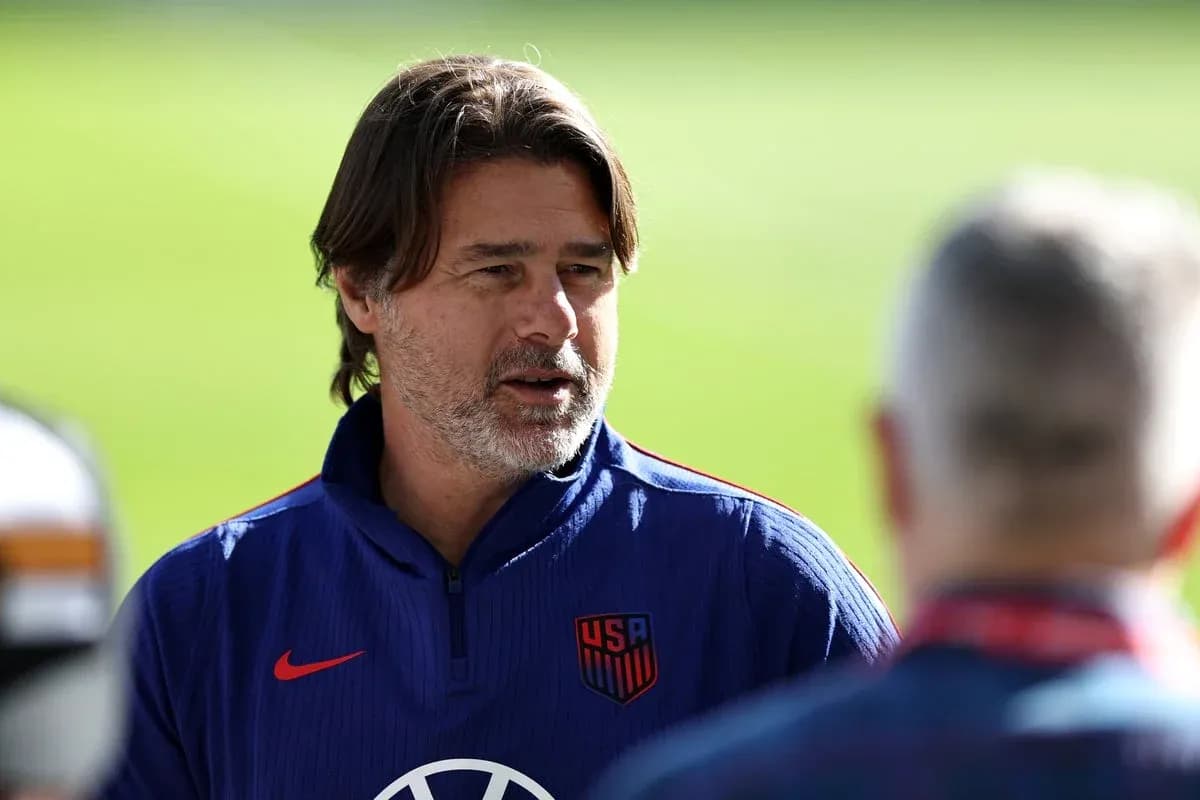
Mauricio Pochettino – the big name, big cost gamble
Mauricio Pochettino has emerged as the leading target. On paper, he offers exactly what United crave: experience, presence, and a track record of jolting underachieving squads back to life.
There is a problem. He is under contract in the United States until the 2030 World Cup. Any move would require compensation north of £7m. For a club already grappling with budget questions, that is not a trivial fee.
Pochettino’s aura is not what it was at Tottenham, when his pressing machine carried Spurs to a Champions League final and near-title challenges. His Chelsea tenure ended after a promising late surge in the 2023/24 season rather than a full-scale revival. His USA side began the 2026 World Cup cycle with huge excitement, only for the Folarin Balogun scandal and a heavy last-16 defeat to Belgium to dull the optimism.
Still, his name carries weight in a dressing room short on inspiration. If United want a galvanising figure, they know what Pochettino can bring. The question is whether his next act in club football should be his hardest job yet.
Eddie Howe – the Premier League builder
Eddie Howe is free. That alone makes him an intriguing option.
His decision to walk away from Newcastle United in the summer shocked the league. He said he needed a break. Three months later, the chance to lead Manchester United would test the strength of that conviction.
Howe’s stock in English football remains high. He inherited a Newcastle side in the relegation zone and turned them into Champions League qualifiers, delivering the club’s highest league finish in two decades and their first domestic trophy in 70 years. Twice he took them into Europe’s elite competition, built on aggressive, high-intensity football that would sit comfortably with Old Trafford’s demand for front-foot play.
Bookmakers currently have Howe among the frontrunners. If United want a modern Premier League operator who knows how to build, not just firefight, they know where to look.
Fabian Hurzeler – the bold, expensive project
Then there is the wildcard: Fabian Hurzeler.
At 33, the Brighton manager has turned the Seagulls into one of the season’s revelations. A 3-0 dismantling of champions Arsenal earlier in the campaign was a coaching clinic. The 3-2 Carabao Cup win at Old Trafford, which knocked United out, will not have gone unnoticed in the directors’ box.
Reports suggest Hurzeler is admired at United. Brighton, though, do not sell cheap. The compensation required for one of Europe’s most coveted young coaches would be significant, and United may simply not have the funds to prise him away.
Hurzeler also works in a finely tuned environment on the south coast, where recruitment, data, and decision-making off the pitch consistently support the work on it. At Old Trafford, he would inherit something far more chaotic. For a coach used to a club that gets most of the big calls right, this would be a leap into the unknown.
He sounds in no rush. “I’m fully focused on my job here,” he said on Friday, stressing his respect for Carrick and his attachment to the “journey” at Brighton. He spoke about time, connections, and people – the sort of long-term language United have used before, then abandoned at the first crisis.
Julian Nagelsmann – the reset specialist with a dented aura
Julian Nagelsmann’s name has hovered around Old Trafford for some time. The former Bayern Munich and RB Leipzig coach, once the poster boy of German tactical innovation, was reportedly on United’s radar when they dismissed Ruben Amorim earlier in the year, with a view to a summer move after the World Cup.
That tournament did not go to plan. Germany crashed out in the last 32 against Paraguay, a result that damaged Nagelsmann’s reputation on the international stage.
Even so, at 39 he remains one of Europe’s most intriguing tacticians. United’s director of recruitment, Christopher Vivell, worked with him in the Red Bull network, a link that would smooth any approach. For a club searching for a long-term architect, Nagelsmann offers a clear identity and a modern training-ground culture.
Whether United, in their current state, can offer him the control and stability he would demand is another matter.
Unai Emery – the elite operator who already has his project
Unai Emery has quietly built something formidable at Aston Villa.
Champions League qualification. A long-awaited trophy with Europa League success. A complete overhaul of the team’s spine over the summer, all under his direction. Villa are at the start of what they believe is a multi-year climb under a manager who relishes methodical construction.
That is precisely why he will be so hard to prise away. Emery holds near-total control at Villa Park, an influence he would not enjoy at Old Trafford. He has spoken about the challenge of building a second competitive Premier League side, and his contract runs until 2029.
Any move for Emery would demand major compensation and a persuasive vision. Right now, United may not have either.
Antonio Conte – instant impact, guaranteed volatility
For many United fans, Antonio Conte is the most tempting kind of trouble.
His teams never lack intensity. His CV, stacked with Serie A titles at Juventus, Inter Milan and Napoli, plus a Premier League crown with Chelsea, commands instant respect in any dressing room. When Tottenham floundered five years ago, he dragged them back into the Champions League at speed.
United, staring at the wrong end of the table, might be tempted by that level of shock therapy.
Conte, though, comes with a warning label. He demands, he confronts, and he speaks his mind. His exit from Spurs in March 2023 followed a ferocious public attack on the club in a now-famous press conference at Southampton. Any board hiring him knows they are inviting scrutiny, not just on the pitch but in every press room.
On Friday, Conte moved to cool the noise. He branded talk of “advanced negotiations” with any club as “speculation” and insisted he will take his time before returning to management after his successful spell at Napoli. He dismissed reports of financial demands and calls for full control, as well as concerns over his “strong personality”, saying there is “no concrete basis” for such claims.
If United reach for Conte, they will be choosing impact over peace. It might be exactly what they need. It might also be the last thing they can handle.
Cesc Fabregas – the visionary outsider
Cesc Fabregas is the romantic option.
The former Arsenal, Barcelona and Chelsea midfielder has turned Como into one of Europe’s most watchable sides. His team did not just beat United in the Champions League on Wednesday; they thrashed them, a tactical and technical dismantling that underlined his growing status as one of the brightest young coaches on the continent.
Yet timing works against United. Fabregas owns a stake in Como and is deeply invested in their debut Champions League campaign. His stock is rising fast, and the lure of returning one day to Barcelona or another of his former clubs will only grow.
He can afford to be patient. United, increasingly, cannot.
The old reflex – another former player?
When the crisis deepens at Old Trafford, the club has a familiar reflex: reach for the past.
Darren Fletcher, then Under-18s manager, stepped in during a previous emergency, overseeing a draw with Burnley and an FA Cup third-round defeat to Brighton before Carrick took charge in January. Before that, Ruud van Nistelrooy bridged the gap between Erik ten Hag’s dismissal and Amorim’s appointment. Before him, Ole Gunnar Solskjaer rode the same emotional rollercoaster Carrick is now experiencing.
There is no shortage of former United players willing to remind a struggling squad what the badge means. The question is whether nostalgia can still move this dressing room, or whether that well has finally run dry.
Fletcher, it is said, knows exactly who to call if the club want one last echo of the Ferguson era. The real decision for United now is starker: keep clinging to the past, or finally choose a manager who can drag them into a very different future.





