Manchester United's JJ Gabriel Faces Uncertain Future
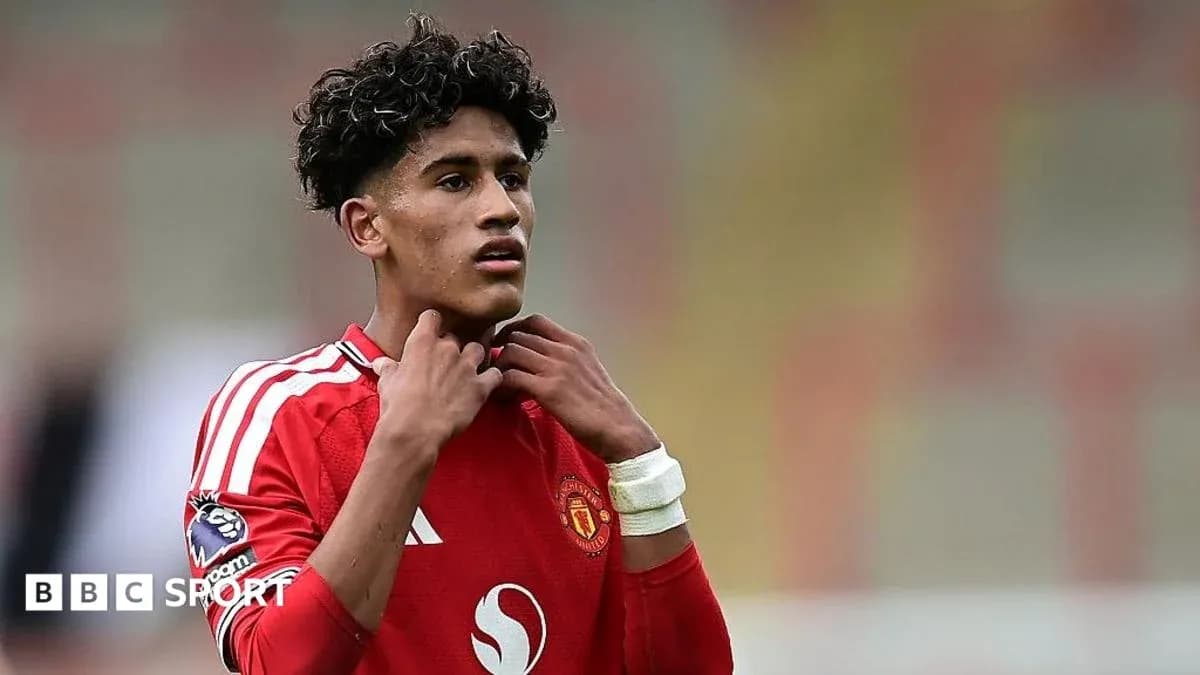
On a night that was supposed to celebrate Manchester United’s next wonderkid, Old Trafford is instead dealing with the possibility that JJ Gabriel might never truly belong to them at all.
Seven days. That is all it has taken for the mood around the 15-year-old to turn from euphoria to anxiety. A week ago he was smashing a hat-trick on his Uefa Youth League debut at Leigh, the kind of performance that felt like a drumroll to history: a first-team bow against Brighton in the Carabao Cup, and the title of United’s youngest-ever player.
Now the club are in firefighting mode.
A prodigy on the brink
Inside United, the alarm is real. Chief executive Omar Berrada and director of football Jason Wilcox are directly involved, trying to drag the situation back from the brink. The hope is simple: that Gabriel tears up his plan to leave and commits to the club that has built so much of its future around him.
It already feels like hope more than expectation.
Those close to the situation talk about promises not kept and a player utterly convinced of both his present level and his ultimate ceiling. Trust has eroded. Once that goes, repairing the relationship with a prodigy this coveted becomes a brutal task.
The rest of Europe can smell opportunity. Real Madrid, Barcelona and Paris St-Germain are tracking developments, heavyweight institutions who specialise in swooping for elite teenagers. For them, Gabriel is exactly the profile: technically gifted, physically sharp, mentally fearless – and unsettled.
“The best 15-year-old in Europe”
Gabriel’s rise has not been quiet. England’s top clubs have seen it up close.
Last season he was named Under-18 Premier League Player of the Year despite being only 14 when the campaign kicked off. He scored 23 goals in the Under-18 league and three more in the FA Youth Cup, dragging United to both the Premier League Under-18 Cup final and the FA Youth Cup final. He swept the individual honours: the league’s top award and United’s own Under-18 Player of the Year.
Those numbers only tell part of the story. Coaches talk about his balance, the way he glides past defenders, the close control in tight spaces, the explosive shot. This season he has added a more aggressive edge without the ball, chasing, tackling, refusing to drift through games on talent alone.
One United source recently called him “the best 15-year-old in Europe”. That kind of label doesn’t just sit in a drawer. It travels. It reaches boardrooms in Madrid, Barcelona, Paris.
United Under-21s coach Adam Lawrence captured the dilemma perfectly after Gabriel’s Youth League treble against Sabah FK.
“The first thing in my job is not to ruin him,” Lawrence said. “When you have a talented player like JJ, you obviously don't want to stifle their freedom and their creativity.”
That’s the tightrope: nurture without smothering, protect without blocking the path.
Contracts, loopholes and a ticking clock
United’s initial response to the growing noise was calm in tone but urgent in intent. Privately, the club stressed they would do everything they could to convince Gabriel that his best route to the top still runs through Carrington. They also pointed out that his registration runs until the end of the season.
That buys them some breathing space in England. It does not guarantee safety from Europe.
Gabriel holds a European Union passport. His mother has Greek-Cypriot heritage, his father represented the Republic of Ireland twice. That status opens doors.
Precedent is not kind to United here. In 2016, the Court of Arbitration for Sport ruled in favour of a 16-year-old dual Argentine-Italian player leaving Velez Sarsfield for Manchester City, judging that as an EU national he could move freely within the European Union even from a non-EU club.
West Brom know the pain as well. When Louie Barry left them for Barcelona at 16 in 2019, Fifa decided the Midlands club had not formally offered him a scholarship. Their claim for €130,000 in training compensation vanished. Six months later Barry moved on to Aston Villa for just under £1m.
United’s nightmare scenario is obvious. Gabriel turns 16 on 6 October. If he walks away at that point and the club end up with no compensation, they will have lost a player already worth millions on the open market, before he has kicked a ball for their first team.
Broken pathways and familiar stories
Football has seen this movie before.
Jadon Sancho was 17 when he stopped training at Manchester City to force a £10m move to Borussia Dortmund, convinced he would play more in Germany than under Pep Guardiola. Morgan Rogers, a key figure in West Brom’s 2019 FA Youth Cup run, left for City on his 17th birthday, just months after that semi-final.
Those cases hang over every big club academy now. Young players and their advisors study them closely.
Sources around Gabriel believe that, when he agreed to stay at United last summer, the conversations with senior figures contained clear markers about his pathway. Those markers, they feel, have not been met.
To United’s credit, he has been exposed to the senior environment. Gabriel trained with the first team under Ruben Amorim and then Michael Carrick. The FA Cup looked like a possible launchpad last season, until Darren Fletcher – then Under-18s coach but now interim senior manager after Amorim’s dismissal – cooled the idea. Fletcher felt it was too soon.
This summer was supposed to be different. Pre-season was meant to be his stage.
The chances that never quite came
Gabriel’s omission from the trip to Helsinki to face Wrexham on 18 July was initially brushed off as a quirk of his return date to training. After that, he travelled everywhere. He was in every squad. Yet he barely played.
Eight minutes. That was his total senior pre-season action, a brief cameo against Atletico Madrid in Stockholm.
The pattern became hard to ignore. He went to Trondheim for the Rosenborg friendly on 24 July. Carrick used 11 substitutes; Gabriel was one of only two United players who stayed on the bench. Five of those who did get minutes have since left, either permanently or on loan.
Another detail jarred. At Croke Park, in a glamour friendly against Leeds United, 18-year-old Tynan Thompson – who had joined from Tottenham just three weeks earlier – made his senior debut, playing 45 minutes. Gabriel travelled. He did not feature.
Inside the camp, many still expected his moment would come early this season, most likely in the EFL Cup. The third-round draw handed United a home tie with Brighton, a repeat of previous cup battles at Old Trafford. It felt like the perfect stage.
Then the Champions League offered another route. Sabah, the Azerbaijani champions, looked on paper like the softest home fixture United might get in the group phase. Carrick’s side led 3-0 at half-time. By the 72nd minute, all five substitutes had been used.
Gabriel was not one of them.
This time, the explanation lay in the regulations. Uefa’s rules meant that, at 15, Gabriel could only play if he was registered on United’s A list. He wasn’t.
The decision raises awkward questions. United filled their 25-man allocation. Among the names was Manuel Ugarte, sidelined with a knee injury until at least January, when the registration window opens again. Thompson, the summer arrival, made the cut. Gabriel did not.
United coaches have suggested privately that Gabriel is not yet at the physical level required for senior football. Those close to the player strongly disagree. They look at Arsenal handing Max Dowman a debut at 15, at Bayern Munich blooding Lennart Karl at 17, and they wonder why United are so hesitant with a player they hail internally as a generational talent.
That is the tension now gripping Old Trafford: a club that has built its identity on trusting youth, and a 15-year-old who no longer feels trusted enough.