Magic Johnson's Take on the Lakers' Transformation
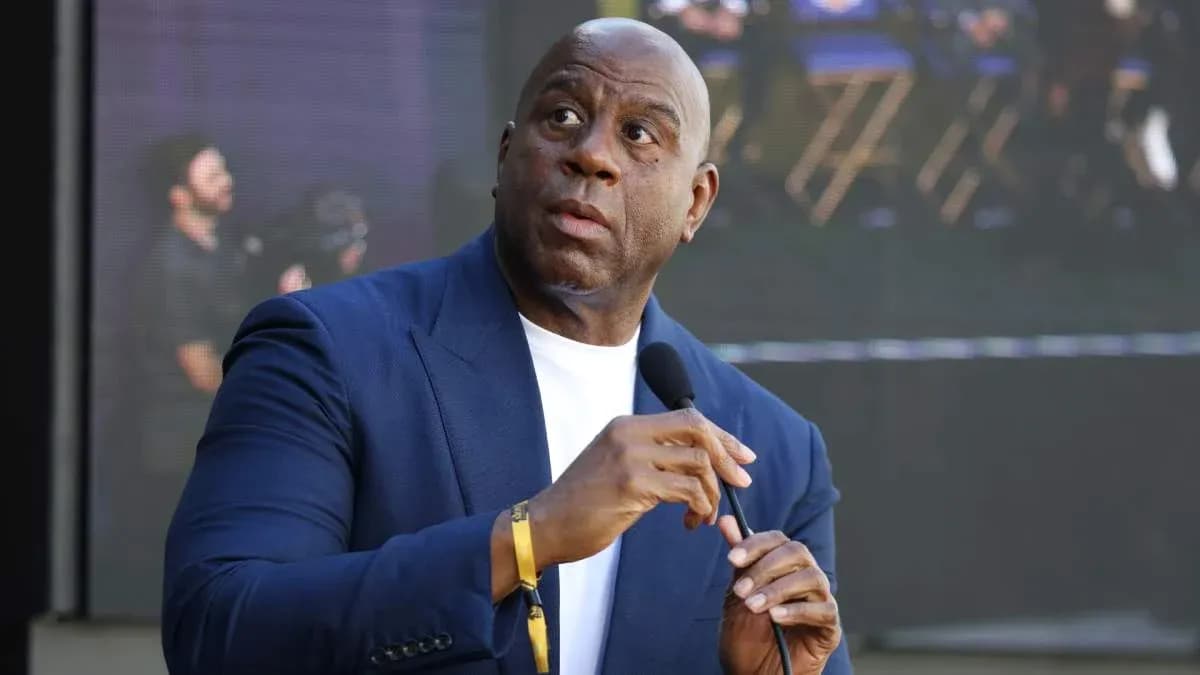
Magic Johnson didn’t mention LeBron James by name. He didn’t have to.
As the Lakers raced out to a 10–2 start behind Luka Doncic and a wave of young legs, the franchise icon logged on to X and fired off a verdict that cut straight through the glow of the record.
“This team is mentally and physically tougher, and that’s why they’re 10-2!”
On its own, it reads like standard early-season praise. But Johnson didn’t stop there. He drew a clear line between this year’s group and last year’s, and that’s where the temperature spiked.
“Last year, the Lakers were a slow team that got beat in transition – but not this season,”
he wrote.
When the man who helped define “Showtime” calls one Lakers team slow and soft, then immediately celebrates the next one as tougher and faster, people are going to connect the dots. Especially when the biggest change is the absence of LeBron James.
A Younger, Faster, Sharper Lakers Team
The numbers back up Johnson’s eye test.
Last season’s starting unit carried an average age of 31.2 years, weighed down by veteran miles from James and Marcus Smart. This year’s starting five? Just 26.2 on average, with the full roster sitting at 25.1. Kevon Looney, at 30, is the oldest player in the locker room.
The difference shows every time they run.
JJ Redick’s Lakers sit tied for 10th in transition points at 24.3 per game, fourth in transition field-goal percentage at .594, and seventh in points per fast-break possession at 1.18. Twelve months ago, the Lakers ranked 18th in transition points (22.4) and 19th in attempts (14.5 per game). Same jersey, very different engine.
This is the version of the Lakers Johnson has been craving: younger, springier, ruthless in the open floor. And he’s not hiding how much he enjoys it.
Not Just Luka’s Show
Johnson’s praise didn’t stop at pace and toughness. He went straight to the bench, the part of this roster that used to sag and now swings games.
Monday’s 124–114 win over the Atlanta Hawks told the story. Luka Doncic, the MVP frontrunner, did what he does with 32 points. But the Hall of Famer made sure everyone knew the win belonged to more than the superstar.
“The Lakers’ win wasn’t just about Luka Doncic (even though he scored 32 points),”
Johnson wrote.
He pointed instead to Collin Sexton’s 18 points, Sandro Mamukelashvili’s five made threes on his way to 23, Walker Kessler’s 21 points and 10 rebounds, and Ziaire Williams’ 12 points. He even highlighted Thiero’s defense as part of the backbone of the victory.
For years, the Lakers lived and died on the whims and health of one or two stars. This version comes at opponents in waves. Sexton attacking off the dribble, Mamukelashvili stretching the floor, Kessler punishing the glass, Williams cutting and slashing, Thiero hounding ball-handlers. Johnson sees something deeper than a hot start; he sees a structure built to last into spring.
The subtext is hard to miss: this isn’t a team propped up by a single aging legend. It’s a rotation, a system, a collective.
JJ Redick Wins a Big Endorsement
Then came the line that might matter most inside the building.
“The Lakers’ win over the Hawks yesterday showed that JJ Redick has become a great NBA coach,”
Johnson declared.
That’s not a casual compliment. For a first-time head coach still carving out his identity, having Magic Johnson call you “great” in front of the basketball world is a stamp of approval that resonates from the locker room to the front office.
Johnson pointed to a specific moment: Redick’s in-game switch from man-to-man to a zone defense. That adjustment, he said, “changed the trajectory of the game.” He also praised Redick’s work drawing up plays out of timeouts, the small details that separate tacticians from placeholders.
Redick arrived with questions swirling around his lack of experience. He now has a 10–2 record, a humming offense, a top-tier transition attack, and the public backing of the franchise’s most beloved icon. Whatever doubts lingered are getting drowned out by results.
A New Era, and a Not-So-Subtle Contrast
Strip away the emotion and the social-media noise, and the facts are simple.
- Last year: older, slower, beaten in transition too often, heavily dependent on veterans like James and Smart.
- This year: no player over 30, a 10–2 start, top-10 transition scoring, elite efficiency on the break, a deep bench swinging games, and a rookie head coach winning the tactical battle.
Johnson chose to spotlight all of that while framing this group as “mentally and physically tougher.” Given who just left the stage, the implication hangs over the season.
The Lakers have been here before, pivoting from one era-defining star to a new identity built on youth, speed, and depth. The difference this time is that the transition is happening in real time, with Luka Doncic already in MVP form and JJ Redick already winning chess matches.
If this is what the Lakers look like in November, what will they be when the games really start to harden in April?