Lionel Messi's Quiet Farewell from International Football
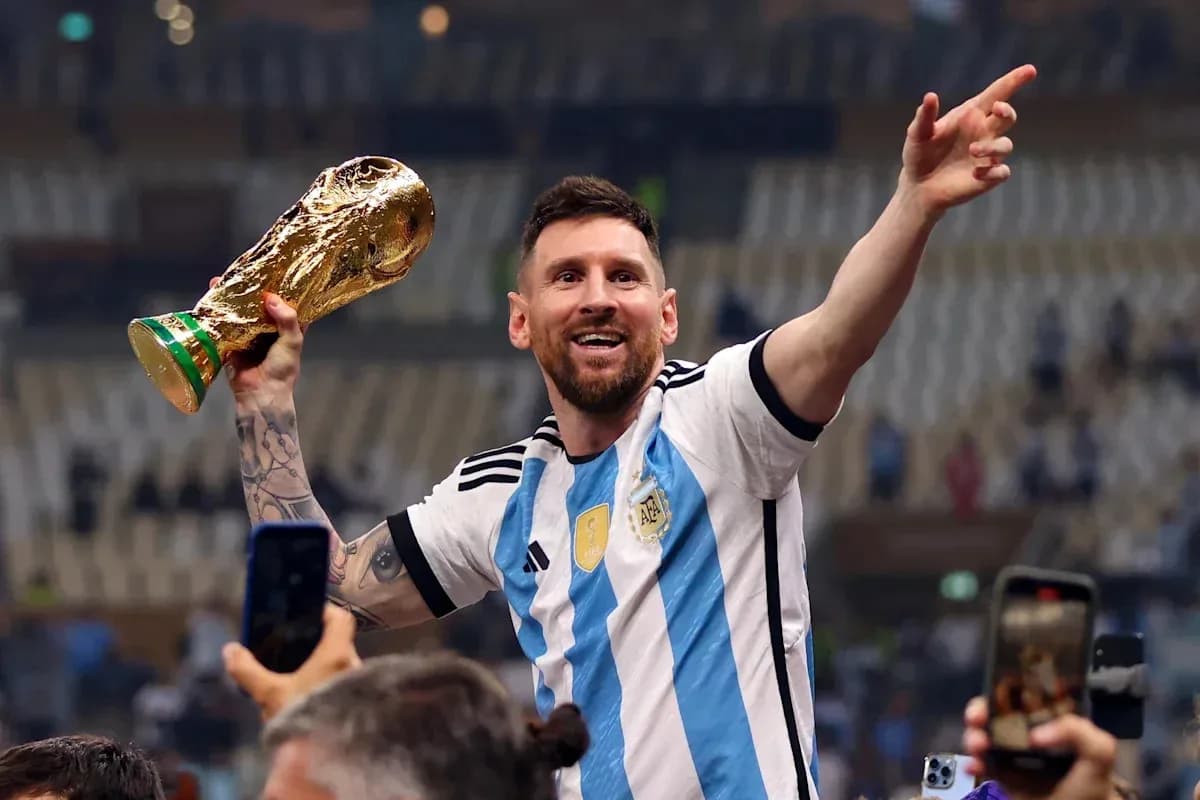
Lionel Messi walked alone.
Not toward a trophy this time, but into the dusk of an international career that has stretched across generations. At 39, after 120 minutes in suffocating heat, he stood on the pitch with a silver medal around his neck, eyes glazed with tears, saying nothing. No speech. No grand gesture. No orchestrated farewell.
Just Messi, staring at the grass that has both broken his heart and made him immortal.
He eventually sat down on that same turf, the same kind he once left convinced he would never conquer with Argentina, and slowly unlaced his boots. One last time in sky blue and white. One last time as Argentina’s No. 10.
The quiet goodbye
There was no “Last Dance” camera crew trailing his every step, no pre-tournament retirement tour, no drawn-out farewell interviews. It ended the way so much of his career has been lived: in silence, in solitude, with the ball and the game saying what he never needed to.
From the moment a tiny four-year-old in Rosario was told he was too small to play with the older kids, Messi has answered doubt not with words, but with touches, dribbles, and goals. That never changed.
Now it is official. After more than 20 years, 207 caps, nine finals and four major trophies with Argentina—capped by the World Cup in 2022—Messi has retired from international football. The last chapter comes with a defeat to a superior Spain, a harsh closing image that cannot dent the scale of the story that came before it.
He leaves the stage as a world champion, a Copa América winner, a Finalissima winner, an Olympic champion, and the central figure in the greatest era his country has ever known.
From “he can’t do it for Argentina” to La Scaloneta
It is easy now, in 2026, to forget how loud the old accusations once were.
- He can do it for Barca, but not for Argentina.
- He disappears in finals.
- He’s not like Maradona.
These weren’t just taunts from rival fans. They came from within his own country. Messi and his family absorbed years of hostility, suspicion, even outright abuse from sections of the Argentine media and fanbase. The same voices that now hail him as a national treasure once questioned his commitment, his character, even his identity.
Four straight finals lost. Copa América heartbreaks. The 2014 World Cup final in Rio. The missed penalty against Chile in 2016. That night he walked away, announcing a retirement that would later be reversed, it felt like a man crushed by a burden too heavy even for him.
The tide turned when Argentina finally built a team worthy of his obsession.
Lionel Scaloni took charge. Rodrigo De Paul ran himself into the ground for him. Cristian Romero and Emiliano Martínez brought steel and defiance. Veterans like Ángel Di María and Nicolás Otamendi stayed on to bleed for one last project. The pieces clicked.
In 2021, at the Maracanã, against Brazil, the dam burst. Argentina lifted the Copa América on their arch-rivals’ soil. The weight that had bent Messi’s shoulders for a decade evaporated in one night.
The flood that followed was ruthless. Enzo Fernández and Julián Álvarez emerged. La Scaloneta became a machine. Argentina battered opponents on their way to more silverware and, in Qatar, the trophy that had haunted him his entire life: the World Cup.
Nobody wanted to face them. Nobody wanted to face him.
The greatest era, the greatest No. 10
By the time he walked out for this final tournament, Messi had already changed the record books beyond recognition.
- Ninety-one goals in a calendar year.
- Eight Ballons d’Or, four before he turned 26.
- More than 1,300 goal contributions.
- Forty-four trophies.
The numbers feel fictional. They will outlive everyone reading them. Yet they still undersell what he represented.
For a whole generation of Argentines, defeat in a knockout match was an abstract concept. Before this last run, schoolchildren had never seen their country lose an elimination game with Messi on the pitch. He had dragged Argentina so high, so often, that normal rules did not seem to apply.
Once he was mocked as an international failure. Now his trophy cabinet is so overloaded that some opponents mutter that the sport itself bends to accommodate him.
The art that numbers can’t reach
Football loses its leading man now, but the deeper loss is something harder to define.
Messi has always been a statistical anomaly, yet the true essence of his greatness lived in the spaces between the numbers. In the way a first touch killed a ball and opened a passing lane in the same movement. In a dummy that sent three defenders chasing a ghost. In a pass nobody else in the stadium had even considered until it had already sliced a back line in two.
Billions of people have kicked a football. Only one made the impossible feel routine with such regularity.
He is the most prolific scorer the sport has seen, but his game was never just about goals. It was about control. About seeing the whole pitch as if from above, while standing in the middle of it. About knowing not only what he could do, but what everyone else would do next.
That is why fans who never supported Barcelona or Argentina still tuned in, week after week, just to watch him. Why a simple layoff or a drop of the shoulder could leave a stadium buzzing. Why even neutral viewers felt a pang of loss as he unlaced those boots.
The weight he carried, and carried again
Talent alone does not explain what he did at this last World Cup cycle. It does not explain how a 39-year-old, with opponents almost closer in age to his children than to him, could still dominate knockout football. It does not explain how he reached another World Cup final with his father gravely ill, the heaviest kind of distraction hovering over every step.
He has conquered the sport multiple times over. Yet he kept playing as if every game might be his last, as if there was always one more debt to pay, one more doubt to erase.
That relentlessness seeped into those around him. An entire generation of Argentine players grew up rushing home from school to watch him at Camp Nou, then found themselves sharing a dressing room with their idol. They did not talk about destiny. They ran. Tackled. Pressed. Covered every blade of grass to make sure the World Cup that “football owed Messi” did not remain a slogan, but became a reality.
They had seen him suffer. They had seen him cry on that Rio pitch in 2014, seen him walk away in 2016, seen him keep coming back. When the chance finally arrived, they refused to let it slip.
The captain beyond the cameras
Perhaps the most telling reaction to his retirement is not the debate over where he ranks in history, but the messages from those who shared the pitch with him.
Teammates talk less about the goals and more about the person. The captain who shielded youngsters from criticism. The leader who spoke quietly, but whose presence filled a room. The friend who treated academy graduates and Ballon d’Or winners exactly the same.
Very few athletes combine the talent to become an icon with the temperament to carry that status without suffocating those around them. Messi did. His selflessness, his willingness to pass when others would shoot, to celebrate a teammate’s goal as wildly as his own, made it easy for players and fans alike to give themselves to his cause.
That is how he leaves international football: not just as a champion, but as an undisputed one.
The last great stage
His career is not finished. There are still nights in Miami, still goals, still free-kicks bent into top corners for Inter Miami, still reunions with old friends. He scored four times in a single match only last week. The touch is intact. The vision has not dimmed.
Yet the World Cup final feels like the last truly seismic occasion of his career, the final time the entire planet watched him with everything on the line.
There is an injustice in that, in the sense that at 39 he could still walk onto any pitch in the world and be the best player there. But he has nothing left to prove. Not to Argentina. Not to Barcelona. Not to Paris, Miami, or anyone else. Not even to himself.
He leaves the international stage the way only the greatest can: with the argument over his legacy already closed.
The boots are off. The shirt is folded away. The No. 10 that once felt like an impossible weight is now a relic of an era that will never be repeated.
The question is no longer what Messi owes football. It is what football will look like now that he is gone from its biggest stage.