Katie Taylor: The Sparring Partner Who Redefined Women's Boxing
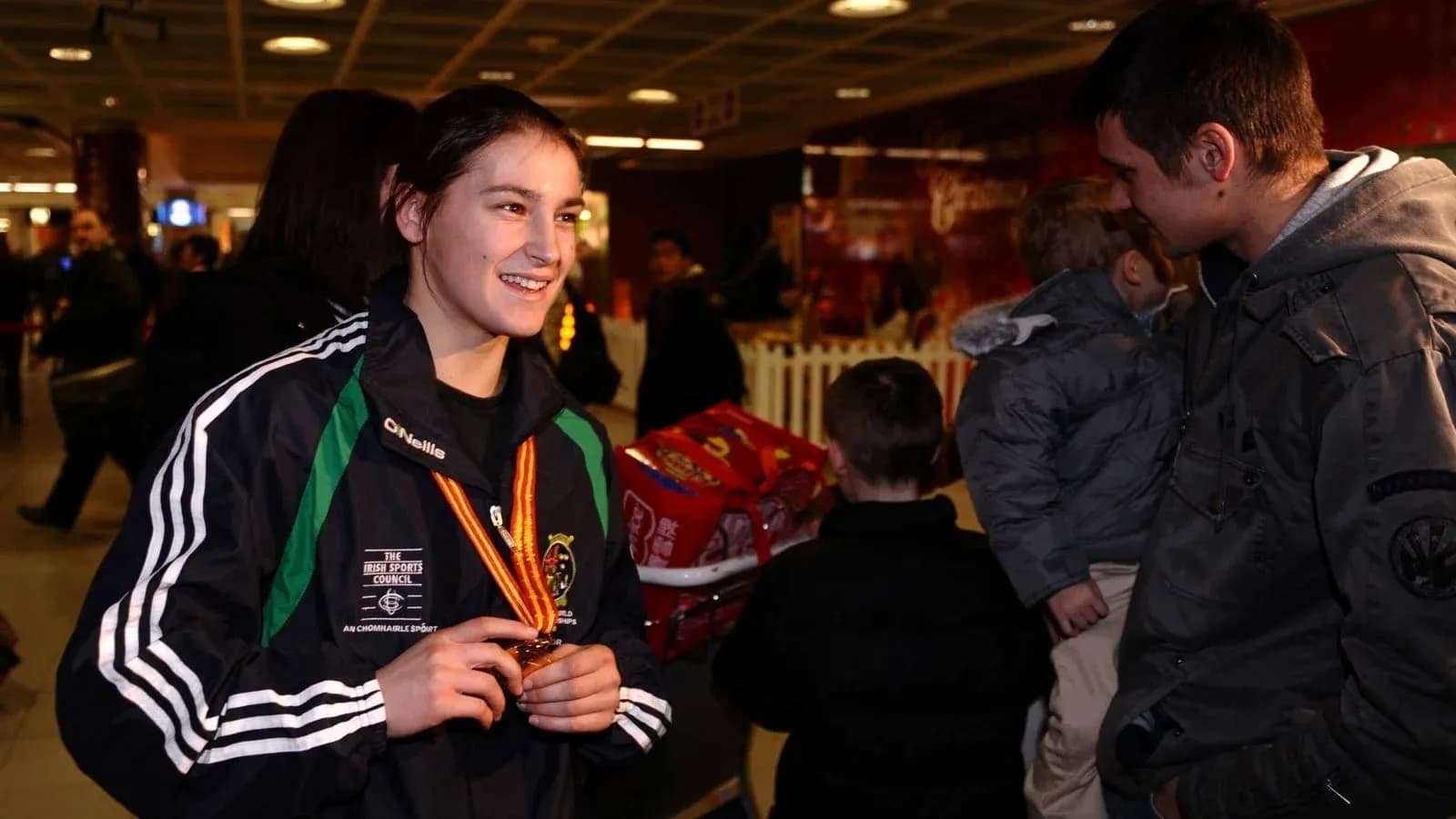
On the eve of her Croke Park homecoming and likely final bow, the tributes to Katie Taylor don’t arrive in neat soundbites. They come as memories. Half-remembered gyms, crowded arenas, borrowed doctor’s coats and a young woman who walked into a man’s world and refused to tiptoe.
What emerges is not just the story of a champion. It’s the story of a sparring partner, a super-fan, a commentator in a stolen white coat, and a country slowly realising that the greatest fighter in the room might be the quiet one in the corner.
“She’s a girl but she is a champion”
Eric Donovan remembers the first time he got told off for going easy on Katie Taylor.
They were teenagers then, both around 16 or 17, on the fledgling Irish team in 2003. Same age, same weight, same ring. Except, in Donovan’s head, there was still a difference.
“In the early days, when I was sparring with Katie, I used to take it easy. Because she was a girl,” he recalls. His coach, the notoriously demanding Zaur Antia, saw it immediately.
“Eric, that's very bad sparring. Very, very bad. Not good.”
Donovan protested. He was sparring a girl, he said. Antia snapped back. “She's a girl but she is a champion! She wants to be Olympic champion. You have to be serious about this!”
That was the moment everything shifted for Donovan. Taylor stopped being the exception in the gym and became what she always had been: another elite athlete demanding respect. From then on, their spars were flat-out. High speed. Technical. Intense. Never malicious, but never soft.
She took her licks. Early on, she was often on the receiving end against male teammates. Paddy Barnes had “great, great battles” with her, Donovan says, though the weight difference helped even the ledger. She never flinched from the punishment. Never asked for the rules to bend.
“She was just one of the lads, one of the boys,” Donovan says. “She never looked out of place… she never stood out like she was a vulnerable person.”
At that time, women’s boxing barely existed at elite level in Ireland. Deirdre Gogarty had blazed a lonely trail before having to leave the country. Taylor picked up the mantle and drove it into the mainstream, right through the brick wall of institutional resistance.
Donovan saw the heartbreak too. When women’s boxing failed to make the Beijing 2008 Olympics, Taylor was crushed. By then she was already a world champion, having won her first global title in 2005. She had the talent, the medals, the profile — but still no Olympic platform.
Then came Chicago in 2007. Donovan was there for the men’s World Championships, which doubled as qualifiers for Beijing. Taylor was invited to box an exhibition on the final night. In the dressing room, the stakes were laid bare.
She was told she was going out to fight not for a belt or a medal, but for women’s boxing to be included in the London 2012 Olympic Games.
That’s what sat on her shoulders as she walked to the ring.
“She went out to box and she gave a masterclass,” Donovan says.
In the stands, some of the brightest young talents in British boxing looked on — Frankie Gavin, Billy Joe Saunders, Luke Campbell, James DeGale. Their reaction was instant.
“Oh my goodness, who’s this?”
Donovan didn’t hesitate.
“That’s my sparring partner.”
From soccer dreamer to teammate
For Gráinne Walsh, Taylor wasn’t just a distant inspiration. She was the reason boxing ever entered her life.
Walsh grew up a “full soccer head,” dreaming of a professional career with a ball at her feet. No boxing heritage, no family tradition. Just curiosity and a summer without a league.
In 2012, needing something to keep fit, she spotted a new boxing club opening across the road from her house in Tullamore. The guest of honour for the opening? Katie Taylor.
Taylor had just returned from the World Championships in China as a five-time world champion. London 2012 loomed a few months away. Women’s boxing was finally Olympic. The timing felt scripted.
“I figured out it was meant to be,” Walsh says. “Once you get involved in boxing and it touches your heart, it's hard to get out of it.”
After meeting Taylor, Walsh was glued to the Olympics. Those Games were a watershed. For the first time, women were allowed to box on the biggest stage of all. Taylor didn’t just walk through the door; she’d spent years kicking it down.
“I always take my hat off to Katie to be able to have seen this dream which was never actually a reality or even a possibility,” Walsh says. “She fought for it to become a possibility.”
The impact on Walsh’s life is stark. Without Taylor, she doubts she’d be a World Championship bronze medallist, an Olympian, or even a boxer.
She chased every chance to watch Taylor up close. Her club coach, a friend of Antia, helped her get into the high performance unit. Walsh would sit quietly in the corner and just watch Taylor train.
Years passed. Walsh won national titles. In 2016, she boarded a plane to the World Championships in Kazakhstan as part of the Irish team.
Her teammate? Katie Taylor.
“I went from super-fan to… still a super-fan,” she laughs. Now Taylor was sitting beside her on the plane, and Walsh was trying not to stutter or go red every time she spoke. The awe never really faded.
London 2012: A gold medal and a borrowed white coat
Ask Marty Morrissey to rank his greatest days behind a microphone and he doesn’t go straight to Clare’s hurling glory. He goes to a boxing ring in London.
Katie Taylor’s Olympic gold in the ExCeL Arena sits at the top.
“It was a social occasion and a historic occasion,” he says. The sound that night still rings in his ears. “When the Fields of Athenry was being sung by the crowd, it echoed and reverberated around the building.”
The final against Sofya Ochigava was tight, tense, draining. When the final bell rang, Taylor wasn’t sure. She turned to her father Pete and Antia, searching their faces for confirmation. They told her they believed she’d done enough. The announcement proved them right. Olympic champion.
Inside the arena, joy spilled over in unexpected ways. Irish fans, delirious, took photos and selfies with British army soldiers guarding the exits. History and irony collided in a blur of green, white and gold.
High in the commentary position, another surreal moment unfolded. Jimmy Magee handled the TV call. Morrissey took the radio. Then a royal visitor appeared. Kate Middleton stopped by to say hello. Morrissey presumes Prince William was there somewhere, but they never met him. Kate, for reasons still unclear, ended up beside them in the commentary box.
The night didn’t end with the medal ceremony. RTÉ chiefs were desperate to get Taylor on TV with Bill O’Herlihy. There was one problem: they couldn’t reach her. Her phone stayed silent. Her father was clear — no media. The night belonged to the Taylors.
Morrissey refused to give up. He discovered she was in the medical centre. Outside, a doctor’s coat and lanyard lay unattended.
He slipped them on.
“I literally put on the jacket and walked into the medical centre,” he recalls. Members of the Irish boxing team burst out laughing when they saw him. “What the hell are you doing here?”
Inside, he found Katie and Pete. Pete said no again. Taylor listened, then stepped in.
“Dad, I think we should do the interview.”
That’s how one of Irish sport’s most iconic post-fight interviews happened — courtesy of a borrowed white coat and a daughter overruling her father.
The night still had one last twist. Before the TV appearance, Pete told Morrissey they were due at the “Irish embassy.” Transport was arranged. Off they went.
Half an hour later, Pete rang back, flustered. Could RTÉ send a car again?
The “embassy” turned out to be a pub.
They got the biggest welcome of their lives, but it wasn’t where they wanted to spend the night. They were collected, brought back to RTÉ, and finally sat down with Bill O’Herlihy. A nation watched the new Olympic champion speak.
The girl from Bray who baffled everyone
For Hugh Cahill, the legend of Katie Taylor began as a rumour up the road.
Katie was from Bray, he was from Greystones. The whispers started early: there’s a girl in Bray who’s battering lads in sparring. More than holding her own. Dominating.
“It was just such a mad concept at the time,” Cahill says.
He assumed it was local exaggeration. A good story getting better with each retelling. Then he saw her train.
By then, he already knew Pete Taylor. Pete worked the door in Jim Doyle’s, a pub on the Greystones seafront that sponsored the local rugby club. After matches, Cahill and his teammates would pile in. Only later did he see Pete in his natural habitat, in the gym, moulding a phenomenon.
A lot of people, Cahill remembers, couldn’t get their heads around women’s boxing. Early on, it felt like a novelty. A curiosity. Then they watched Katie fight.
The 2012 Olympic final against Ochigava changed everything. Cahill calls it, alongside Bernard Dunne’s 2009 world title win, one of the most seminal sporting events he’s ever attended.
The ExCeL Arena that day felt less like a stadium and more like a packed nightclub. The noise didn’t just rise, it ricocheted. Every roar bounced off the walls and straight back into the ring. Almost nobody in the building supported Ochigava. A handful of Russians, maybe. They disappeared under the Irish din.
Cahill still feels that, for all the admiration, Katie Taylor remains strangely unknowable to the wider public. Surveys show enormous respect. Stories circulate of her quiet charity work, done without cameras. Beyond her boxing greatness and her deep religious faith, though, he believes many people would struggle to say who she really is.
The mystery only adds to the aura.
“She was good, she was deadly”
Long before the world titles, before the Olympic gold, before the professional belts, Mick Dowling saw something special.
Pete Taylor, a good friend, brought his daughter to Dowling’s Mount Tallant Boxing Club in Terenure. Dowling took one look and saw a fighter who didn’t need convincing.
“My initial memory of her was she was hugely dedicated,” he says. “She threw a lot of punches, she wasn't a big hitter but she was so, so fit.”
Her style caught his eye. Bob, weave, slip, slide. All-action. A constant blur of movement and angles, not a one-punch knockout artist but a relentless accumulator. It was a style he loved.
Her father’s influence, Dowling stresses, was enormous. Pete drove her, pushed her, believed in her long before the rest of the world caught up. His contribution, Dowling says, should never be forgotten.
“She was good, she was deadly,” he says simply. You could see it, even then. Like watching a gifted young footballer and knowing, instinctively, that they’re different.
Crucially, she could take a punch. Not every talented boxer has a chin. Taylor did. She didn’t seek punishment, but she didn’t shy away from it either. She might take a few, but she’d always give more back.
Dowling was coaching with the Irish team at the time, travelling constantly, but every time he saw Taylor, the feeling grew stronger.
“This was a real, real up and coming young star,” he says. “And she's proven that's exactly what she was.”
From the teenage girl being told to be treated like a champion in a cold gym, to the woman who walked into a ring in Chicago with the future of her sport on her shoulders, Katie Taylor has always been more than just another fighter.
She was the sparring partner who forced boys to raise their game, the dreamer who turned an Olympic impossibility into routine reality, the quiet superstar who slipped from super-fan posters to the seat beside you on the plane.
Now, as Croke Park prepares to close the curtain on her fairytale career, one question lingers over the stadium and the sport she reshaped: when the final bell rings, how long will it be before Ireland — or anyone — sees another one like her?