Katie Taylor's Retirement: A New Chapter Begins
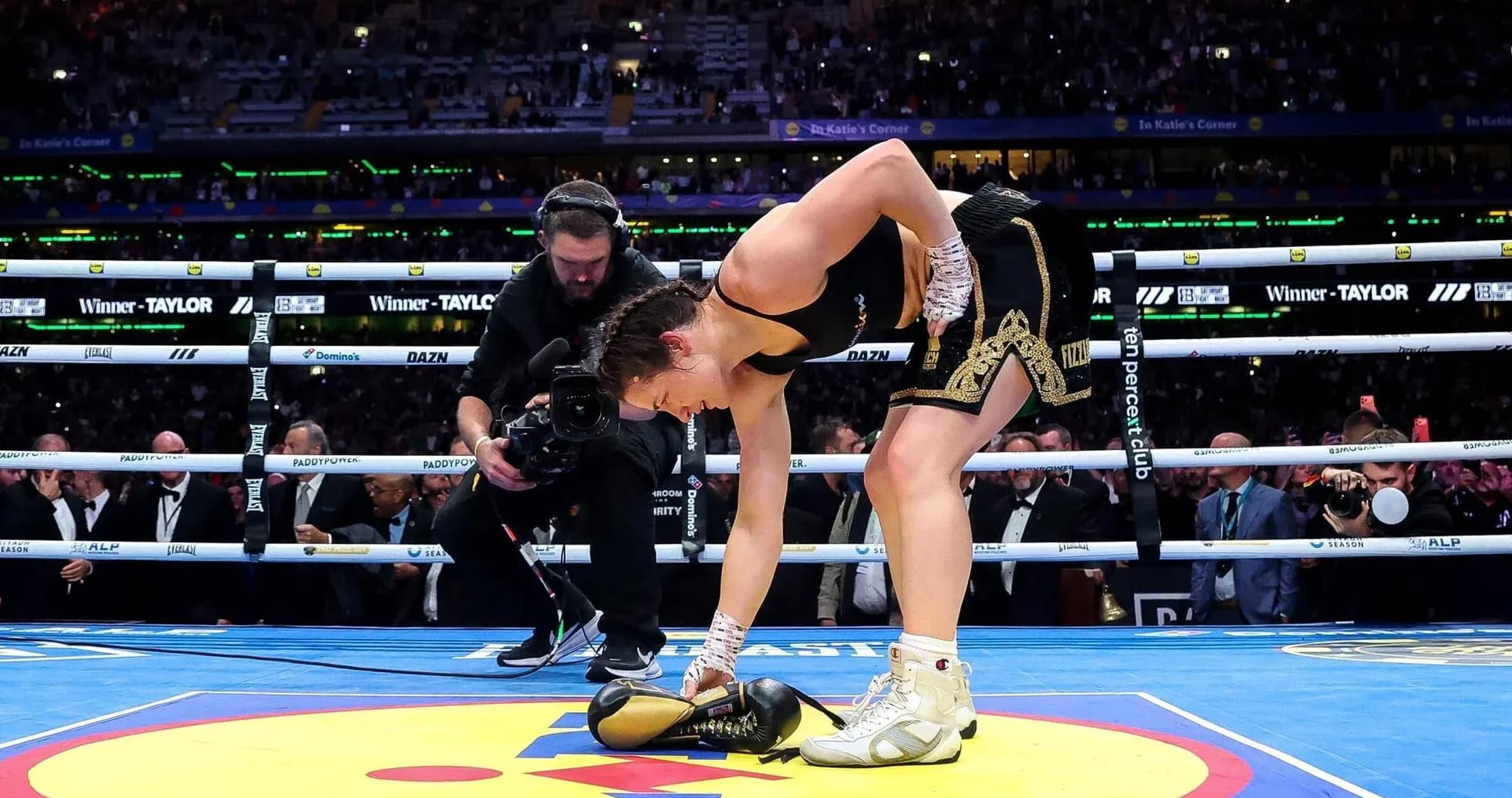
Katie Taylor stepped away on Saturday night and stared into the same vast, unknowable space that has swallowed so many greats before her.
Boxers talk about retirement as their first death. Other sports are no gentler. The numbers are brutal: Premier League and NFL stars bankrupt within years, marriages collapsing, identities evaporating once the lights go out and the crowd moves on. The stories are everywhere. The endings are rarely kind.
Eddie Arcaro, the only jockey to win the US Triple Crown twice, had a line for it. “When a jockey retires he becomes just another little man.” Ray “Boom Boom” Mancini, once the WBA lightweight world champion, framed it another way: “Since I’ve retired I eat less, weigh less, train less and care less.” Both men built decent second lives. Both still had to fight their way through the void.
For Katie Taylor, that opponent now steps through the ropes.
The perfect exit
What comes next? That’s the question that hung over Croke Park long after the final bell and her classy win over Flora Pili, a performance that brought down the curtain on one of the most significant careers in Irish sporting history.
Alan Minter, undisputed middleweight king of the early 80s, used to joke there were only two reasons boxers came back: they were broke, or they needed the money. Taylor should fit neither category. A purse of roughly €3m is expected from Croke Park alone. She took in more than €7m from the last of her three epic meetings with Amanda Serrano. The bank balance is secure.
But this is about more than money. Much more.
As Irish farewells go, hers is almost absurdly complete. Croke Park bathed in adoration. A performance that honoured the fighter she has always been. A send-off so perfectly pitched it nudges Brian O’Driscoll’s 2014 Six Nations goodbye into second place on the national podium of exits. This wasn’t a fade-out. It was a full stop, written in capital letters.
And yet the story doesn’t end there.
If her long-time manager Brian Peters gets his wish, the next time we see Taylor it won’t be under bright lights and ring walks, but in parish halls and small theatres from Inisbofin to inner-city Dublin. The plan is a nationwide stage production, “Her Story”, with Taylor on the road alongside Steve Bunce, revisiting the journey in front of live audiences.
“It's going to be quite magical,” Peters said.
The idea of Katie Taylor voluntarily touring the country to talk about herself feels, on the surface, at odds with the woman Ireland has watched for two decades – intensely private, guarded, happiest when the gloves were on and the questions stayed away. But second acts rarely follow the script.
Who, years ago, would have predicted Roy Keane as a media darling, a staple of TV adverts and viral clips? Who foresaw Bill Belichick’s public persona unravelling so messily once he stopped being the all-powerful Patriots coach? Once the job title falls away, people change. Or at least, they show different sides.
Taylor hinted at that shift in the last week. She spoke more, lingered longer on the microphone, allowed more of herself to seep through. Eddie Hearn even joked about how long she talked in the ring after beating Pili. The voice has always been there. The world has just rarely heard it.
“I determined very, very early on in my career not to talk but to show my boxing skills and just to let my excellence do the talking and let my talent do the talking,” she said on Sunday morning. “And I've kept to that throughout my whole career.”
Now those skills, and that voice, sit on the table, waiting for their next assignment.
Boxing, belief and a country that watched her grow up
It feels inevitable that boxing will remain a constant. The form that takes is wide open. Coaching is an obvious path. Advisory roles, mentoring, high-performance structures, media work around major fights – all of them fit her experience and her influence.
That influence is already deep. A generation of Irish fighters, men and women, point directly to Taylor when asked why they laced up gloves. Another generation is lining up behind them. The image of her sparring with ten-year-old Clodagh Keating last week was more than a sweet photo opportunity; it was a snapshot of the pipeline she has helped build.
The question is where she chooses to plug herself into it.
Asked about a formal role in Irish boxing, she smiled and referenced a more domestic complication: persuading her husband to swap their life in Connecticut for a permanent move back across the Atlantic has not, she admitted, “gone down very well”. There are six children to factor into every decision now. Any new chapter has to fit around that reality.
Family will sit at the core of whatever comes next. So will faith.
If anyone still doubted the centrality of her beliefs, they only needed to watch her ring walk at Croke Park, striding out to “All Hail King Jesus”, or listen in the aftermath. Taylor spoke openly about how clinging to her faith and what she believes to be the word of God carried her through the darkest moments – the devastation of Rio 2016, the personal turmoil that followed, the sense that everything she had built might be slipping away.
“Look what God's done. He's done the impossible in my lifetime and he's came through time and time again,” she said. “And that's what I was saying in the ring afterwards and giving him all the glory and the honour for all that I've achieved.”
That kind of public declaration sits easily in the sporting culture of the United States, where she now lives, but lands in a more complex space in modern Ireland, where the relationship with religion is shifting and often fraught. Yet in Taylor’s case, it has never seriously jarred with the public mood. It has never been used as a stick to beat her with.
That in itself says something about the place she holds in the Irish psyche.
Her status stretches beyond medals and belts, beyond Olympic gold and undisputed crowns. She occupies a rare space: a unifying figure in a country that has watched her at her most dominant and at her most broken, and claimed both as part of its own story.
She admits she doesn’t fully understand it.
“I don't know, to be quite honest,” she said when asked why the bond runs so deep. “I think people, the whole country, has seen me and my good times and they have also seen me during my devastations as well. I think people really resonate with your vulnerabilities as much as your successes.
“They see me cope with the heartbreak of Rio. They see me cope with the heartbreak of the shadow of loss. They see me in the, just, personal difficulties as well. So yeah, I think my story is the story of everybody in the whole country.”
Maybe that’s it. The nation saw the prodigy, the trailblazer, the champion. It also saw the tears, the doubts, the rebuild. It watched her walk into arenas alone and walk back out carrying the weight of its expectations, then do it all again when things went wrong.
Now it has watched her leave.
The ring is behind her. The lights at Croke Park have dimmed. Retirement, that toughest of opponents, waits in the silence.
Her story? It isn’t finished. Not even close.