Katie Taylor Retires: A Legendary Career Ends on Her Terms
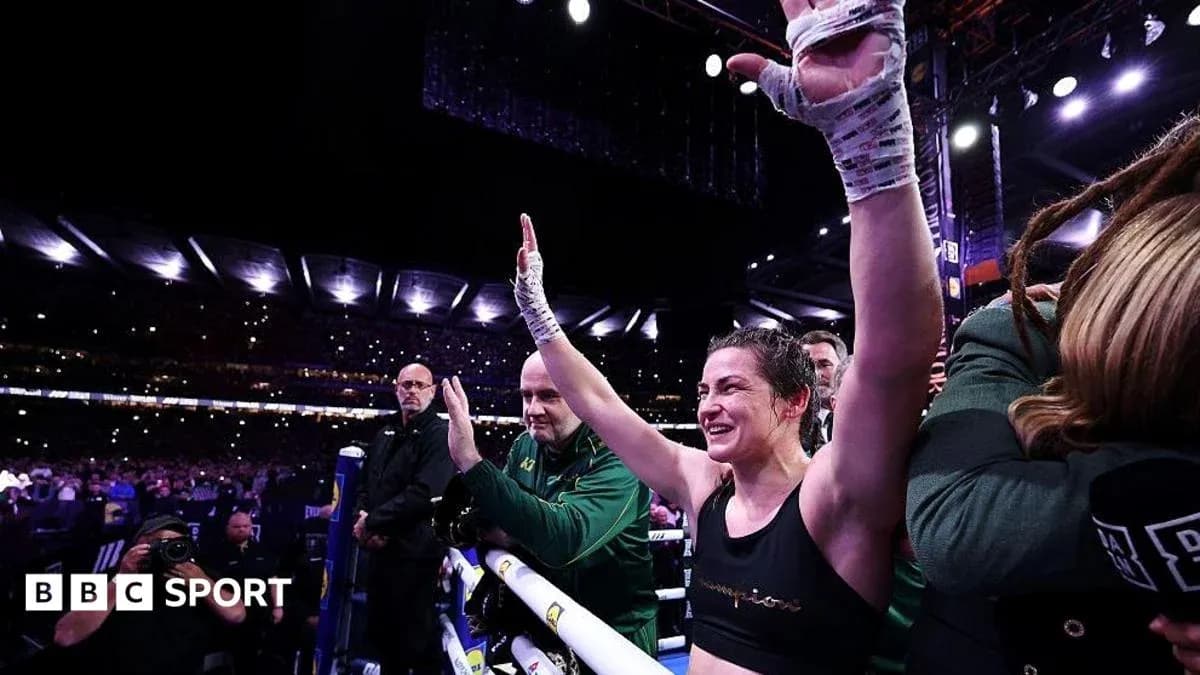
Katie Taylor leaves on her own terms, and the sport bows with her.
On a cool Dublin night at Croke Park, in front of more than 80,000 people, the Irish icon closed the book exactly as she has lived it: winning, composed, and utterly unflinching under the brightest lights. A points victory over France’s Flora Pili made her the undisputed light-welterweight champion, added another chapter to an already sprawling legacy, and then drew the curtain on a professional career that reads like mythology: 26 wins from 27 fights, Olympic gold, and three undisputed reigns across two divisions.
She didn’t need a knockout. She didn’t need drama. She just needed to be Katie Taylor one last time.
A final masterclass
From the opening bell, Taylor looked sharper, quicker, and more certain of herself than a 40-year-old fighter has any right to be. She stepped in and out of range, beat Pili to the punch time and again, and stitched together the kind of crisp, three- and four-punch combinations that once changed the way the world viewed women’s boxing.
The pattern rarely shifted. Taylor’s timing controlled the pace, her feet dictated the geography of the ring, and Pili, game but outgunned, spent long stretches trying to solve a puzzle that had confounded far younger opponents.
As the final round began, the noise inside Croke Park swelled. Taylor responded the only way she knows how. She emptied the tank, throwing one last furious burst of combinations, driving Pili back as the crowd rose in unison. It felt less like a finish and more like a standing ovation delivered with gloves on.
When the decision was read, it was a formality. The performance had already told the story.
A stage worthy of the star
Croke Park, steeped in Irish sporting history, gave Taylor the kind of send-off reserved for national treasures. Westlife performed before the main event, turning the night into something between a title fight and a homecoming concert. By the time Taylor made her ring walk, it felt as though the entire country had squeezed into the stadium.
Former world champion Carl Frampton captured the uniqueness of her bond with the Irish public. He pointed out that Taylor has never chased the spotlight, never seemed at ease in front of cameras, yet still commands a level of adoration few fighters – male or female – have ever known.
“Katie Taylor is different, she's special and there will never be another one like her,” he said, summing up what the evening already made clear. This was not just a farewell to a champion. It was a goodbye to a phenomenon.
The champions who followed her path
As the final bell faded, the tributes rolled in from the very fighters who now carry the sport she helped build.
Unified lightweight champion Caroline Dubois, one of the brightest young stars in the game, called Taylor “one of the best to ever do it” and offered a message that echoed the sentiment of an entire generation. “Thank you so much for paving the way,” the Londoner wrote on X. “Wishing you happiness, success and joy for this next season.”
From the United States, Claressa Shields – who brands herself the Greatest Woman of All Time – saluted a rival in greatness. “Congrats Katie. Now ride off into the sunset. You deserve it all,” she wrote, a rare moment where two titans of different eras nodded to each other across the Atlantic.
Super-featherweight champion Alycia Baumgardner went straight to the heart of Taylor’s impact. She called her “a trailblazer who helped set the stage for all of us” and added: “What a legacy. It's been a privilege watching your journey from the beginning.”
These are not empty compliments. They are acknowledgements from women whose own careers exist, at least in part, because Katie Taylor pushed open doors that had long been bolted shut.
An exit like no other
Retirements in boxing are often messy. Legends linger too long, lose to fighters they would once have outclassed, and leave the sport in a haze of regret and what-ifs. Taylor refused that script.
Former cruiserweight world champion Tony Bellew didn’t hide his awe at the way she chose to step away. “I don't think in all of my years of watching this game, I have seen an exit as beautiful, amazing and fitting,” he said. For Bellew, and for many watching, the sight of Taylor leaving as an undisputed champion, in front of her own people, on her own terms, set a new standard.
“She has just retired as the greatest champion ever,” he added. “I have never seen a fighter leave as an undisputed champion on their own terms.”
In a sport that so often chews up its heroes, that detail matters. Taylor walks away not as a faded memory but as a reigning, undisputed force who chose the moment herself.
The legacy that lingers
Numbers can only go so far in explaining what she has done: 26 wins, a single defeat, Olympic gold, three undisputed reigns. The rest lives in the way young fighters now talk about world titles as expectations, not fantasies. It lives in sold-out arenas for women’s main events, in prime-time broadcasts, in little girls shadowboxing in gyms that once had no space for them.
Taylor’s relationship with the Irish public, as Frampton observed, is unlike anything else in boxing. She never chased celebrity, never tried to play the showman. She just kept winning, kept carrying herself with a quiet, unshakable dignity, and somewhere along the way, a nation decided she belonged to them.
On this final night at Croke Park, under the lights, with the songs still echoing and the gloves finally coming off, Katie Taylor left as she arrived: head down, heart full, history trailing in her wake.
The belts will move on. The division will reset. The next wave, led by the very fighters who hailed her, will fight for their own place in the story.
But in women’s boxing, the question now is simple: after Katie Taylor, what does greatness look like?