Katie Taylor's Emotional Retirement Celebration at Croke Park
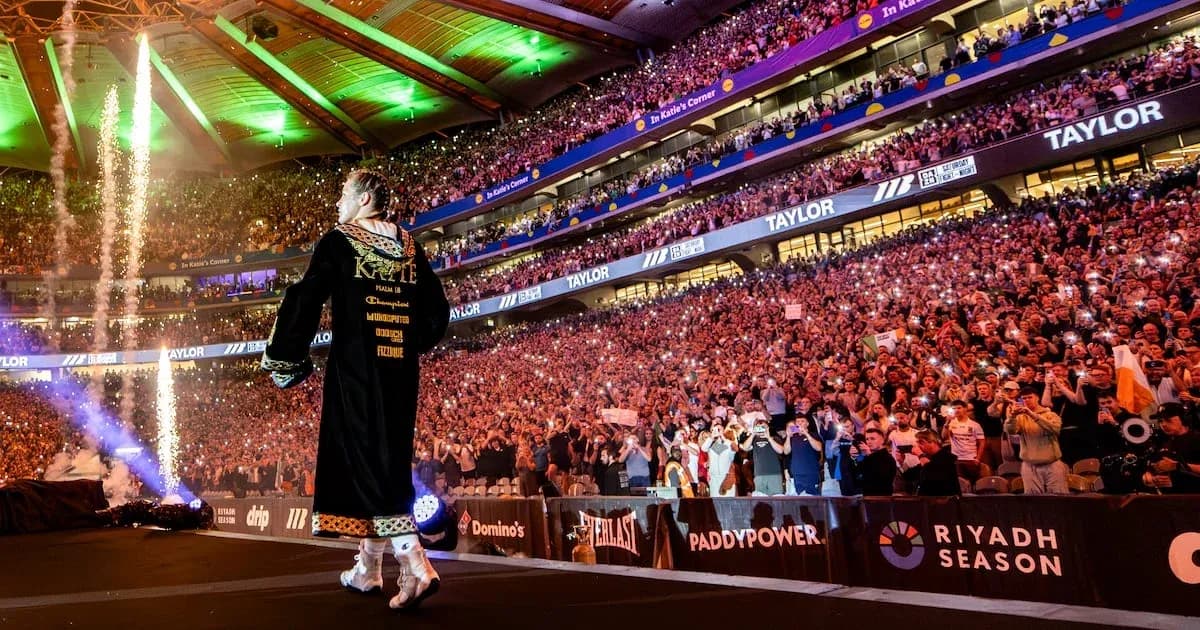
On a soft September night in Dublin, Croke Park threw a retirement party that made every carriage clock and gold watch in sporting history look faintly ridiculous.
No gifts, no speeches, no polite sandwiches. Just 80,000 people and a wall of noise for Katie Taylor.
From the RTÉ gantry, Natasha Jonas – once an opponent, now an admirer – tried to take it all in. “It’s unreal,” she said, and it was. Jonas remembered chasing an Olympic dream in “the middle of nowhere in China” in 2012, hearing a roar from nowhere when Taylor boxed. She wandered over, assuming it couldn’t possibly be Irish fans. It was. They’d come from Beijing. “People just follow her wherever she goes.”
On Saturday, they followed her home.
A stadium dressed for a farewell
Croke Park glowed. The lighting operator deserved a bonus and then some; the place shimmered like a Champions League final crossed with a rock concert. The old bowl has seen everything, but rarely has it looked like this.
The soundtrack matched the setting. Grace. The Fields of Athenry. Zombie. The crowd belted them out with the kind of gusto usually reserved for last orders or last minutes. Visitors from abroad must have been baffled. Taylor, the most decorated Irish boxer of her generation, was being serenaded with songs about an executed rebel, a famine deportee, and the victims of The Troubles.
As ever on this island, the occasion was joyful, the lyrics laced with trauma. That contradiction felt perfectly Irish.
RTÉ leaned into the emotion. The montages rolled, the slow-motion highlights, the medals, the Madison Square Garden nights, the Olympic gold. Bernard Dunne sat beside Jonas, just about keeping his composure. “This is more than just a boxing match,” he told Jacqui Hurley. “It’s a celebration, a thanks for what Katie’s given us over the years.” Then My Way boomed out over the speakers and any remaining stiff upper lips went with it.
A rave, a football match, and a goodbye
The night kept layering up. Three-quarters of Westlife emerged to deliver You Raise Me Up, and 80,000 phone lights flicked on, turning Croke Park into a galaxy. Marty Morrissey danced with Michael Flatley when Olé Olé Olé took over, a scene so surreal it felt like someone had spiked the national water supply.
“It’s like a rave that meets a football occasion,” Hurley said, and that just about nailed it.
At ringside, Paul O’Flynn grabbed a word with Shane Lowry. On the big screens, tributes rolled in from Bono, Ed Sheeran, Niall Horan and Rory McIlroy – superstar fans, all stuck behind the camera rather than in the stands, or so the joke went. Just before the anthem, Barry Keoghan’s voice cut through with a final flourish of sentiment.
“All stories begin at home. The rare ones end there, too. And so, Katie returns for every fan who walked the journey beside her ... for all Ireland. When they ask you about Katie, you can begin with four simple words. Once upon a time.”
If Kleenex weren’t official sponsors, they missed a commercial open goal.
The walk, the roar, the mismatch
Flora Pili, the woman tasked with sharing Taylor’s last ring, walked out first. She took one long look around Croke Park, her expression screaming “mon Dieu” without a word spoken. Lesser souls might have headed straight for Rosslare and the first boat out. Pili stayed, shoulders squared, and showed plenty of courage just by being there.
Then came the main event.
Taylor entered to All Hail King Jesus, a choice that left much of the crowd humming rather than singing, but it hardly mattered. The fireworks took over, a cascade of colour tearing across the Dublin sky. Taylor puffed out her cheeks as she surveyed the scene. For once, even Madison Square Garden – the site of some of her greatest nights – looked small. This was bigger. This was home.
“I’m feeling pretty emotional myself here and it hasn’t even started,” commentator Hugh Cahill admitted. Beside him, Eric Donovan could only gasp: “Oh my gosh, this is extraordinary.”
When the bell finally rang, the boxing itself felt almost secondary. Pili tried, but she rarely laid a meaningful glove on Taylor. The Irishwoman controlled the distance, the tempo, the tone. Every flurry from Taylor drew a roar; every brief success from Pili was swallowed by the noise. Had the visitor found any real success, she’d have had 80,000 to answer to.
The unanimous decision came as predictably as the standing ovation that followed. Nobody came for jeopardy. They came to say goodbye.
Gloves down, story told
After the final interview, Taylor took a slow walk back to the centre of the ring. She removed her gloves and placed them on the canvas, a simple act that said more than any speech. They landed squarely on the Lidl logo – a sponsor’s dream shot to rival the famous Nike swoosh as Tiger Woods’s ball paused on the lip at Augusta. Somewhere, Aldi executives winced.
“What now?” O’Flynn asked, microphone in hand.
“I’m just going to enjoy the fruits of my labour,” Taylor replied. “I’m going to eat chocolate.”
No grand declarations. No hint of a comeback tease. Just chocolate. A Time Out, in every sense. She has earned that, and more.
So the story that began in Bray, that swept through London, New York and beyond, ended where it always wanted to – under Irish skies, with a nation singing sad songs and wearing a smile.
Once upon a time, indeed.