Kapil Pokhariya: From WWE Dreams to Asian Games Boxing Medal
The cotton mattresses never stood a chance. Neither did the pillows, or the homemade punching bag stuffed with mountain soil.
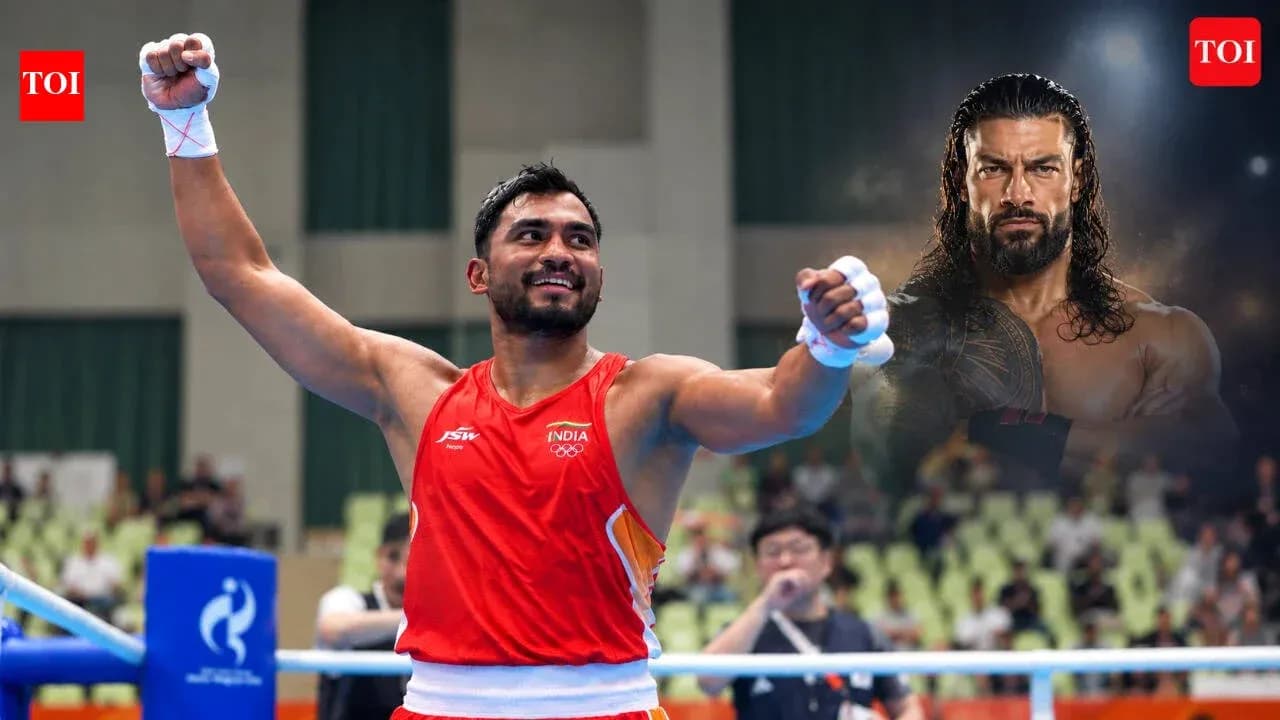
In Chakarpur village, Khatima, a young boy named Kapil Pokhariya spent his childhood turning his home into a makeshift WWE arena. He would launch himself off beds, hammer cushions, fling them over walls and then, when the television went silent, try to recreate every punch he had just seen from his hero, Roman Reigns.
Those neighbours who laughed at the obsession now have an Asian Games medallist in their midst.
In Aichi-Nagoya, Japan, the Indian Army havaldar climbed onto the boxing podium, bronze medal around his neck, after finishing third in the men’s 90kg category at the 2026 Asian Games. The boy who once skipped meals and playtime to catch WrestleMania and Money in the Bank is now part of India’s boxing elite.
“I never knew that copying Roman Reigns and practising those punches would bring me this far,” Kapil told TimesofIndia.com. He still has the recordings of those old WWE shows. He still remembers which moves he tried to imitate first. And he still laughs when he admits: “Honestly, I started learning how to throw punches by copying Roman Reigns.”
From Chakarpur to a Boxing Ring
Boxing was never meant to be his story.
Kapil’s father, Narendra Singh Pokhariya, served in the Indian Army and had a clear plan for his son: study hard, clear the exams, and join the Army as a commissioned officer. Not as a boxer. Certainly not as a kid flying off mattresses in a tiny house in Uttarakhand.
Narendra watched his son’s antics with a mix of irritation and concern. At first, the response was predictable. Scoldings. Even beatings when the damage to household items went too far. But one scene began to shift his thinking.
After school, Kapil would drag sand into a thick sack, tie it up, and pound it with everything he had. Day after day.
“A teacher used to teach boxing at a nearby school. I saw the students punching a bag and decided to make one myself,” Kapil recalled. “My father scolded me in the beginning, but later he took me to a training centre and got me admitted there. That is how I got into boxing.”
There was no gleaming academy waiting for him. No state-of-the-art gym. Just a small training ground, a handful of boys, and a coach who could give them only a few hours on selected days.
“I come from a small village where boxing was never a popular sport. Pooran Bohra sir was there. He trained a small group of boys for just a few hours on selected days of the week. But I was interested in learning. I listened to him carefully and repeated everything he taught me when I returned home,” Kapil said.
The routine was simple: absorb every instruction, then go back and rehearse it alone. Over and over.
The First Fall, Then the Rise
By 2015, the homemade punching bag and dusty training ground had carried him to his first state-level competition. The excitement was raw. So were the nerves.
He walked into a ring for his first official bout and into an atmosphere he had never experienced before. The crowd, the lights, the pressure. It all hit at once.
The result was brutal in its simplicity: defeat in the opening round.
“I was really disappointed. It was the first bout of my life, and I was seeing such a large crowd for the first time. I lost in the first round. But that competition and the defeat taught me a lot. My interest in boxing grew even stronger after that,” he said.
That early failure didn’t close a door; it flung one open. When he returned for a national-level competition, the mindset had changed. So did the outcome.
This time, he didn’t just win a few bouts. He went all the way and took gold.
The medal brought more than pride. It brought prize money. And with it, a job in the Indian Army. In April 2017, Kapil joined the force and was appointed as a havaldar. The boy who had once been scolded for punching a homemade bag was now a serviceman and a serious boxer.
His career accelerated. The Army system gave him structure, exposure, and higher-level competition. Services events brought more medals and tougher opponents. The raw power from his childhood started to look like a genuine career.
“My father wanted me to study and join the Army as a commissioned officer. He joined as a sepoy and retired as a havaldar. But he wanted me to reach a higher rank if I joined the Indian Army,” Kapil said.
One moment stands out for him. “He was very happy. The day I won a national medal, he hugged me. That was when I realised that I had achieved something big in my life.”
The Asian Games bronze has added another layer to that story. It will also bring a promotion: Kapil will now be elevated to naib subedar. The son has overtaken the father in rank.
“Papa said, ‘Ab tu mera senior ho gaya hai’,” Kapil recalled, smiling.
‘Khatima ka Russell’
The punches were not his only weapon growing up.
Like millions of Indian kids, Kapil spent hours on dusty grounds with a bat in his hand. Gully cricket, inter-village matches, the familiar rivalries of small-town sport. But he didn’t just blend in. He stood out.
Tall, muscular, and capable of sending the ball into the distance, he quickly earned a reputation as a power-hitter. The comparison came naturally to those who watched him bat.
“I loved Andre Russell. I also liked Hardik Pandya. People used to call me ‘Khatima ka Russell’ because of my power. The boys wanted me in their team because I could hit big sixes,” he said, laughing.
The cricket field gave him a nickname. The boxing ring gave him a future.
Bronze Won, Eyes on LA 2028
For Kapil, the bronze in Aichi-Nagoya is not a destination. It’s a checkpoint.
His biggest dream is clear and non-negotiable: to walk into the Los Angeles 2028 Olympic Games wearing India’s colours and to leave with a medal.
Under the Boxing Federation of India’s selection criteria, Asian Games medallists will be the main entries in their weight categories for the 2027 World Boxing Championships in Astana, Kazakhstan. Scheduled for April, that tournament will double as the first qualifying event for LA 2028.
Kapil knows what that means. The road stretches far beyond one podium in Japan.
“Rukna nahi hai ab, bas aage dekhna hai,” he said. No stopping now, only forward.
“The Olympics is the ultimate dream. I want to go there, represent my country and win a medal. That is the only thing on my mind right now. I am preparing for the World Championships in April,” he added.
From cotton-filled mattresses in a small Uttarakhand home to a place on the Asian Games podium and a ticket into the World Championships frame, Kapil Pokhariya has already rewritten the script that was once laid out for him.
The next chapter will be written not in a village courtyard or a gully cricket field, but in Astana and, if he gets his way, under the bright lights of Los Angeles.