
India Dominates Maldives in Group B Clash
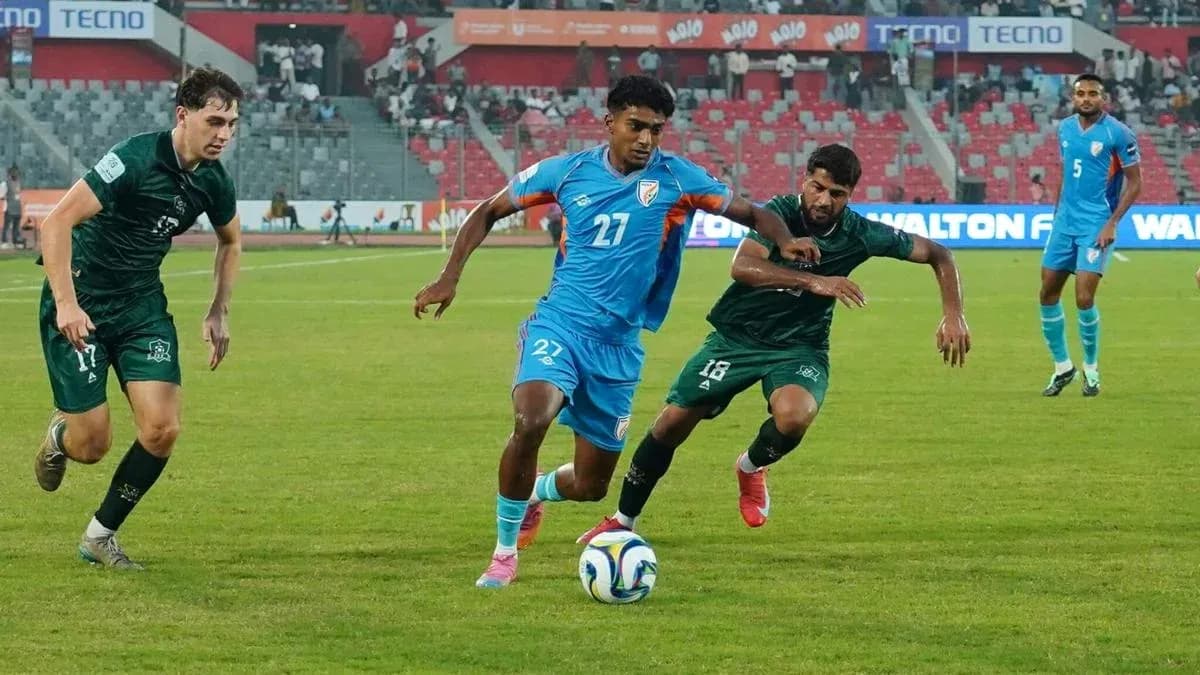
India strolls into half-time on top, Maldives clinging on and out of ideas. The whistle brings brief relief for the islanders, not a reset of the contest.
From the opening exchanges, India seized control of Group B and refused to loosen its grip. The passing was sharp, the press relentless, the intent obvious: finish the job, finish top, and send a message in the chase for a record-extending 10th regional crown. Maldives had flickers, half-moments on the break, but never truly carried the weight of a goal threat.
The pattern was set early. A long ball aimed for Ibrahim Hassan looked promising for a heartbeat, but Uvais read it, turned, and simply outworked him, tracking back to win possession and snuff out the danger. That sequence summed up Maldives’ half: hopeful balls forward, met by Indian composure and superior organisation.
At the other end, India’s attacking rhythm grew with every minute. Suhail Bhat, already one of the revelations of the tournament, kept finding pockets of space. Played through on the right side of the box, he burst into the area and lashed a shot at the near post, forcing Shareef into a sharp save and a hurried push behind for a corner. The warning was loud. Maldives didn’t heed it.
The pressure finally cracked them. Abdul Rabeeh, bold and direct from the back, stepped in to win the ball off Yoosuf and surged into the box. Yoosuf, desperate to repair his mistake, dived in again. This time, he wiped Rabeeh out. No debate, no delay. The referee pointed straight to the spot.
Up stepped Suhail. No fuss, no theatrics. He waited, watched the goalkeeper lean, then rolled the ball the other way into the bottom-left corner. Calm, clinical. Goal number three in this tournament for the Mohun Bagan youngster, and the kind of penalty that belongs to a player whose confidence is rising by the game.
The card soon followed at the other end of the pitch. Frustration seeped into Maldives’ play, and Macarton Nickson went into the book for a shove on Hassan Eenaaz inside their own box. It was clumsy, needless, and symbolic of a side struggling to cope with both the tempo and the stakes.
Three minutes of added time offered Maldives a sliver of hope to reset, to nick something before the break. Instead, India simply managed the clock, moved the ball, and reminded everyone why it sits comfortably at the top of Group B. On current evidence, India doesn’t just look like a team chasing a point to stay above Pakistan; it looks like a team intent on dominating the group outright.
Upcoming Challenge
Away from this regional campaign, another test looms. The senior Indian men’s team heads to Auckland to face New Zealand at Go Media Stadium in an international friendly on Thursday, the first of two matches marking 100 years of sporting ties between the nations. The challenge will be very different. On paper, too: India sits 138th in the FIFA rankings, New Zealand 88th.
Khalid Jamil has not treated it as a routine exercise. He has torn up the previous list from the window that featured Panama, Brazil and Uruguay, and named a much-changed squad. Captain and senior goalkeeper Gurpreet Singh Sandhu has been left out, opening the door for fresh faces. Som Kumar, Ricky Meetei Haobam, Lalremtluanga Fanai and Tomba Singh Haobam have all earned call-ups, a clear nod to the next generation.
The reshuffle has even cut into the current SAFF campaign, where India fields a second-string side. Bijoy Varghese, Muhammad Suhail and Liston Colaco have departed that tournament to join the senior setup for the New Zealand friendlies. It is a bold move, one that speaks to a broader plan: use every window, every match, to stretch the player pool and harden it against higher-ranked opposition.
For now, though, the story of the night is simpler. India is cruising, Maldives is hanging on, and the second half will decide whether this is merely a professional win—or the kind of statement performance that underlines why India still talks about that 10th title as an expectation, not a dream.





