Hansi Flick's Historic Youth Revolution at Barcelona
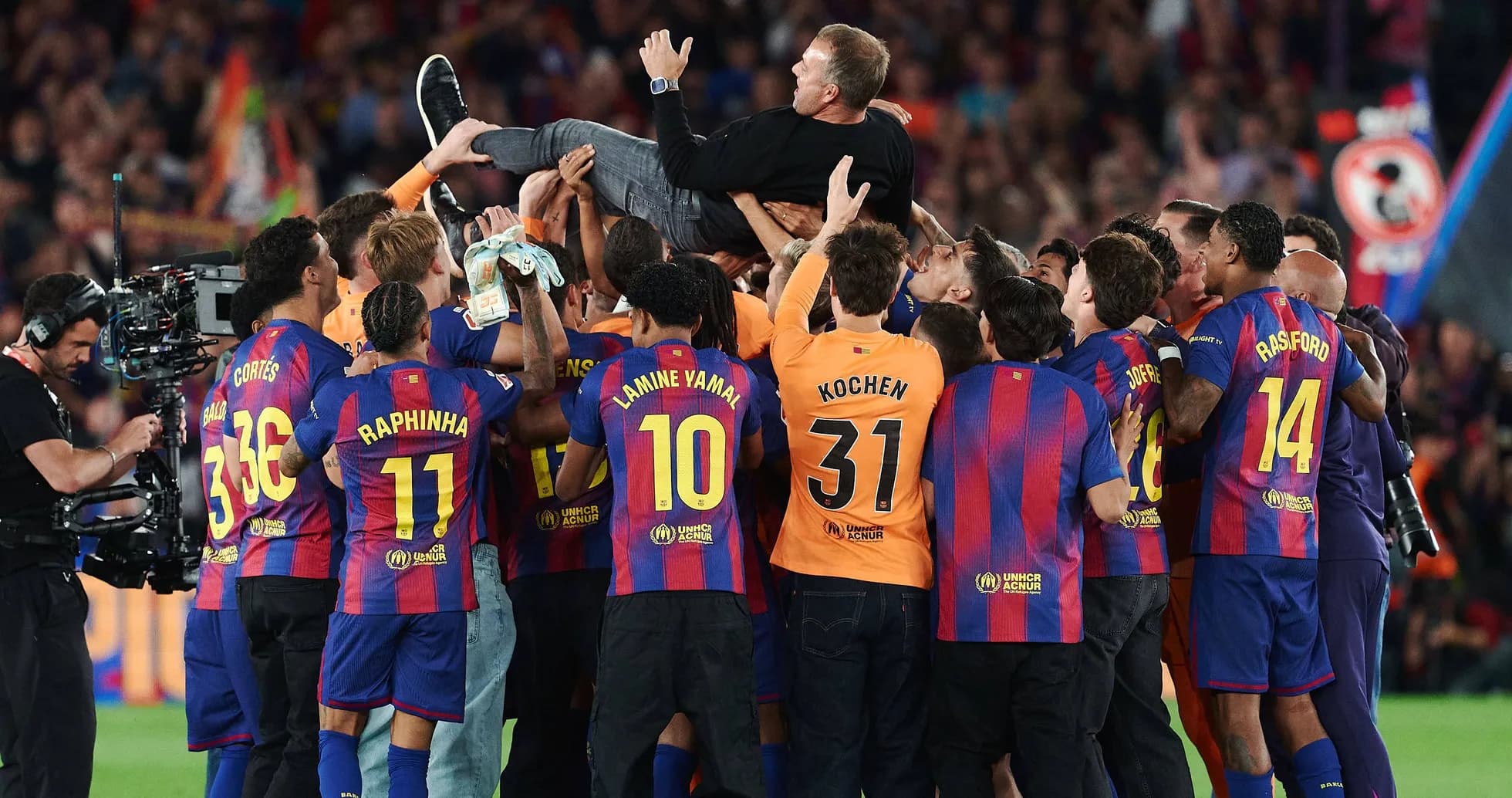
Hansi Flick didn’t just win a football match at the Spotify Camp Nou. He tore up a page of Barcelona’s history and wrote a new one in bold ink.
On a night that felt like a manifesto, the German coach sent out the youngest home starting XI the club has ever fielded. Average age: 23.18. A 14-year-old record, gone.
Flick steps into Guardiola’s territory
Journalist Oriol Domènech confirmed what everyone in the press box suspected as the teams were announced: this was the youngest Barcelona side ever to start at the Camp Nou. Not just any record, either. Flick’s line-up edged out Pep Guardiola’s much-celebrated 2011 team that faced BATE Borisov in the Champions League, a night that had long stood as the reference point for Barça’s faith in youth.
Guardiola’s name has been attached to so many of the club’s benchmarks that surpassing one of his sides is never a small detail. Flick did it in one swoop, with a team that looked less like a cautious blend and more like a declaration.
La Masia at the heart of it
Look down the team sheet and the pattern jumps out. Seven of the starters came through La Masia. This wasn’t a token gesture or a nostalgic nod to the past. It was the academy, back at the centre of the project.
Two more players, Pedri and Joan García, are full Spanish internationals, proof that the core of this team is not just young, but already hardened by top-level football. Only Raphinha and Anthony Gordon were born outside Spain, underlining how local and homegrown this version of Barcelona really is.
The dates of birth tell the story even better than the names. Raphinha, born in 1996, stood alone as the only starter born in the 20th century. Around him, a squad built for the future: Joan García, Eric García and Anthony Gordon from the 2001 crop, Gerard Martín and Pedri from 2002, Fermín from 2003.
And then came the real jolt.
The 2007 generation steps onto centre stage
Flick didn’t just lean on youth; he trusted it to an extreme rarely seen at this level. Four players born in 2007 started together: Pau Cubarsí, Marc Bernal, Xavi Espart and Lamine Yamal.
One teenage prodigy is a talking point. Four in the same XI is a statement. It speaks to the club’s urgency, its financial reality, but also its belief that the next great Barcelona might already be walking the corridors of La Masia.
These are players who, on another timeline, might still be easing their way into underage sides. Instead, they are being asked to carry the weight of a stadium and a shirt that has defined an era of European football.
A project, not a one-off
This was not a romantic experiment thrown together for one sentimental night. The numbers across the season back that up. As sporting director Deco has outlined, this is the shape of the project.
Barcelona currently have the youngest squad in La Liga, with an average age of 24.2 years, level with Levante. Across Europe’s top five leagues, only four teams are younger: Auxerre (23.6), Parma (23.4), Toulouse (22.5) and Strasbourg (22).
Eleven players in Flick’s squad are under 20. Three of them – Lamine Yamal, Cubarsí and Bernal – already carry significant experience at the highest level, despite none of them having turned 20. They are not just filling out the bench; they are central to the team’s identity.
The dressing room still has its elders, but only just. Five players are over 30: Szczęsny (36), Cancelo (32), Livaković (31), Christensen and Rodri (both 30). Three of those arrived this season, brought in to stabilise a squad that might otherwise tilt too far towards inexperience.
Between the kids and the veterans sits what Deco has called the “middle class”: Anthony Gordon at 25 and Adeyemi at 24, players in their prime years, asked to bridge the gap between raw talent and seasoned authority.
Beating a benchmark night
To break Guardiola’s record, Flick had to go further than a famous night in December 2011, when Pep fielded five reserve-team players – Bartra, Rafinha, Cuenca, Montoya and Sergi Roberto – in a 4–0 win over BATE Borisov.
That evening has lived long in Barcelona’s memory as a symbol of trust in the academy. Flick’s line-up, confirmed now as even younger, pushes that idea into a new era. This is not about sprinkling in a few hopefuls around a veteran spine. It is about handing the keys of the Camp Nou to a generation barely out of school.
Records can be statistical quirks. This one is not. It is a snapshot of where Barcelona are, and where they are determined to go. The question now is simple: can this daring youth revolution carry the weight of a club that measures itself in trophies, not just in milestones?